
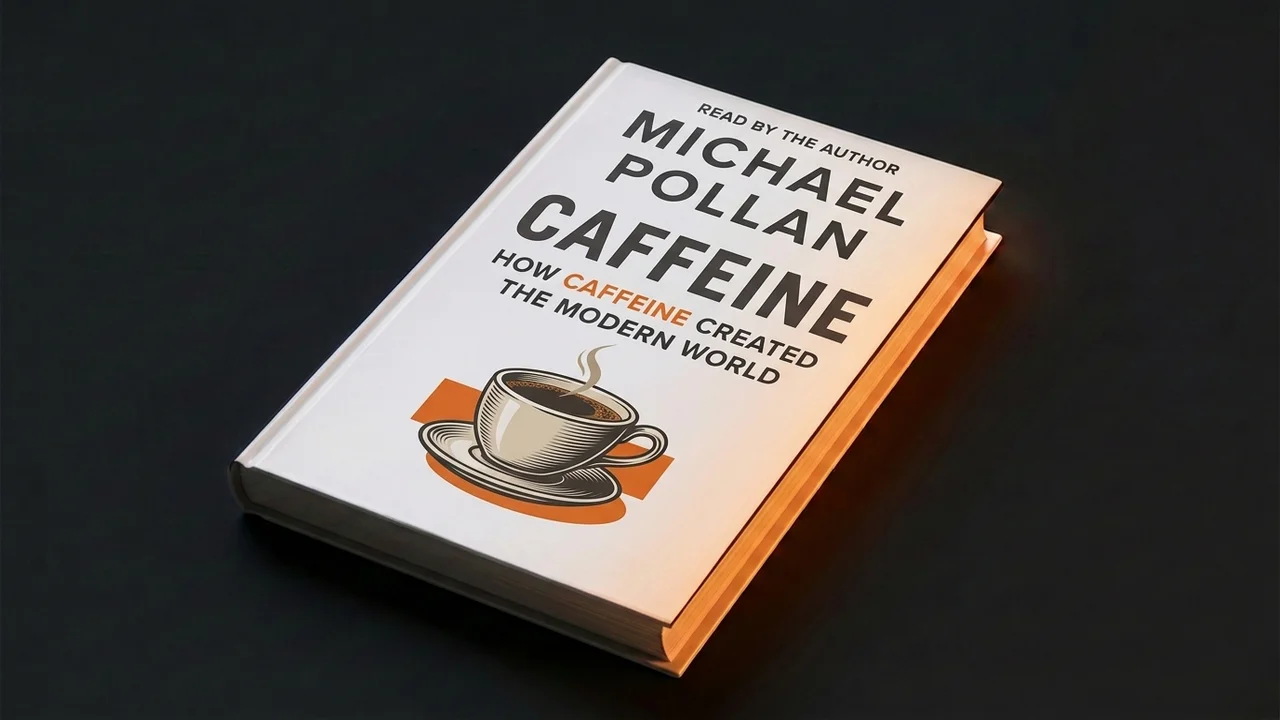

“Caffeine equips us to cope with the world caffeine helped us to create.”
Let me ask you something. When was the last time you went a full day without caffeine?
Not because you were doing some health challenge or trying to prove a point — but just naturally, without even thinking about it. If you’re like me, the answer is probably “I genuinely don’t remember.” And that should tell you something.
I first heard about this book from Michael Pollan’s interview on the Joe Rogan podcast. Pollan is already one of my favorite investigative journalists — his work on psychedelics in How to Change Your Mind was PHENOMENAL — so when he said he wrote a short book on caffeine, I was immediately in.
And at just two hours on audiobook, this is one of those rare listens that doesn’t drag, doesn’t pad itself with filler, and still manages to completely change how you think about your morning cup.
The Neuroscience — Your Brain on Coffee
Here’s what blew my mind. Caffeine doesn’t actually give you energy. It blocks the receptors in your brain that tell you you’re tired. There’s a molecule called adenosine that builds up throughout the day — it’s essentially your body’s sleep pressure signal. Caffeine sneaks in and parks itself in those adenosine receptors, preventing you from FEELING the tiredness that’s actually still accumulating.
So you’re not more energized. You’re just less aware of how exhausted you actually are.
Think about that for a second. Every morning when you drink your coffee and feel that “boost,” what’s really happening is your brain was already in withdrawal from the previous day’s caffeine wearing off. The coffee doesn’t take you above baseline — it brings you BACK to baseline. You’re essentially curing the problem that caffeine itself created.
Pollan actually quit caffeine for three months while writing this book. His description of the withdrawal is brutal — brain fog, headaches, zero motivation. But after a couple of weeks, his sleep improved dramatically, his dreams became more vivid, and his natural energy stabilized in a way he hadn’t felt in decades.
How Caffeine Built the Modern World
This is where the book gets REALLY interesting. Pollan makes a compelling argument that caffeine didn’t just accompany the rise of modern civilization — it actively enabled it.
Before coffee and tea arrived in Europe, the default beverage was alcohol. Water was unsafe in most cities, so people drank beer and wine from morning to night. Think about that — entire populations walking around mildly buzzed for centuries. The Age of Reason didn’t just happen because philosophers decided to start thinking harder. It happened because Europe switched from a depressant to a stimulant.
Coffeehouses became the hubs of intellectual exchange in London, Paris, and Vienna. The Enlightenment was essentially FUELED by caffeine. Scientists, writers, revolutionaries — all gathering in coffeehouses, wired and ready to argue about ideas. Insurance companies, stock exchanges, and newspapers were born in coffeehouses.
And then there’s the Industrial Revolution. Factories needed workers who could stay alert for 12-hour shifts doing repetitive tasks. Caffeine made that possible. Without tea and coffee, you simply don’t get the disciplined, clock-watching labor force that industrialization demanded.
The Capitalism Connection
This is the part I kept thinking about long after the audiobook ended. Caffeine and capitalism are deeply intertwined. Capitalism requires productivity. Productivity requires focus. Focus requires — well, in our modern world — caffeine.
We’ve built an entire economic system that runs on a stimulant, and then we wonder why everyone is anxious and can’t sleep. The irony is almost too perfect. We use caffeine to work longer and harder, which disrupts our sleep, which makes us need MORE caffeine the next morning. It’s a cycle that benefits the economy but not necessarily the individual.
As someone who’s been building businesses online for years, I recognize this pattern in myself. Those late-night work sessions fueled by another cup of coffee — was that discipline and hustle, or just a drug making me think I was productive while my sleep quality tanked?
Addiction Without the Stigma
Here’s something wild. Caffeine is the most widely consumed psychoactive substance on the planet. Over 90% of adults consume it daily. If ANY other drug had that usage rate, we’d call it an epidemic.
But caffeine gets a pass. Why? Because it makes us PRODUCTIVE. Society rewards the effects of caffeine — alertness, focus, longer work hours — so we collectively agreed to pretend it isn’t really a drug. There’s no stigma around saying “I can’t function without my morning coffee.” In fact, people say it proudly, as if dependence on a substance is a personality trait.
Pollan makes this point without being preachy about it. He’s not telling you to quit caffeine. He’s just asking you to be honest about what it is and what it’s doing to your brain chemistry.
The Sleep Trade-Off
The biggest takeaway for me was the impact on sleep. Caffeine has a half-life of about six hours. That means if you drink a cup of coffee at 2 p.m., by 8 p.m. half of that caffeine is still in your system. By midnight, a quarter is still there — actively blocking your adenosine receptors and reducing the quality of your deep sleep.
You might fall asleep fine, but the QUALITY of that sleep is compromised. And since deep sleep is when your brain clears waste products and consolidates memory, you’re essentially trading long-term cognitive health for short-term alertness.
After listening to this book, I cut off all caffeine after noon. And honestly? My sleep improved noticeably within a week. I still drink coffee — I’m not a monster — but I’m much more intentional about it now.
Final Thoughts
This is one of those books that punches way above its weight. It’s short, dense, and forces you to reconsider something you do every single day without thinking. Pollan is a gifted writer who makes neuroscience, history, and sociology feel effortless — and at two hours, there’s no excuse not to listen to this.
You don’t NEED caffeine to get through your day. But you might be addicted to the habit of wanting it, rather than actually needing it. And understanding that difference is worth more than any cup of coffee.
4/5 — an essential listen for anyone who drinks coffee, tea, or anything with caffeine. So basically, all of you.
Thanks for reading.
— Leonidas
