Porto Alegre, Brazil: A Travel Guide To The Capital Of The Gaúchos
Porto Alegre is the capital of Rio Grande do Sul, Brazil’s southernmost state, and the largest city in the country south of São Paulo. About 1.5 million people live in the city itself and around 4.4 million in the metropolitan region. It sits at the northern end of the Lagoa dos Patos lagoon, on the eastern bank of the Guaíba river, less than 200 km from the Uruguayan border.
The city was founded in 1772 by Portuguese-Azorean immigrants and named Porto dos Casais (Port of the Couples) after the families the Crown brought in to colonise the empty pampas. It was renamed Porto Alegre, Happy Port, in 1773. The 19th century brought waves of German and Italian immigrants who, together with the Azorean founders and the gaúcho cattle culture of the pampa interior, gave Rio Grande do Sul a distinct identity inside Brazil. Locals call themselves gaúchos, drink chimarrão (yerba mate), and grew up arguing about football: Grêmio and Internacional, the two big clubs, are both headquartered here.
The city is rare among Latin American capitals in that almost everything memorable about it is on foot. The Centro Histórico is a tight grid of Belle Epoque and Eclectic facades, the Cidade Baixa neighbourhood south of the centre is wallpapered with graffiti and turns into a giant outdoor bar during Carnival, and the great parks (Parque Farroupilha and Jardim Botânico) are walkable from the middle of the map. The Guaíba sunset from the Usina do Gasômetro is one of the great urban views in Brazil.
Porto Alegre is also, more than any other Brazilian city its size, a place where the visible wealth gap is impossible to look away from. The decay of the Cais Mauá riverfront, the homeless encampments in the parks, the catadores pushing carts of recyclables past Belle Epoque facades: it is part of the city, and the photos below do not crop it out.
I spent a week here in February 2017, during Carnival, with my then-girlfriend Angie. Below are 148 photos covering the Centro Histórico, the Cidade Baixa carnival blocos, the CAFF Brutalist government complex, the Usina do Gasômetro, the Praça da Matriz, the Parque Farroupilha and its Monumento ao Expedicionário, and a full afternoon in the Jardim Botânico.
First Glimpses Of Porto Alegre
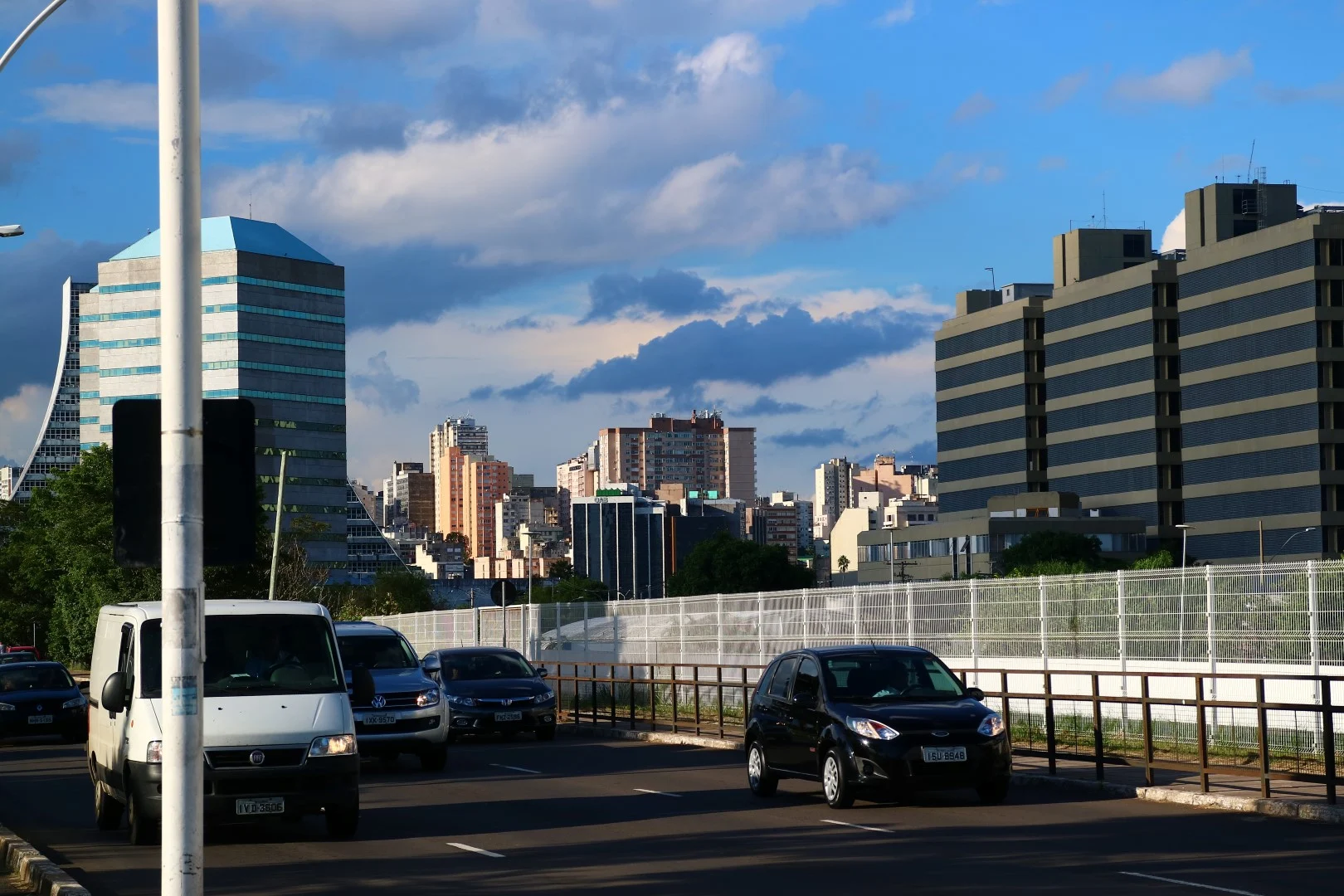
The first thing you notice driving in from the airport is the Guaíba. The river is more than 2 km wide here and looks more like a lake than a river. Long pitched-roof warehouses (the Cais Mauá) line its eastern bank, the city rises immediately behind them, and at the south end the green hills of Guaíba island close off the horizon. The elevated viaducts that ring the centre give you the city’s full skyline in one frame.
The Arroio Dilúvio, the canal that bisects the city east to west, is the other landmark you cross constantly. It is polluted enough that the city has installed permanent oil-containment booms along it.
Porto Alegre seen from an elevated viaduct, the Guaíba river and the green hills of the far bank in the background.
A blue mid-century apartment slab anchoring the skyline above an elevated road; the city stops abruptly at the river.
Downtown towers and an office block in cyan glass behind a wide boulevard, shot from a flyover ramp.
A white VW Fox at a downtown intersection with the cupola of Igreja Imaculada Conceição peeking from the skyline.
The Arroio Dilúvio, the polluted creek that bisects Porto Alegre, with a yellow oil-containment boom strung across it and apartment towers behind.
Sunset on a wide boulevard near the river, palm silhouettes and lamps.
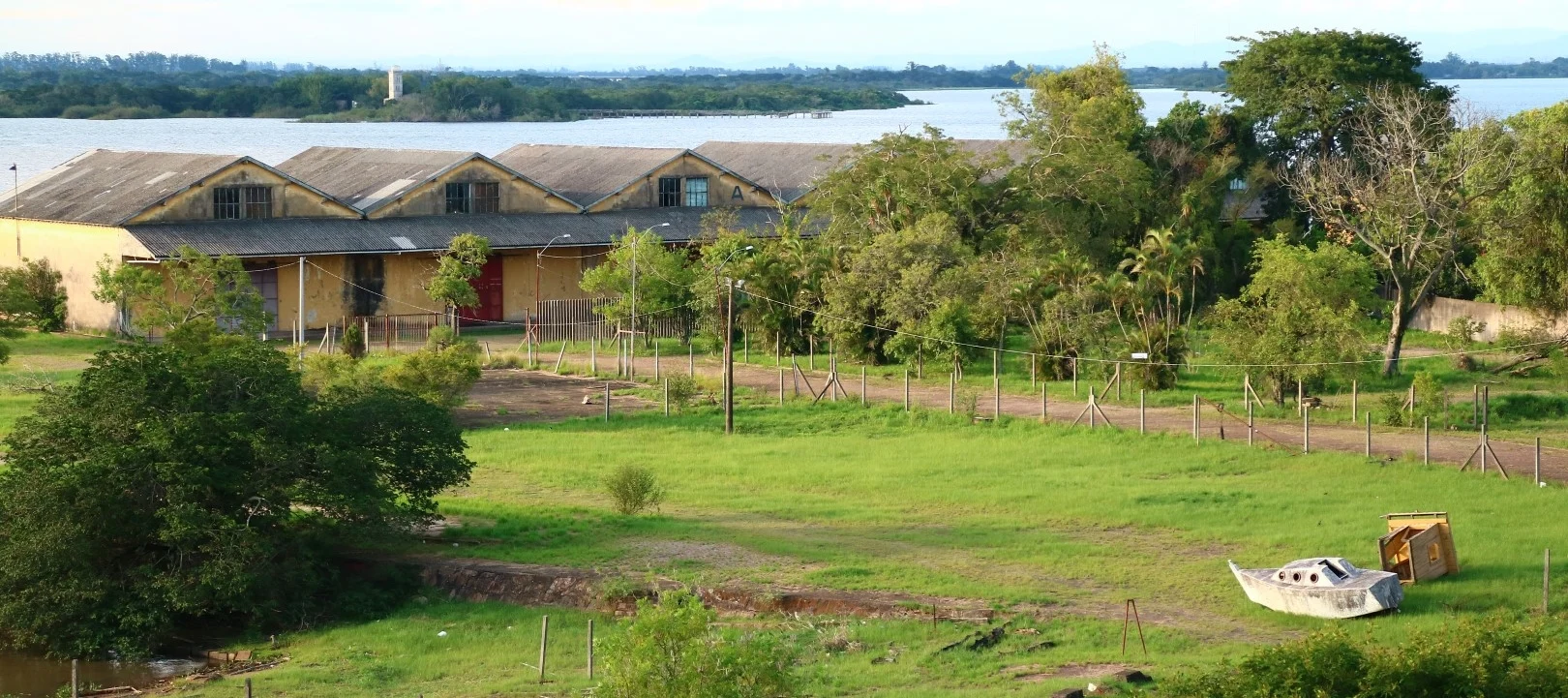
The Cais Mauá: long pitched-roof warehouses on the Guaíba river, a wrecked sailboat abandoned in the grass.
Under the elevated viaduct on Avenida João Goulart, every support column painted floor-to-ceiling with graffiti.
The same viaduct from beneath, looking through painted columns toward Sunday street life and a small Ferris-wheel.
"DIEM" tagged onto a chunk of concrete in the tall riverside grass at the Guaíba's edge.
CAFF: Brasília Comes To Porto Alegre
The Centro Administrativo Fernando Ferrari (CAFF) is the seat of the Rio Grande do Sul state government, on a long site at the southern edge of the centre. It was designed by the gaúcho architect Carlos Maximiliano Fayet and built between 1969 and 1973, at the height of Brazilian Brutalism and the Brasília-style civic architecture of the military government era.
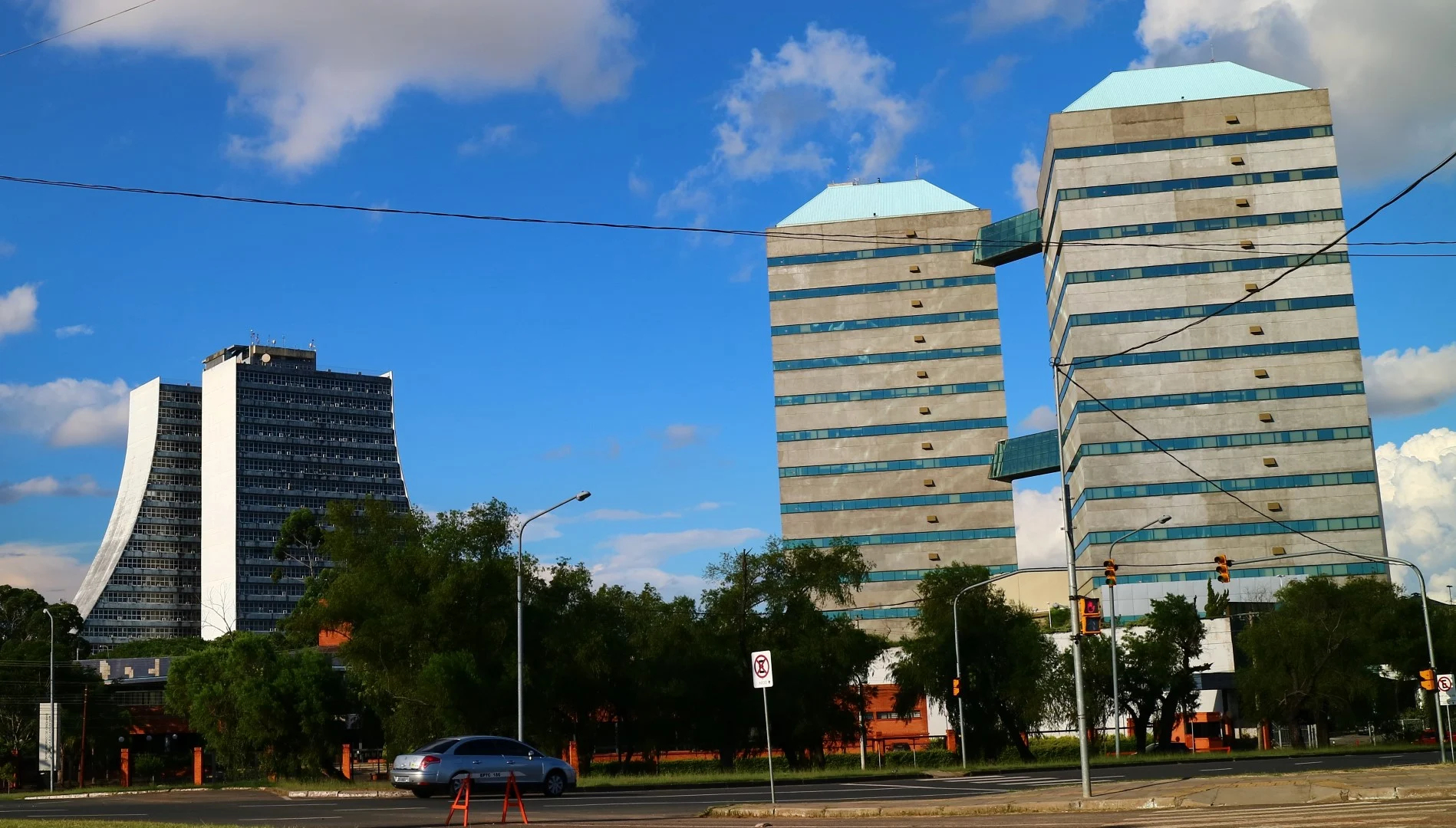
Three buildings: two 17-storey raw-concrete towers connected by sky-bridges, and a long curving boomerang-shaped slab (the Pedreira block) in front, where most of the executive offices sit. Around it are the same kinds of mid-century plaza-art that came with Brasília itself: a white plastic Molécula sculpture on a roundabout, a rusting corten-steel composition on the lawn.
The Centro Administrativo Fernando Ferrari (CAFF), the seat of the Rio Grande do Sul state government, designed by Carlos Maximiliano Fayet and built 1969-1973: the boomerang-shaped Pedreira block in front of the twin office towers.
The twin 17-storey CAFF towers connected by sky-bridges, a Brasília-era Brutalist statement on the edge of downtown.
A wider view of the whole CAFF complex: the slanted boomerang slab and the two towers, all in raw concrete.
The "Molécula", a white plastic dodecahedron sculpture on a roundabout, with the curving CAFF base behind.
A cluster of rusty corten-steel sculptures on the lawn in front of CAFF, the kind of abstract civic art that came with the building in the 1970s.
Mid-rise residential Porto Alegre on the other side of the railway viaduct: an IDMAL water silo tagged top to bottom on a roundabout.
The Usina Do Gasômetro: A Power Plant On The Guaíba
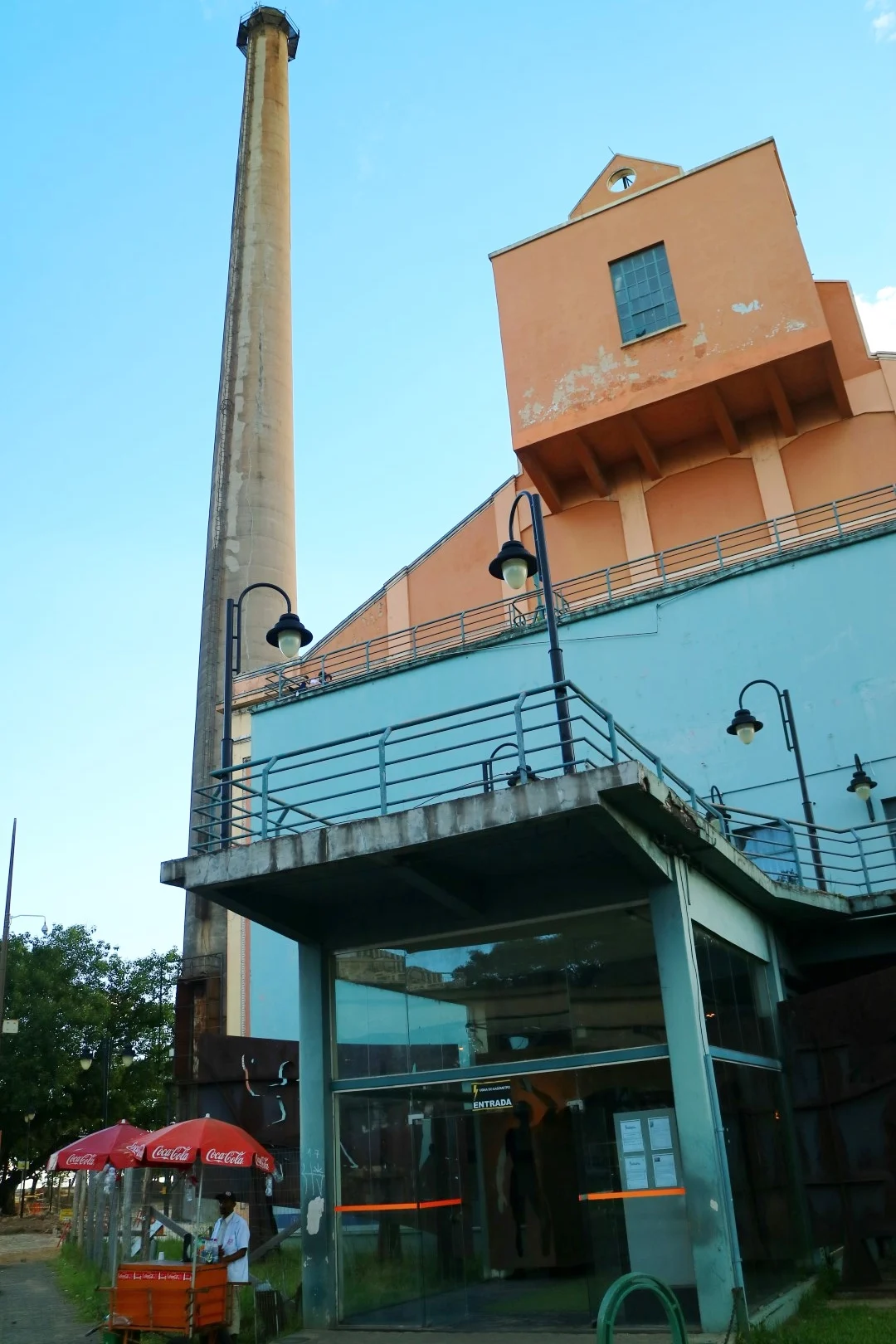
The Usina do Gasômetro is the most photographed building in Porto Alegre. It was a coal-fired thermoelectric plant built in 1928 to give the city its first reliable grid, ran continuously until 1974, sat abandoned for a decade, and reopened in 1991 as the municipal cultural centre: galleries, a cinema, a theatre, and a riverside esplanade that is the best sunset spot in the city.
The 117-metre chimney is visible from most of downtown. The salmon-and-turquoise brickwork on the original turbine hall has been preserved during restoration.
The 117-metre chimney of the Usina do Gasômetro, a 1928 thermoelectric coal plant that ran until 1974 and reopened in 1991 as the city's main cultural centre.
The Gasômetro from its entrance side: the salmon and turquoise brickwork, the connected utility block, a Coca-Cola umbrella vendor waiting outside.
A red Porto Alegre city bus parked under a flowering tree, the public-transit livery of the municipal Carris fleet.
The Centro Histórico: A Decaying Belle Epoque
Porto Alegre’s Centro Histórico is, building for building, one of the best preserved late-19th-century commercial cores in Brazil, and one of the most physically decayed. The German and Italian immigrants who arrived through the port in the 1880s and 1890s built Eclectic, Belle Epoque, and Art Nouveau commercial palaces along Avenida Mauá and Rua dos Andradas: hardware stores, banks, shoe-shops, hotels. Most of them are still standing, most are still in their original commercial use, and most are visibly falling apart.
The decay is part of the visual character. The Edifício Tumelero, the Du-Pé, the Memorial do Rio Grande do Sul, the Catedral Metropolitana, the Igreja Nossa Senhora das Dores: an inventory of every late-19th-century European architectural revival, weathered for a hundred years in subtropical humidity. The 20th-century overlay is Modernist office slabs (Banrisul, mid-century apartment towers on Rua dos Andradas) wedged between them.
The old Cais Mauá storefront strip on the riverside, a row of decaying late-19th-century shophouses with brightly tagged facades, parked under modern hotels.
A closer view of the same strip: "Latinha Cobre" recycling shop, "Sucessos Camargo" hotel, faded ornament fighting decay.
The Edifício Tumelero on Avenida Mauá: a yellow Belle Epoque pile with red-tile mansard, dormer windows, and ornate cresting, today a Tumelero hardware store.
The Tumelero from street level: arched ground-floor portico, a bus on the avenue, sky-blue summer clouds.
The Edifício FTEC, an Eclectic 1910s commercial building on the same strip, looking up at its sculpted cornice and gabled top.
The Edifício Du-Pé, with copper-domed turret and red Du-Pé shoe-store sign on its ground floor, on Avenida Mauá.
Angie walking past the same Du-Pé building, Rio Grande do Sul state flag flying from a balcony.
Avenida Borges de Medeiros at midday: a green-spandrel mid-century office slab tight against an ochre Modernist tower, a worker in orange uniform sweeping the sidewalk.
A row of blue and white Eclectic shophouses with iron balconies on a downtown street, an ALDO Calçados sign at ground level, motorcycles parked along the kerb.
The salmon-pink Memorial do Rio Grande do Sul, the 1913 former state treasury on Praça da Alfândega, now a state museum.
Rua dos Andradas, the main pedestrianised shopping spine of the centre: shoppers, palm trees, the wrought-iron Voluntários da Pátria streetlamps.
A corner of the same pedestrian zone: a yellow Eclectic building with TALIA store signage, families crossing through the chumbo.
Long graffiti wall just off Rua Voluntários da Pátria: a black stick-figure mural of "O Megafone de Ouro" amid spray-bombed letters.
Looking up the side of a decaying Centro building with red curtains in its broken windows, a high-rise block looming behind.
Looking straight up the brick skeleton of an unfinished tower behind the Mercado Público, a palm tree in foreground.
The salmon-pink Edifício Imperial passage on Rua dos Andradas, a Belle Epoque arcade with curved iron balconies and pedestrians passing through.
Looking up at the Imperial's arched upper-floor windows and the small dome that crowns it.
The bronze double-statue of "O Conversador" on a park bench, a literary monument to the gaúcho poets on a downtown square.
The pink coral-stone Igreja Anglicana de São Lucas, one of the few Anglican churches in southern Brazil, on a quiet downtown side street.
Igreja Nossa Senhora das Dores, an 1881 twin-spire neoclassical Catholic church on Largo Treze de Maio.
A close-up of the Nossa Senhora das Dores facade: the niches, the cornice, the small angels.
Inside Nossa Senhora das Dores: the gilded carved-wood altarpiece and pews.
The stepped Baroque retable behind the main altar of Nossa Senhora das Dores, crucifix at the top, gilt and white throughout.
Nossa Senhora das Dores from the side, through summer leaves.
The Catedral Metropolitana de Porto Alegre, a 1929-1986 Renaissance-revival cathedral on Praça da Matriz, its central mosaic reading "Bem-aventurada me chamarão todas as gerações" (All generations shall call me blessed).
The pale-blue Comando Militar do Sul, the headquarters of the Brazilian Army's Southern Military Command, with the national coat of arms above the entrance.
A pink Eclectic former bank or theatre on a tree-lined Centro street.
Two Art Deco stone heads peering down from the cornice of a Centro building, partially hidden behind tram wires.
A yellow Eclectic mansion (Solar dos Câmara or similar) on a quiet downtown side street.
Looking down a steep Centro street toward the blue-clad Banrisul tower in the distance.
Looking straight up at the Banrisul Tower, the 1958-1973 modernist 24-storey HQ for the Banco do Estado do Rio Grande do Sul.
Two yellow taxis at a downtown corner, palm trees, no-bus-only sign.
Rua dos Andradas on a quiet Sunday: mid-century apartment slabs leaning over the street, almost no traffic.
A pregnant woman in a floral dress waits at a bus stop in front of closed graffitied shopfronts: Salgadaria do Centro, Mini Pizza, Point Biju.
The pink Solar Lopo Gonçalves or similar 19th-century gaúcho townhouse hidden in a downtown side-square, a single mid-century apartment tower rising behind.
Praça Da Matriz: The Theatre, The Monument, The Cathedral
Praça da Matriz (officially Praça Marechal Deodoro) is the civic heart of the city. The Catedral Metropolitana on the north side; the salmon Theatro São Pedro, an 1858 neoclassical opera house still in continuous use as the oldest theatre in southern Brazil, on the south; the Palácio Piratini (the state governor’s residence) and the Palácio da Justiça (the high court) on the east and west. In the centre of the square stands the Monumento a Júlio de Castilhos, a 1913 granite obelisk crowned by a winged Republic, commemorating the gaúcho positivist politician who wrote the 1891 state constitution.
Theatro São Pedro on Praça da Matriz, an 1858 neoclassical opera house in pale yellow with terracotta-tile roof and arched portico, the oldest theatre in southern Brazil still in use.
A bronze relief mounted on the theatre wall: a winged figure with sword, a 20th-century monument to the city's playwrights.
The Monumento a Júlio de Castilhos on Praça da Matriz: a granite obelisk crowned by a winged Republic, dedicated 1913 to the positivist gaúcho politician who shaped the 1891 Rio Grande do Sul state constitution. The plinth reads "15 de Novembro 1889", the date of the Proclamation of the Republic.
The base of the same monument: bronze allegories of the Republic, History, and Liberty, with a bronze dragon at the foot, the cupola of the Catedral Metropolitana visible behind.
The Castilhos monument from below: the seated figures, the obelisk pointing up at the cumulus.
Another angle of the same base, the wrought-iron lamp visible at the corner.
Faces Of Inequality
Porto Alegre, like most Brazilian capitals, is a city where the gap between the wealthy and the homeless is visible on almost every block. Catadores push shopping carts of cardboard and aluminium past Belle Epoque facades. Homeless encampments occupy corners of the central parks. Teenage boys sleep on yellow concrete benches in the midday sun. A mural quotes Paulo Freire, the gaúcho-influenced theorist of the Pedagogy of the Oppressed and a son of Rio Grande do Sul’s intellectual tradition: “Não se pode falar de educação sem amor”, one cannot speak of education without love.
A barefoot young man crouches on the asphalt sorting through trash bags by a white panel truck.
A shirtless man dragging a shopping cart full of his belongings through a downtown park.
A homeless encampment under the trees: blue tarps, plastic chairs, scattered belongings, two dogs wandering.
A street artist in a Guarda do Embaú surf-town tank top paints a sunny colonial street on canvas, surrounded by paint cans and the encampment of the man who lives there.
Two men push and pull a shopping cart overloaded with bags of cardboard and recyclables, the catadores who keep Brazilian cities' recycling chains working.
Two shirtless boys spread out on a Centro sidewalk, one already asleep, parked silver Honda Fit beside them.
A graffiti wall with a cartoon rat character and the tags "JANE OTM 555" running its length.
A young man pulls a cart of recyclables past a wall stencilled "POVO COM LULA", the people with Lula, in the months before the 2018 election.
A mural quoting Paulo Freire, the Brazilian educator and theorist of the Pedagogy of the Oppressed: "Não se pode falar de educação sem amor", one cannot speak of education without love.
A shirtless man asleep on the sidewalk against an iron fence at night, plaid jacket as a pillow.
A teen boy stretched out asleep on a yellow concrete bench in the midday sun, barefoot, blue shorts, Globo T-shirt.
An older man asleep on a Parque Farroupilha bench in the late-afternoon sun, hands folded under his head, leather shoes still on.
Cidade Baixa: Graffiti By Day
Cidade Baixa (“the Lower City”) is the boho neighbourhood immediately south of the centre, built on the lower terraces between the centre and the river. Walk a single block of Rua João Alfredo or Rua República and you’ll see more graffiti per square metre than anywhere else in southern Brazil. Murals stretch the length of entire buildings, repeat across the next block, then continue under the highway underpass. The neighbourhood is full of decaying Eclectic mansions awaiting either restoration or demolition, indie cafes and barber shops on every other corner, and a slowly gentrifying mix of students, artists, and the original working-class residents.
A crumbling yellow Eclectic corner house in Cidade Baixa, peeling paint, balustrade balcony, parked Citroëns out front.
A long wall of bright graffiti murals on Rua João Alfredo, blue and orange figures, kids walking past.
Another graffiti panel: red shutter doors and a monochrome painting of sleeping nudes, a silver Fiat parked alongside.
A long graffiti wall featuring a sad cartoon face, an indigenous warrior, and a hip-hop figure in a blue hoodie.
A highway underpass on Avenida da Azenha, every concrete surface covered with full-wall colour murals.
Two adjacent panels of a Cidade Baixa mural: a Day-of-the-Dead skull witch with bats, a cat in a wizard hat.
The orange-walled "Entrevero" storefront on Rua Coronel Vicente: panther, octopus, and Day-of-the-Dead figures painted across the facade.
Angie posing in front of a wall mural of a tree of life by the artist Charles Hofmail: birds, a fox, painted reflection in water.
A decaying yellow tenement on Rua Voluntários da Pátria, heavily tagged, awaiting either restoration or demolition.
A neighbourhood playground in Vila Flores tucked under a leaning eucalyptus, low pastel townhouses behind.
Cidade Baixa: Carnival At Night
I was in Porto Alegre during the four days of Carnival 2017. Most of Brazil’s image of Carnival is the giant Rio sambódromo and the Salvador trio-elétrico circuits. Porto Alegre has neither. What it has, instead, is dozens of small neighbourhood blocos (block parties) that walk a route through Cidade Baixa each night of Carnival, gathering thousands of people behind a single percussion section, costumed, drinking, dancing the route, dispersing at dawn. I walked with Bloco da Vitrine and a few others. The photos below cover the first night.
The Brigada Militar, Rio Grande do Sul’s state police, runs both the polite small-town policing of standing for selfies with tourists and the riot-squad cordon a block away. Both end up in the photos.
Selfie of Leo and Angie, a mounted police horse passing behind us.
Two mounted Brigada Militar officers ride two abreast through the Cidade Baixa carnival street, crowd parting around them.
A churrasco vendor on Rua João Alfredo at sunset, a wall of Skol beer umbrellas and the crowd of Bloco da Vitrine waiting for the music to start.
The bloco fills the street: thousands packed shoulder to shoulder, umbrellas, the first night of Carnival in Cidade Baixa.
The crowd pushing past a wall of Skol-umbrella vendors, the streetlights just coming on.
Red Coca-Cola umbrellas marking the line of drink-stalls along the curb.
A vendor in a cap grilling spetinhos on a portable charcoal grill, a family pausing to order.
Cidade Baixa intersection at twilight, Skol umbrella, graffitied corner building.
A solitary Brigada Militar officer at the edge of the crowd in his green-and-black uniform.
Two young girls dragging bags of recyclable cans collected from the carnival crowd.
An improvised street bar: a folding table loaded with dozens of plastic bottles of cheap home-mixed cachaça, Natasha vodka, and energy drinks.
Wide view of the Cidade Baixa crowd at sundown, traffic lights and dancers.
The Sanar pharmacy corner at twilight, the bloco filling every metre of street up to the next intersection.
A little girl in a green princess dress and tiara holds her mother's hand in the carnival crowd.
Two women in matching grass-skirt and feather-headband indigenous-warrior costumes, red face paint, posing arm in arm.
Two women: one with a beer, one holding a FUCK TRUMP sign in red shorts and a US-flag-pattern top, the first Carnival 2017 after the November 2016 US election.
The Bloco da Vitrine drum line warming up: two surdo drummers in baseball caps marked "TRINCA 2017".
The full percussion section of the bloco: surdos, tamborims, repique, all in white T-shirts.
An older costumed man in a white toga and red-banded headdress dances through the crowd, a one-man-bloco impersonating a Roman senator.
A young man in an indigenous-warrior costume, red face paint, feather headband, grins at the camera.
A Brigada Militar riot squad in camouflage and body armour lined up against a graffitied builder's fence on Rua Frederico Mentz, holding the line for the parade.
Parque Farroupilha And The Monumento Ao Expedicionário
Parque Farroupilha, universally called Parque da Redenção, is Porto Alegre’s central park: 38 hectares of trees and paths between the centre and the Cidade Baixa, with a reflecting pool at one entrance, a lake in the middle, monuments and an open-air market on Sunday mornings. The Monumento ao Expedicionário, a granite triple arch by the sculptor Antônio Caringi dedicated in 1957, commemorates the 25,000 men of the Brazilian Expeditionary Force (FEB) who fought alongside the US Fifth Army in Italy in 1944-45. Inside the arch stands a bronze allegorical figure of Victory holding the tablets of the Republic.
The Colégio Militar de Porto Alegre, a 1912 federal military secondary school, sits one block away, its mustard-yellow Eclectic facade with an Art Deco curved gable above the main entrance.
The reflecting pool at the entrance to Parque Farroupilha, commonly called Parque da Redenção, downtown skyline behind.
Avenida João Pessoa: a row of imperial palms lining the road along the south side of Parque Farroupilha.
Locals bathing at the wading-pool steps inside the Redenção, three young men washing themselves and a child in the shallow lake.
The Monumento ao Expedicionário, dedicated 1957 by sculptor Antônio Caringi: a granite triple arch framing a bronze allegorical figure of Victory, commemorating the Brazilian Expeditionary Force that fought with the Allies in Italy in 1944-45.
Closer view of Caringi's bronze: a draped warrior holding the tablets of the Republic and a spear, with serpents coiling around its base.
The Colégio Militar de Porto Alegre, a 1912 federal military secondary school in mustard-yellow Eclectic with an Art Deco curved gable above the main entrance and a clock in the pediment.
A residential street near the park: a 1950s Modernist single-storey house, geometric mural on its fence, mid-rise apartments behind.
The Jardim Botânico
The Jardim Botânico de Porto Alegre, founded 1958 on a wooded hillside on the southern edge of the city, is the second-largest botanical garden in southern Brazil. It is also free, easy to walk, full of side-necked turtles in the central pond, and one of the most relaxed afternoons you’ll have in the city. The Museu de Ciências Naturais on the grounds has the Rio Grande do Sul fossil and biodiversity collection: a life-sized Prestosuchus model from the Triassic, taxidermy dioramas of pampa and Pantanal ecosystems, and a wall of bird-beak diversity that is the best small natural-history exhibit in Brazil.
The bamboo plank-bridge over the bright-green algae pond is the photo every visitor takes.
The wooden welcome sign at the entrance to the Jardim Botânico de Porto Alegre, founded 1958 on the southern edge of the city.
The garden's hand-painted park map, Leo's shadow falling across it.
Leo walking the length of the bridge in a red plaid shirt.
Leo perched on the log railing of the bridge, a bougainvillea in full pink flower behind him.
Angie posing on the railing, the bridge stretching back through the bamboo.
A solitary agave specimen in a clearing, surrounded by tropical understorey.
Macro of a giant Monstera deliciosa, the Swiss cheese plant, all fenestrations and veins.
A stone staircase climbing up through an arched tunnel of trees and dappled afternoon light.
A cluster of turtles surfacing at the pond's edge, half in the water, half out.
A close-up of one turtle's face, an almost-smiling expression.
Two side-necked turtles basking together, necks fully extended.
Macro of a single turtle peering forward from inside its shell.
Two more turtles lined up to bask, the long retractile necks characteristic of the Phrynops genus.
The garden's xerophyte (arid-zone) section: a cluster of prickly-pear cacti in fruit.
A massive blue-green Agave americana in flower-bud, the central spike just starting to extend.
Prickly pear and staghorn-like succulents at the rocky edge of the same section.
Inside the Museu de Ciências Naturais on the garden grounds: a life-sized model of Prestosuchus chiniquensis, a 7-metre Triassic-era "rauisuchian" reptile discovered in Rio Grande do Sul in 1942.
The museum's bird-beak diversity display: a grid of taxidermy heads showing how form follows function, from the spoonbill to the toucan to the saw-whet owl.
A forest-floor diorama of mounted small mammals, coati and agouti, on a fallen tree trunk.
A pampa wetland diorama: a great egret, a capybara, and a moorhen at the edge of a painted marsh, the Pantanal-style ecosystem of southern Brazil.
The Porto Alegre skyline seen from the Jardim Botânico hilltop, the city framed by a wall of green canopy.
Angie with the garden's bright-red-and-green park train, a permanent sculpture-toy beside the picnic ground.
Conclusion
Porto Alegre is the most European-feeling of Brazil’s big cities and the most physically decayed of its state capitals. A week was enough to see most of it on foot. The Centro Histórico, the Cidade Baixa carnival blocos, and the Jardim Botânico are the three places worth structuring a visit around. The Gasômetro at sunset is mandatory.
Since 2010, Leonidas has been an incredible Web Developer, and amazing Digital Marketer. He is the author of various exciting case studies in digital marketing, most notably in Pay Per Call Marketing.
Make sure to read the case studies to make your life so much better!