
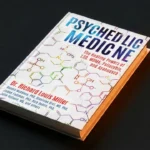
“They unlock parts of the mind that, heretofore, we are unable to access. It is a tool for wisdom and a tool for looking deep inside yourself and searching out fear.”
I listened to the audiobook version while in the process of overcoming some stuff, meditating, smoking some DMT, and getting some LSD. The author interviews a couple of high-level individuals in the psychedelics industry, from psychiatrists, to chemists, to biologists, to political scientists.
Most of the content revolves around the suppression of psychedelics by various governments, followed by outstanding mental health results from clinical trials, along with effects that people feel when they use psychedelics recreationally, and then the amazing benefits and low levels of adverse effects.
The audiobook continues the same narrative that’s been building up in the last 5–10 years of the safe applications of psychedelics. I look forward to doing more DMT and trying my first LSD after this.
Who Is Richard Louis Miller?
Dr. Miller is a clinical psychologist who has been involved with psychedelic research since the 1960s. The guy has been at it for DECADES. He’s not some newcomer jumping on the psychedelic hype train — he was there before the War on Drugs crushed the entire field into silence.
What makes his approach different from other psychedelic books is the interview format. Instead of writing from a single perspective, Miller brings in researchers, therapists, and activists who are actually doing the work. You hear from the people running clinical trials, treating patients, and navigating the absurd legal landscape that still classifies these substances alongside heroin.
The War on Psychedelics
One of the most frustrating takeaways from this book is how much progress was LOST because of politics. In the 1950s and 1960s, psychedelic research was thriving. Therapists were using LSD to treat alcoholism, depression, and end-of-life anxiety — with remarkable success rates.
Then the counterculture happened. Timothy Leary happened. Governments panicked. And just like that, decades of legitimate scientific research got buried under a mountain of propaganda and scheduling laws.
Miller’s interviewees make it painfully clear — we didn’t stop psychedelic research because the science failed. We stopped because politicians needed a convenient enemy. The science was working. That’s what makes the whole thing so infuriating.
MDMA, Psilocybin, and the Clinical Renaissance
The strongest sections of the book cover the modern clinical trials. MDMA for PTSD. Psilocybin for treatment-resistant depression. Ayahuasca for addiction. The results coming out of places like Johns Hopkins and MAPS are genuinely extraordinary.
We’re talking about patients who failed EVERY conventional treatment — years of therapy, multiple medications, nothing worked — and then one or two guided psychedelic sessions produced lasting breakthroughs. Not temporary relief. Actual, measurable, sustained improvement.
That’s not placebo. That’s not wishful thinking. That’s hard clinical data.
Miller does a good job of letting the researchers speak for themselves here. He doesn’t oversell it or make wild claims. The scientists present their findings, acknowledge the limitations, and let the results do the talking. Which, frankly, is all they need to do — the numbers are that impressive.
DMT — The Molecule I Keep Coming Back To
If you’ve read my reviews of DMT: The Spirit Molecule and DMT Dialogues, you know I have a particular fascination with dimethyltryptamine. Miller touches on it here too, though not as deeply as Rick Strassman does in his work.
What I appreciate about Miller’s treatment of DMT is how he contextualizes it within the broader psychedelic medicine framework. It’s not just about the experience — although the experience is absolutely mind-blowing — it’s about what these molecules reveal about consciousness itself.
The fact that our own brains produce DMT naturally, and that we STILL don’t fully understand why, tells you everything about how much we have left to learn about the human mind.
The Safety Question
One thing Miller hammers home through multiple interviews is the safety profile of psychedelics. And this is important, because the biggest obstacle to legalization isn’t the science — it’s the fear.
Classic psychedelics like psilocybin and LSD are essentially non-addictive. They don’t cause organ damage. The lethal dose is astronomically high compared to substances we sell over the counter without batting an eye. Meanwhile, alcohol and tobacco — both perfectly legal — kill HUNDREDS OF THOUSANDS of people every year.
The irony is staggering. We schedule psilocybin alongside heroin but sell vodka at every gas station. If you can read this book and still think the current drug classification system is based on science rather than politics, I don’t know what to tell you.
What Could Have Been Better
The interview format is a double-edged sword. On one hand, you get diverse perspectives and real expertise. On the other hand, some interviews feel repetitive — multiple guests making essentially the same arguments about legalization and safety. By the fifth or sixth time someone explains why scheduling is broken, you get it.
I also wish Miller had pushed harder on some of the more controversial claims. A few of his guests veer into territory that feels more spiritual than scientific, and he tends to let those statements pass without much challenge. A bit more critical pushback would have strengthened the book’s credibility.
Final Thoughts
If you’re already into psychedelic research, Psychedelic Medicine won’t blow your mind (pun intended). But it’s a solid, well-rounded overview of where the field stands and how it got here. Miller has done the work of curating voices from across the entire spectrum — science, therapy, policy, and personal experience.
For anyone curious about psychedelics but still on the fence, this is an excellent starting point. It’s grounded, evidence-based, and honest about both the potential and the limitations. And if you want to go deeper on DMT specifically, pair this with Strassman’s work and you’ll have a damn solid foundation.
3.5/5 — a good overview of psychedelic medicine that covers wide ground, even if it occasionally retreats into familiar territory.
Thanks for reading.
— Leonidas
