

“Productive people and companies force themselves to make choices most people are content to ignore.”
How many productivity books have you read that promised to change everything — and then left you feeling exactly the same a week later? Yeah, me too. More than I’d like to admit.
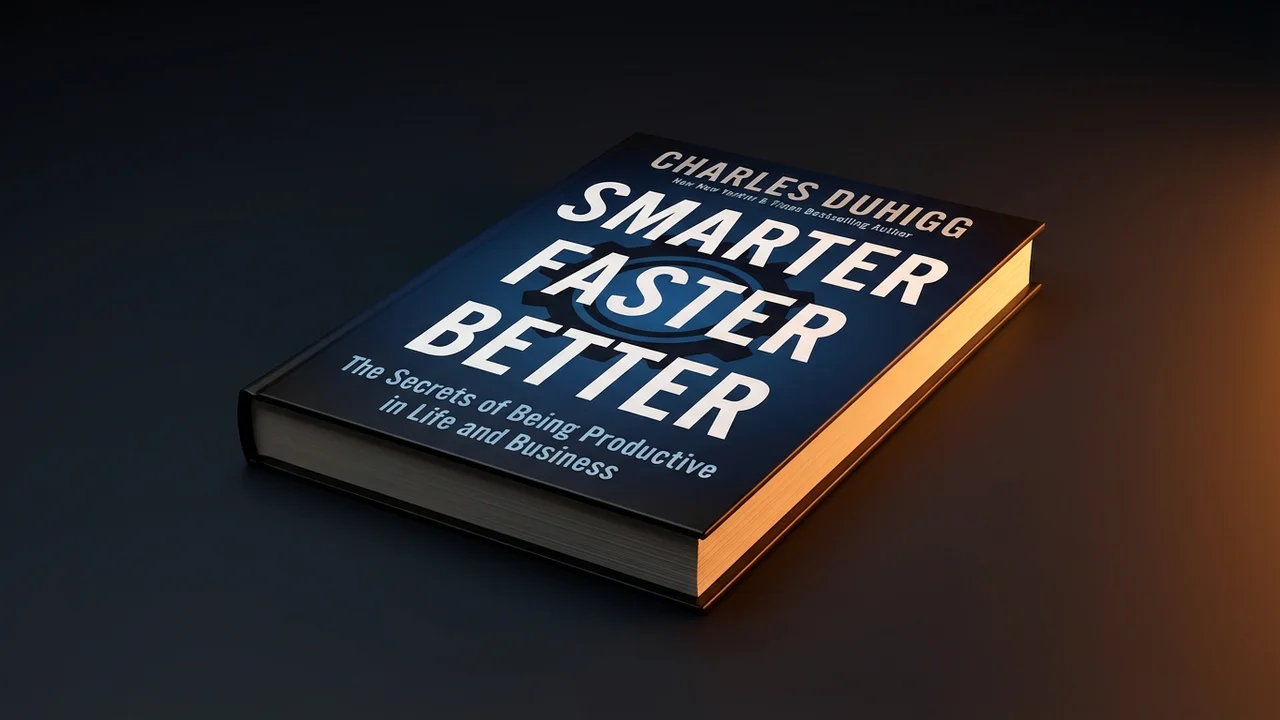
Charles Duhigg’s Smarter Faster Better takes a different approach to the whole productivity conversation. Instead of giving you a 10-step checklist or a morning routine to copy, he tells STORIES. Lots and lots of stories. About airline pilots, Marine Corps recruits, Disney filmmakers, poker players, and factory workers. And then, somewhere in between, he connects these stories to eight big ideas about how humans actually get things done.
I listened to the audiobook while traversing Spain — trains, buses, long walks through small towns — and I’ll be honest, I can’t say I remember every detail. But the concepts that stuck? They stuck HARD. And they’ve changed how I think about my work habits.
Motivation Starts With Control
The first concept Duhigg covers is motivation, and his take on it is probably the most useful thing in the entire book. He argues that motivation isn’t something you either have or don’t have. It’s something you generate by making choices — specifically, choices that give you a sense of CONTROL.
He tells the story of how the Marine Corps redesigned their basic training program. Instead of just barking orders, they started giving recruits micro-decisions. Small choices. “How do you want to organize your platoon for this exercise?” Nothing revolutionary, but it flipped a switch in their brains.
When you feel like you’re in charge of something — even a tiny something — your brain treats it as meaningful. And meaning generates motivation. As an entrepreneur, I’ve noticed that the days I feel the MOST motivated are the days I plan out my own schedule from scratch, rather than reacting to whatever lands in my inbox.
The Google Team Study
Duhigg digs into Google’s internal study on what makes some teams brilliant and others useless. They called it Project Aristotle, and they studied hundreds of teams over several years.
The result? The most important factor wasn’t intelligence, experience, or even having the right mix of skills. It was psychological safety — whether team members felt safe to take risks and speak up without being shut down.
I’ve seen this play out in every mastermind group and partnership I’ve ever been in. The ones where people were afraid to say “this isn’t working” always collapsed eventually. The ones where honesty was the default? Those are the ones that made money.
Goal Setting — Stretch Goals vs. SMART Goals
Here’s where Duhigg gets really practical. He makes a distinction between two types of goals that most people lump together, and the difference matters A LOT.
Stretch goals are the big, audacious ones. “I want to build a six-figure business.” “I want to visit every country in the world.” These fire up your ambition and force you to think beyond your current limitations.
SMART goals (Specific, Measurable, Achievable, Realistic, Timeline) are the tactical, day-to-day targets that break the stretch goal into actual steps.
Duhigg’s argument is that you need BOTH. A stretch goal without SMART goals is just a daydream. And SMART goals without a stretch goal turn you into a task-completing robot who never does anything truly meaningful. The combination is where productivity lives.
This is one of those concepts that sounds obvious when you hear it, but almost nobody actually does it. I know I didn’t — at least not consciously — until I read this.
Mental Models and Focus
The chapter on focus was eye-opening. Duhigg talks about mental models — essentially, telling yourself a story about what you expect to happen BEFORE it happens. This is how pilots avoid catastrophic mistakes, and it’s how productive people maintain focus in chaotic environments.
When you visualize your day before it starts, you’re building a mental model. When something unexpected hits you, your brain already has a framework to process it. Without that framework, you just react. And reactive people are rarely productive people.
I started doing this on long travel days — mentally walking through what I needed to accomplish before I even opened my laptop. The difference was noticeable almost immediately.
Decision Making and Probabilistic Thinking
Duhigg dedicates a chapter to a professional poker player named Annie Duke, and it’s probably the most entertaining section of the book. Duke doesn’t think in terms of “right” and “wrong” decisions. She thinks in PROBABILITIES.
The goal isn’t to be right every time — that’s impossible. The goal is to make decisions where the odds are in your favor, over and over, and let the math work itself out over time.
This is essentially how I approach online marketing. You don’t know which ad campaign will hit or which landing page will convert. But if you run enough experiments with favorable odds, the aggregate results will trend positive. That’s not hope — that’s statistics.
The Storytelling Formula
Now, here’s my honest critique. Duhigg follows a very specific writing formula throughout the book, and once you see it, you can’t unsee it. Step one — tell a story. Step two — tell another story. Step three — briefly explain the productivity principle connecting them. Step four — wrap the stories up in a neat bow.
It’s engaging, sure. But sometimes I wanted him to go DEEPER into the science and spend less time on narrative. The ratio felt off — like 80% story and 20% substance. For a book about productivity, it could have been more… well, productive with its pages.
If you’ve read Duhigg’s first book, The Power of Habit, you already know this formula. It does mean the book sometimes feels more like a collection of magazine articles than a cohesive argument.
Final Thoughts
Smarter Faster Better gave me two or three ideas that genuinely improved how I work — the motivation-through-control concept and the stretch-plus-SMART goal framework being the biggest ones. That’s more than most productivity books deliver.
Is it the best book on productivity? No. I’d put Cal Newport and James Clear above Duhigg for actionable advice. But as an introduction to WHY some people and teams outperform others, it’s a solid, enjoyable read.
3.5/5 — Worth a listen on a long trip. Just don’t expect it to be the last productivity book you’ll ever need.
Thanks for reading.
— Leonidas
