
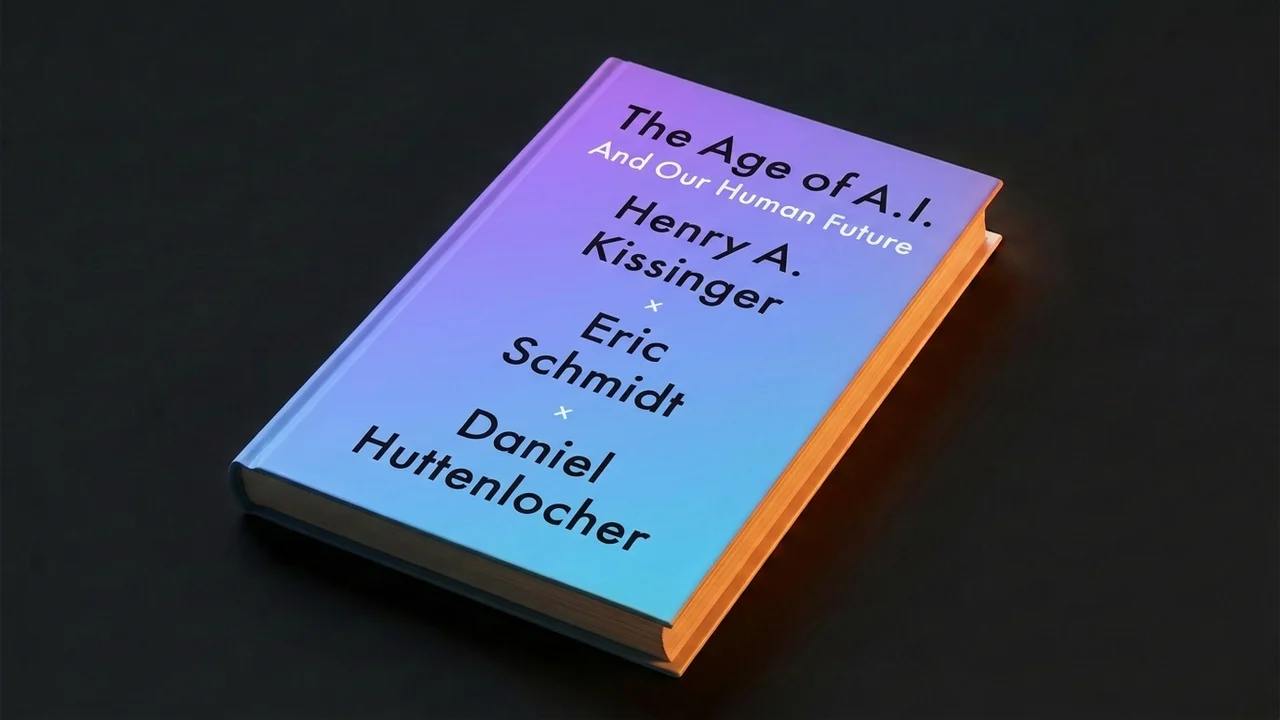

“When information is contextualized, it becomes knowledge. When knowledge compels convictions, it becomes wisdom.”
Let me be upfront — I blazed through this as an audiobook, passively, while doing daily tasks. Cooking, cleaning, walking around. I retained maybe 40% of it on the first pass. Had to read a review afterwards just to piece together what I had actually listened to.
But despite the scattered absorption, the big themes stuck. And honestly? The themes are what matter here, because this is not a technical manual. It is a philosophical book written by a diplomat, a tech CEO, and an MIT dean — three people who found common ground on one idea: AI is about to change EVERYTHING.
The Enlightenment Comparison
The central argument of the book is that artificial intelligence represents a transformation on par with the Enlightenment. That is a massive claim. The Enlightenment fundamentally shifted how humans understood reality — from divine authority and superstition to reason, science, and individual thought.
Kissinger, Schmidt, and Huttenlocher argue that AI is doing something similar. Except this time, the shift is not from faith to reason — it is from human reason to machine logic. For 300 years, human reason was the gold standard. The foundation of science, democracy, economics, law. And now we are building machines that can outthink us in specific domains — chess, drug discovery, military strategy — yet we cannot fully explain HOW they do it.
That is not just a technological development. That is a philosophical crisis.
The Black Box Problem
One of the concepts that stuck with me is what they call the inscrutability of AI — the “black box” problem. We build these systems, feed them data, they produce results, and sometimes nobody, not even the engineers who built them, can explain why the algorithm reached a particular conclusion.
When Google ranks your search results, an AI decided the order. When social media flags or promotes content, an AI made that call. When a military simulation suggests a strategy, an AI generated it. The reasoning behind the decision? Opaque.
We are trusting systems we do not fully understand to make decisions that affect billions of people. The authors are right to flag this as a problem that goes far beyond technology — it is a governance crisis, an ethics crisis, and ultimately an identity crisis.
AI and Geopolitics
This is where Kissinger’s fingerprints are all over the book, and it is also the part I found most compelling.
If you have read The Hundred-Year Marathon or followed any geopolitics in the past decade, you know that the USA and China are locked in a technology race. AI is at the center of that race. Whoever leads in AI development gains an enormous strategic advantage — militarily, economically, and in terms of global influence.
The book discusses weaponized AI, cyberwarfare, and the terrifying prospect of autonomous weapons systems. Imagine AI making decisions about nuclear arsenals without human oversight. The authors do not treat this as science fiction. They treat it as an imminent reality that requires international agreements NOW.
This is the section that genuinely kept my attention, even through the passive listening. Because geopolitics is not abstract — it determines the world your children will inherit. And the idea that AI could accelerate conflicts, enable disinformation campaigns at unprecedented scale, or be deployed in warfare without any human in the loop? That should keep everyone awake at night.
Network Platforms as New Powers
Another angle the authors explore is how AI-driven network platforms — think Google, Facebook, Amazon — are becoming powerful entities that transcend traditional national borders.
These platforms know more about their users than most governments do. They shape what you see, what you buy, what you believe. And they operate globally, beyond the regulatory reach of any single nation.
Eric Schmidt, having run Google, obviously has insider perspective here. The book acknowledges that these platforms have become quasi-governmental in their influence. They are the new gatekeepers of knowledge, and AI is the engine that powers them.
As an internet marketer, this hits home. The algorithms determine who sees your content, who clicks your ads, who buys your product. You are at the mercy of AI systems that can change overnight without explanation.
What Is Left of Being Human?
The deepest question the book raises is simple: if machines can reason better than us in specific domains, what is left that is uniquely human?
The authors suggest that the digital abundance of information is actually eroding our capacity for the kind of sustained, solitary reflection that produces wisdom. We are drowning in data, skimming everything, absorbing nothing deeply. Sound familiar? Because that is exactly how I consumed this book.
I blazed through it passively. Afterwards, I tried using AI itself to write a review for the book, and ended up being more fascinated by the tool than by finishing the actual review. Then I forgot about the whole thing for almost a month.
If that is not a perfect illustration of the book’s thesis, I do not know what is. AI is incredible, AI is distracting, and AI might be subtly eroding our ability to focus, reflect, and form genuine convictions.
Final Thoughts
The book is more philosophical than practical. It raises far more questions than it answers, and some readers will find it repetitive — the Enlightenment comparison gets hammered home pretty hard. It also reads like three different writing styles stitched together, which makes sense given the three authors.
But the core message is important. AI is not just another technology. It is a fundamental shift in how knowledge is created, how power is distributed, and how we understand our place in the world.
AI continues to progress at a pace that makes this book — published in 2021 — already feel dated in its examples, yet remarkably prescient in its warnings. The questions these authors raised have only become MORE urgent, not less.
3/5 — important ideas, somewhat dry delivery. Recommended for anyone interested in geopolitics, technology policy, or the philosophical implications of artificial intelligence. Just maybe read the physical copy instead of half-listening to the audiobook while doing dishes.
Thanks for reading.
— Leonidas
