
“Under pressure we don’t update; we protect. We feel threatened, so we avoid, escape or shut down.”
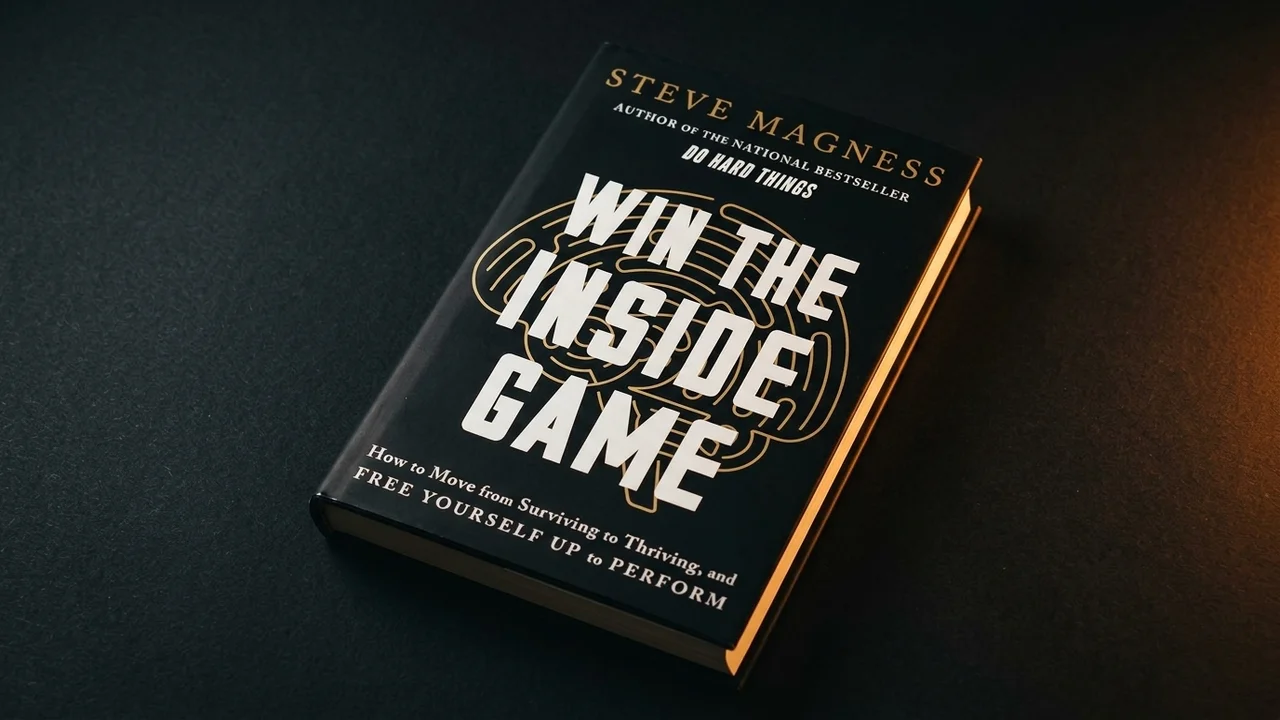
Some books you finish and immediately want more from the author. That was me after Do Hard Things. Steve Magness took the old-school idea of toughness, put it up against the actual science, and walked me through the argument like a good coach. So when Win the Inside Game came out, picking it up was automatic.
I wish I could tell you the streak continued.
Instead, this is the rare review where my main takeaway is not about the book’s ideas. It is about the reading experience itself. Because this book, a book about escaping survival mode and freeing yourself up to perform, somehow managed to stress me out while I was reading it.
The Pitch: Be, Do, Belong
Let me give the book its fair shake first, because the core premise is genuinely good.
Magness argues that when we tie our self-worth to achievement, fuse our identity to our career, and chase external validation, we flip into survival mode. Fight, flight, freeze, avoid. And a brain in survival mode does not perform. It protects and defends.
His answer is a three-part framework built on clarity. Be: get clear on who you are, and stop welding your entire identity to one role. Do: get clear on why you pursue things, so intrinsic motivation drives you instead of the scoreboard. Belong: find real connection instead of contorting yourself to fit in.
Written out like that, in three clean sentences, it sounds like a tight book. Here is the problem: it took an outside summary for me to see that structure at all.
A Firehose With No Nozzle
Reading this book felt like standing in front of a firehose of ideas with nobody holding the nozzle.
One paragraph introduces a concept. The next jumps to a different concept. Then a quote from an athlete. Then a story about another athlete. Then a general observation about modern life. Then a new study. And before any of it gets developed, we are off to the next thing.
I kept waiting for the chapter to circle back and stack the pieces into an argument. It rarely did. The ideas just kept coming, paragraph after paragraph, connected by a broad narrative vibe rather than an actual structure.
And look, I am not a careless reader. I read this with complete focus, no distractions, genuinely trying to follow the thread. I still lost it. Repeatedly.
I Had to Ask ChatGPT What I Just Read
Here is my honest confession, and I rarely had to do this with a book before.
Partway through, I started reading a ChatGPT summary of the book, chapter by chapter, just to understand what I had just read. Not to skip the reading. I did the reading. I needed the summary to reverse-engineer the structure the book itself never made visible.
Think about what that means. The summary of the book communicated the book’s ideas better than the book did.
That is not a reader problem. That is an editing problem. Somewhere at HarperOne, someone should have sent this manuscript back with one note in big red letters: organize it.
A Book About Calm That Radiates Stress
The structural chaos is only half of my complaint. The other half is the tone.
This book is supposed to move you from surviving to thriving. Yet the prose is soaked in drama. Threat, pressure, fear, protection, collapse, crisis. Stress-loaded ideas and stress-loaded wording, thrown at the reader page after page, with barely a pause to breathe.
Some background helps here. Magness was the whistleblower in the Nike Oregon Project doping scandal, the man who reported Alberto Salazar and then spent years living through the investigation and the fallout. That took real courage, and I respect him for it.
But reading this book, it felt like all the darkness of those years was being manifested and thrown directly at me. The siege mentality, the hypervigilance, the sense that the world is one giant psychological threat. It bleeds through every chapter.
A book about winning the inside game should model the calm it preaches. This one reads like it was written from inside the storm.
Like a Friend Ranting About Their Problems
The comparison to Do Hard Things is brutal, and unavoidable, because it is the same author.
Do Hard Things had a spine: old-school toughness versus the new science of toughness. Every chapter hung off that one clear conflict. You always knew where you were and what was being argued.
Win the Inside Game has no such spine. It feels like Magness emptied his notebook onto the page, every idea, every quote, every athlete anecdote he had collected, and trusted a broad narrative to hold it together.
The best description I can give you: it is like having a friend who rants about their problems. There is real substance in there, real pain, even real wisdom. But it arrives as an unstructured stream, and after an hour of nodding along you realize you could not summarize what they actually said.
What Survives the Flood
Is there value here? Yes, if you dig for it.
The identity-fusion idea is the keeper: when you are your job, your sport, or your business, every setback becomes an existential threat, and you start playing defense with your whole life. I have watched entrepreneurs do exactly this, and I have caught myself doing it too. Separating who you are from what you do is real, practical advice.
The intrinsic-versus-extrinsic motivation material is solid too, even if it has been covered better elsewhere. And his point about belonging without conforming deserves its own, better book.
So the raw material is good. It just never got assembled.
Final Thoughts
Here is my advice. If this topic interests you, read Do Hard Things first. It is the stronger book by a wide margin, with a clear concept and an argument that actually builds.
If you have already read it and want more Magness, go in knowing what this is: a pile of genuinely good ideas delivered as an overwhelming, disorganized, stress-soaked rant. Keep a summary handy. I am not joking.
3 out of 5. Good ideas, rough delivery, and a reading experience that left me more tense than when I started.
Thanks for reading.
— Leonidas
