
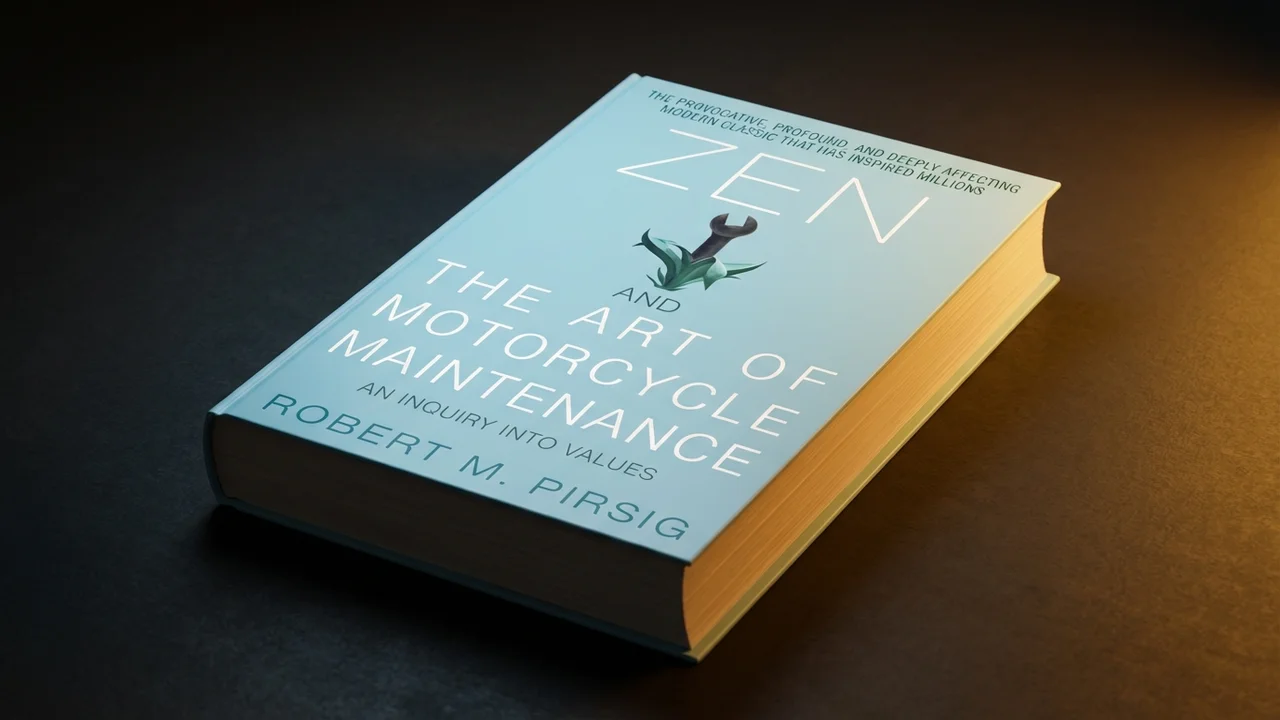

“The only Zen you can find on the tops of mountains is the Zen you bring up there.”
If you want to read a complicated philosophical book, then start here. I honestly needed a Wikipedia article to summarize what the author was writing about once I finished.
But here’s the thing — that confusion? It’s kind of the point. Pirsig doesn’t hand you answers on a silver platter. He makes you WORK for them. And whether you love that or hate it, you have to respect it.
The motorcycle ride that the main protagonist and his son embark on is just a front for a really deep philosophical look at the definition of “quality.”
The author himself is a very technical person, and I suppose this book was his gateway into describing something he had thought about for years. Nonetheless, you get lost in the philosophical technicalities and ultimately wonder: what is the point?
Well, I’ve been thinking about that question for a while now. And I think the point is simpler than Pirsig makes it seem.
The Two Worlds
One of the central ideas in the book is the split between what Pirsig calls the “classic” and “romantic” ways of understanding the world. Classic is the analytical, technical mind — the person who looks at a motorcycle engine and sees components and systems. Romantic is the intuitive, feeling mind — the person who just wants to ride the thing and feel the wind.
Most people live on one side. The romantics think the classics are boring. The classics think the romantics are shallow. Neither side understands the other.
I actually found this incredibly relatable. In online business, you see this divide ALL the time. There are people who obsess over the data — click-through rates, conversion funnels, split tests — and there are people who obsess over the brand, the story, the feeling. The best marketers I’ve ever encountered? They do both. They understand the numbers AND the narrative.
That’s essentially what Pirsig is arguing. Don’t pick a side. Merge them.
Historical Connections
There are a few educational tips and higher-consciousness bits. I enjoyed the historical connections between ancient Greek philosophers and how we currently perceive ourselves and the information around us.
Pirsig goes deep into Aristotle, Plato, and the Sophists — and he makes a compelling case that Western philosophy took a wrong turn somewhere. The Sophists were teaching rhetoric and “excellence” (which is really just another word for quality), and then Plato and Aristotle came along and buried them under logic and dialectic reasoning.
The result? A civilization that knows HOW to build things but forgets to ask whether those things are actually good. We optimize for efficiency but not for meaning. Pirsig thinks that’s a fundamental problem.
Whether you agree with his interpretation or not, it’s a fascinating lens. It made me reconsider how much of my own thinking is just inherited assumptions I’ve never questioned.
Phaedrus — The Ghost in the Machine
The most unsettling part of the book is the Phaedrus storyline. Without spoiling too much, Pirsig is essentially writing about a former version of himself — a man who became so obsessed with defining Quality that it drove him to a mental breakdown.
This isn’t just a philosophical exercise. It’s autobiographical. Pirsig actually went through electroshock therapy. The man on the page literally lost his mind chasing an idea and had to rebuild himself from scratch.
That adds intensity you won’t find in most philosophy texts. This isn’t some professor theorizing from a comfortable chair. This is a guy who went to the edge, fell off, and came back to tell you what he saw.
Heavy stuff.
Quality — You Know It When You See It
So what IS Quality? Pirsig spends the entire book circling this question, and his answer is deliberately slippery. Quality isn’t objective — it’s not a measurable property of an object. But it’s not purely subjective either — it’s not just “whatever you like.”
Quality, according to Pirsig, exists in the RELATIONSHIP between you and the thing you’re experiencing. It’s the moment before your analytical mind kicks in and starts categorizing. It’s the immediate, pre-intellectual awareness that something is good or right or true.
I’ll be honest — when I first read this, I thought it was circular reasoning. But the more I sat with it, the more it made sense. Think about the last time you heard a piece of music that gave you chills, or watched someone genuinely excellent at their craft. You KNEW it was quality before you could explain why. The explanation comes after. The recognition comes first.
That’s what Pirsig is pointing at.
The Motorcycle as Metaphor
The motorcycle maintenance stuff isn’t filler — it’s actually the most practical part of the book. Pirsig argues that taking care of your motorcycle with genuine attention and care is a form of meditation. It’s Zen in action.
When you rush through a repair just to get it done, you produce garbage work. When you’re fully present — when you actually CARE about doing it right — that’s when Quality shows up.
This applies to everything. Writing, cooking, building a website, having a conversation. The quality of your output is directly tied to the quality of your attention. That’s a lesson I keep coming back to.
This book is recommended for business professionals by a few business-centric websites. I’m not quite sure why, other than to confuse you or to get you to overthink.
Actually — I take that back. I think I understand now. It’s because the concept of Quality as Pirsig defines it is something every professional should grapple with. Are you just going through the motions? Or are you actually paying attention to the work itself?
Final Thoughts
Nonetheless, I’m sure this book has a purpose, primarily to get you to think very deeply. I recommend this if you want a difficult book to read, and perhaps you might find a purpose to it, because there definitely is one.
I’m already overthinking.
But that’s the mark of a book that does its job. It burrows into your brain and rewires a few connections. You might not agree with everything Pirsig says — I certainly didn’t — but you WILL think differently about what “quality” means in your own life and work.
Is it an easy read? Absolutely not. Is it worth the effort? I’d say yes — if you enjoy having your assumptions challenged.
3.5/5 — a challenging, rewarding book that demands patience and rewards persistence.
Thanks for reading.
— Leonidas
