

“Questions you cannot answer are usually far better for you than answers you cannot question.”
If you’ve read Sapiens and Homo Deus, you already know Yuval Noah Harari is one of the sharpest thinkers alive. Sapiens covered our past — how we went from insignificant apes to rulers of the planet. Homo Deus looked at our future — where technology and biology might take us next. So what about the present?
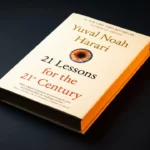
That’s exactly what 21 Lessons for the 21st Century tackles. And let me tell you — it’s the most uncomfortable of the three. Because instead of looking back at history or speculating about tomorrow, Harari holds up a mirror and says, “Look at the mess you’re in RIGHT NOW.”
The Stories We Live By
This is where Harari really shines. The central thesis running through the book is that humans are storytelling creatures. We don’t just live in the physical world — we live inside narratives. Religion, nationalism, capitalism, communism — these are all STORIES. Fictions we collectively agreed to believe in because they help us cooperate at scale.
But here’s the problem. The big stories of the 20th century are crumbling. Communism collapsed. Liberal democracy is under strain everywhere. And even capitalism — the supposed winner — is producing levels of inequality that are getting harder and harder to ignore.
Harari doesn’t pick a side. He simply points out that none of these narratives have a good answer for the challenges of the 21st century — artificial intelligence, bioengineering, and the potential rise of a “useless class” of humans who have been automated out of relevance.
The Useless Class
This was the chapter that hit me hardest. Harari argues that as AI and automation advance, we won’t just lose blue-collar jobs — we’ll lose white-collar ones too. Doctors, lawyers, accountants, even marketers. Algorithms are getting better at pattern recognition than humans, and they don’t need sleep or salary.
So what happens when MILLIONS of people have nothing economically useful to contribute? What do you do with a population that the economy simply doesn’t need?
As someone who builds businesses online, this chapter made me pause. I’ve spent years learning digital marketing, copywriting, building systems — skills I thought were future-proof. Harari’s argument is that NO skill is future-proof. The only real strategy is constant reinvention. Keep learning, keep adapting, and never assume that what works today will work in ten years.
Religion Gets Dismantled
This is where the book got REALLY interesting for me. Harari routinely dissects and dismantles religious worship — not with hostility, but with cold, surgical logic. He doesn’t say religion is evil. He says it’s outdated as a framework for solving modern problems.
Can the Bible tell you how to regulate genetic engineering? Can the Quran guide policy on artificial intelligence? Can any ancient text help us navigate a world where algorithms know you better than you know yourself?
The answer, according to Harari, is no. And he makes a compelling case. These texts were written for a world of farms, swords, and plagues — not a world of server farms, drones, and data mining. The moral frameworks are still valuable in some ways, but they’re completely unequipped for the dilemmas we’re about to face.
Nationalism vs. Global Problems
Another fascinating section deals with nationalism. Harari acknowledges that nationalism served a purpose — it helped organize large groups of strangers into functioning societies. But the biggest challenges of the 21st century are GLOBAL. Climate change, nuclear war, technological disruption — none of these respect borders.
You can’t solve climate change with a nationalist mindset. You can’t regulate AI country by country when the technology is borderless. Yet here we are, retreating further into tribal identities at the exact moment we need more cooperation, not less.
Having traveled to dozens of countries, I see this tension everywhere. People want to feel like they belong to something — a nation, a culture, an identity. But the problems we face don’t care about your passport. That contradiction is one of the defining struggles of our time, and Harari nails it.
Meditation and Self-Knowledge
Here’s what surprised me most. The final chapter is about meditation. Harari is a Vipassana practitioner — he does a 60-day silent retreat EVERY YEAR. And his argument is that in a world full of noise, manipulation, and algorithmic influence, the most radical thing you can do is sit still and observe your own mind.
As someone who meditates daily, this chapter felt like validation. In a book full of geopolitics, economics, and technology, Harari ends by saying: if you don’t understand your own mind, you have no chance of understanding the world. Your monkey-brain will get hijacked by every algorithm, advertisement, and politician competing for your attention. I couldn’t agree more.
A Few Caveats
The first few chapters on technology and work didn’t quite grab me. They felt like retreads of ideas Harari already explored more thoroughly in Homo Deus. The book also jumps between topics quickly — terrorism, fake news, immigration, education — and some chapters feel more like extended essays than connected arguments.
But that’s partly the point. These are 21 separate lessons, not one continuous narrative. Once I accepted that structure, the book clicked.
Final Thoughts
If Sapiens made you rethink the past and Homo Deus made you rethink the future, 21 Lessons will make you rethink the present. It’s not the strongest of the trilogy — Sapiens still holds that crown — but it’s the most immediately relevant. Every chapter forces you to confront something you’d rather not think about.
Harari doesn’t give you easy answers. He gives you better questions. And in a world drowning in confident idiots who have all the answers, that’s exactly what we need.
A+ — highly recommended, especially if you’ve already read the first two books in the trilogy.
Thanks for reading.
— Leonidas
