
“As we care about more of humanity, we’re apt to mistake the harms around us for signs of how low the world has sunk rather than how high our standards have risen.”
Is it hard to believe that everything in the world is getting better, day by day? That fewer people are dying of disease, war, and poverty than at any point in human history? That life expectancy is climbing, literacy is spreading, and extreme poverty is collapsing?
If you watch the news, absolutely none of that sounds right. But Steven Pinker doesn’t care about your feelings. He cares about the DATA.
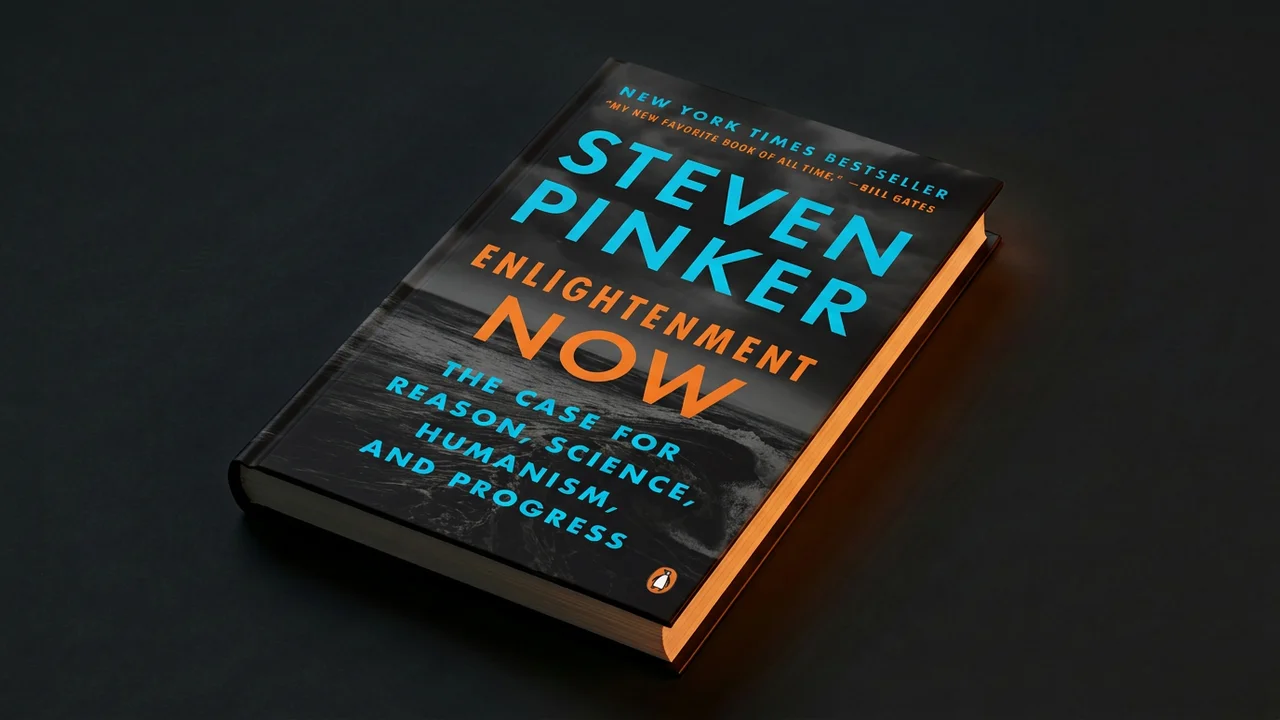
I would typically write a lengthy review, summarizing all of the points in this book. But times have changed, and I’m no longer in the mood to do that. Instead, I want to tell you why this book matters — and why it’s essentially the sequel that The Better Angels of Our Nature deserved.
The Sequel We Needed
I reviewed Pinker’s first big book, The Better Angels of Our Nature, and gave it a 5/5. That book focused on one thing: the decline of violence throughout human history. It was massive, data-heavy, and genuinely eye-opening.
Enlightenment Now takes that same approach and applies it to EVERYTHING else. Health, wealth, safety, peace, knowledge, happiness, the environment — Pinker tackles all of it. And his argument is the same: things are getting better, and the reason they’re getting better is because of Enlightenment values — reason, science, humanism, and progress.
In summary, statistically speaking, things are getting better. Just like his first book, The Better Angels of Our Nature, things are improving, despite the “availability bias” of bad and shocking news that’s sometimes never-ending on TV.
The Numbers Don’t Lie
Pinker throws chart after chart at you. Life expectancy? Up. Child mortality? Down. Famine? Almost nonexistent in the modern world compared to a century ago. Literacy? Through the roof.
Nevertheless, Steven Pinker pinpoints how, on a global scale (not just with America, as most books tend to cover all the time), things are getting better, both physically (live longer, relatively healthier, etc.) and existentially (people are relatively becoming happier and have more spare time).
One of the most powerful sections is about extreme poverty. Two centuries ago, roughly 90% of the world’s population lived in what we would now call extreme poverty. Today? It’s under 10%. That’s an INSANE improvement that almost nobody talks about. Why? Because gradual progress doesn’t make headlines. A plane that lands safely isn’t news.
Why We Think Everything Is Terrible
This is the part of the book that hit closest to home for me. Pinker explains that our brains are wired for negativity. We evolved to pay attention to threats — that’s what kept our ancestors alive. Our monkey-brains scan for danger constantly, and the modern news media exploits that instinct like a drug dealer exploits addiction.
Every single day, the news presents you with the worst things happening across the entire planet. Murders, wars, natural disasters, political chaos. And because you’re seeing ALL of it, compressed into a 24-hour news cycle, your brain concludes that the world is falling apart.
But here’s the thing — the world isn’t falling apart. You’re just being shown all the falling-apart parts. The 99% of humanity quietly going about their improving lives doesn’t get a segment on CNN.
I think about this every time I travel. I’ve been to dozens of countries, and what strikes me again and again is how NORMAL most of the world is. People going to work, raising families, building things. The apocalyptic narrative just doesn’t match reality on the ground.
Enlightenment Values — The Engine of Progress
Pinker’s core thesis is that the progress we’ve made isn’t accidental. It’s the direct result of Enlightenment thinking — the idea that we should use reason and evidence to solve problems, rather than relying on tradition, superstition, or authority.
Science gave us vaccines, sanitation, and agricultural revolutions. Humanism gave us human rights, democracy, and the abolition of slavery. Reason gave us the ability to question bad ideas instead of just accepting them.
And these aren’t just Western ideas — Pinker shows that as Enlightenment values spread globally, the improvements follow. Countries that embrace education and evidence-based policy do better on virtually every measure of well-being.
Where Pinker Gets Pushback
Now, I’m not going to pretend this book is perfect. Pinker has his critics, and some of their points are valid. The biggest one? He can come across as dismissive of real suffering. When you’re throwing charts showing everything is great, it can feel tone-deaf to people dealing with poverty, inequality, or systemic injustice RIGHT NOW.
But I think that’s a misread of his argument. Pinker isn’t saying everything is perfect — he’s saying things are BETTER than they used to be, and the tools that got us here (science, reason, humanism) are the same tools that will keep pushing us forward. Acknowledging progress doesn’t mean ignoring problems. It means having the confidence that problems CAN be solved.
It’s a long book, and sometimes can drone on, but it covers everything that needs to be covered, extensively.
The Optimism Shelf
If you’ve read The Rational Optimist by Matt Ridley or Factfulness by Hans Rosling — both of which I’ve reviewed — this book fits right on the same shelf. They all make the same fundamental point: the world is getting dramatically better, and most people have no idea.
But Pinker goes deeper than the others. He doesn’t just show you the data — he explains WHY progress happens and ties it to a philosophical framework. That makes it feel more substantial than a collection of optimistic statistics.
Final Thoughts
Look, I get it. Optimism about the world can sound naive. Especially when you open Twitter and it feels like civilization is on fire. But that’s exactly why books like this matter. They force you to zoom out, look at the long arc of history, and realize that the trajectory is overwhelmingly positive.
Pinker doesn’t ask you to ignore problems. He asks you to believe that problems are solvable — because historically, we’ve solved an incredible number of them. And the approach that works best? Reason, science, and genuine concern for human well-being.
If The Better Angels of Our Nature convinced me that violence has declined, Enlightenment Now convinced me that EVERYTHING ELSE is following the same trend. It’s one of the most important books I’ve read on how to think about the world.
A+ book.
Thanks for reading.
— Leonidas
