
“Between stimulus and response there is a space. In that space is our freedom and our power to choose our response. In our response lies our growth and our freedom.”
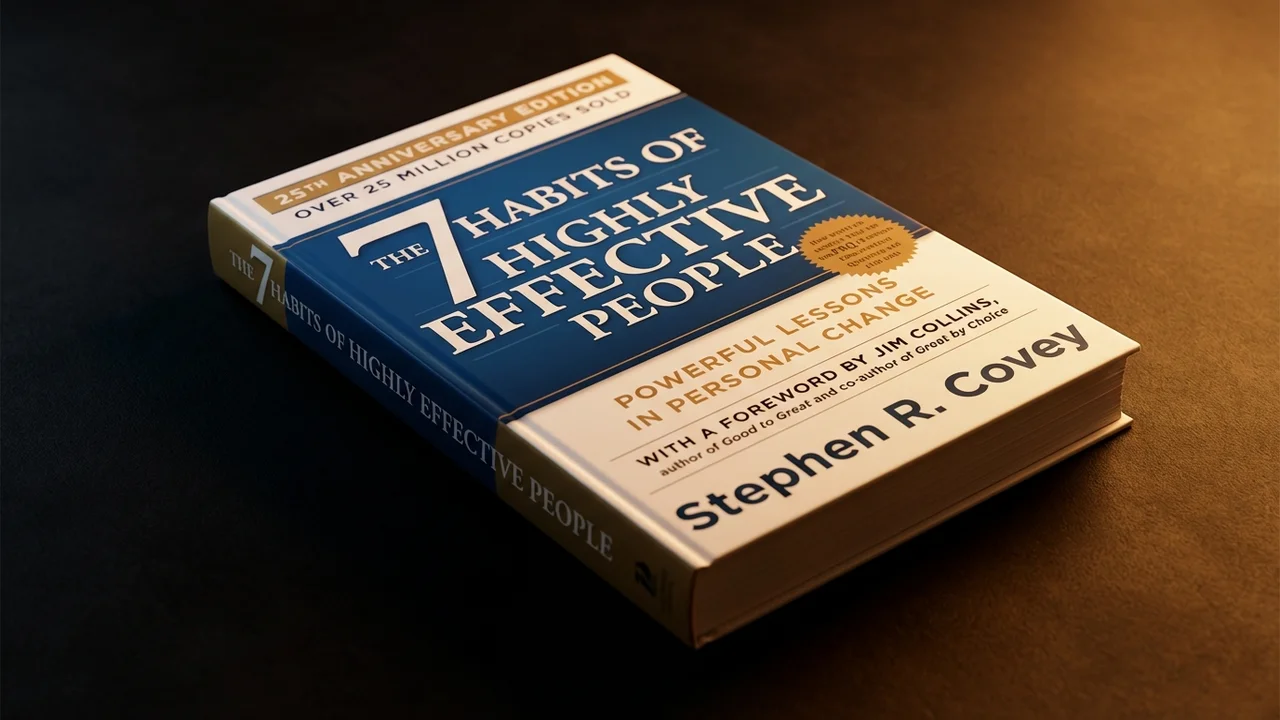
I listened to this one as an audiobook while driving to work. Back and forth, chapter by chapter, letting Covey’s ideas marinate during highway commutes. And I’ll be honest — I went in thinking this was going to be another generic self-help book full of platitudes and motivational fluff.
I was wrong.
This book has been around since 1989. It has sold over 25 million copies. And yet, most people I know who “know about” the 7 habits can barely name three of them. That tells you something. People treat this book like a checkbox — “Yeah, I’ve heard of it” — without ever actually ABSORBING what Covey is teaching. Which is a shame, because the principles in here are more relevant now than ever.
The 7 Habits
For reference, here they are:
- Be Proactive
- Begin with the End in Mind
- Put First Things First
- Think Win-Win
- Seek First to Understand, Then to Be Understood
- Synergize
- Sharpen the Saw
Covey structures these from the inside out. Habits 1–3 are about personal independence — mastering yourself. Habits 4–6 are about interdependence — working with others effectively. And Habit 7 ties it all together as a renewal principle. It’s a framework, not a list of tips. And that distinction MATTERS.
Be Proactive — Own Your Responses
This is where it all starts. Covey draws a sharp line between reactive people and proactive people. Reactive people let circumstances dictate their emotions and actions. Proactive people recognize that gap between stimulus and response — and they CHOOSE how to act.
I think about this every single day. In business, in relationships, in traffic — the moment you realize you have a choice in how you respond to anything, your entire life changes. Most people walk around on autopilot, reacting to the world like pinballs bouncing off bumpers. Covey says: stop that. You’re not a pinball.
Begin with the End in Mind
This one is deceptively simple. Covey asks you to imagine your own funeral. What do you want people to say about you? What do you want to be remembered for? Then work backwards from there.
It sounds morbid, but it’s incredibly powerful. Most of us are so busy climbing ladders that we never stop to ask if the ladder is leaning against the RIGHT wall. I’ve seen this in my own life — chasing goals that looked impressive on paper but meant absolutely nothing to me on a deeper level. This habit forces you to define what success actually looks like for YOU, not for Instagram.
Put First Things First
Here’s where Covey introduces his famous time management matrix — urgent vs. important. Most people spend their lives bouncing between urgent tasks and mindless distractions. The real magic happens in Quadrant II: things that are important but NOT urgent. Planning. Relationship building. Exercise. Learning. Personal development.
This is the habit that separates people who are busy from people who are EFFECTIVE. And as someone who has spent years in internet marketing — an industry that practically worships urgency — this was a wake-up call. Not everything that screams for your attention deserves it.
Think Win-Win
Covey isn’t naive about this. He doesn’t mean “be nice and let people walk all over you.” He means seek solutions where everyone benefits — and if you can’t find one, walk away. No deal is better than a bad deal.
I’ve used this framework in business negotiations more times than I can count. The moment you shift from “how do I win?” to “how do WE win?” — the entire dynamic changes. People open up. Trust builds. And ironically, you end up getting MORE than you would have by being cutthroat.
Seek First to Understand
This is the listening habit, and it might be the hardest one to practice. Most of us listen with the intent to REPLY, not to understand. We’re formulating our response while the other person is still talking. Covey calls this “autobiographical listening” — filtering everything through your own experience instead of genuinely hearing the other person.
Honestly, this habit alone is worth the price of the book. If you can truly master empathic listening — understanding someone else’s frame of reference before inserting your own — you will be better at EVERY human interaction. Sales, management, friendships, marriage. All of it.
Synergize & Sharpen the Saw
Synergy is Covey’s way of saying that collaboration — real collaboration, not the corporate buzzword version — produces results greater than the sum of individual efforts. When people with different strengths come together with mutual respect and creative openness, the outcomes can be extraordinary.
And then there’s Habit 7 — Sharpen the Saw. This is about continuous renewal in four dimensions: physical, mental, social/emotional, and spiritual. You can’t keep chopping wood with a dull axe. You have to stop, sharpen, and then get back to work. Exercise. Read. Meditate. Connect with people who matter. This isn’t optional — it’s the foundation that makes all the other habits sustainable.
As someone who believes in perpetual self-improvement, this habit resonated with me the most. It’s the meta-habit. The habit of maintaining ALL the other habits.
Final Thoughts
What I appreciate most about Covey is that he’s more “to the point” than most self-help authors. Variable amounts of storytelling, yes, but the directives are clear and actionable. He doesn’t drown you in anecdotes for pages on end — he states the principle, illustrates it, and moves on.
Is this the most exciting book you’ll ever read? No. It’s not designed to be. It’s designed to be a MANUAL for living with intention and integrity. And manuals aren’t thrilling — they’re useful. This book is supremely useful.
I would definitely recommend this for perpetually self-improving individuals. If you’re the type of person who reads, reflects, and actually tries to get better every day, this is essential reading. The 7 habits aren’t revolutionary in isolation — but as a SYSTEM, they’re one of the most complete personal effectiveness frameworks ever written.
4/5 — a classic that earns its reputation.
Keep sharpening the saw.
— Leonidas
