
“Abundance is not about providing everyone on this planet with a life of luxury—rather it’s about providing all with a life of possibility.”
Is it hard to believe that everything in the world is getting better, day by day? Most people would say no. Turn on the news and it’s all doom — wars, recessions, pandemics, climate disasters. Our monkey-brains are wired to focus on threats, not progress. That’s how we survived the savanna. But it’s also why we’re TERRIBLE at seeing the bigger picture.
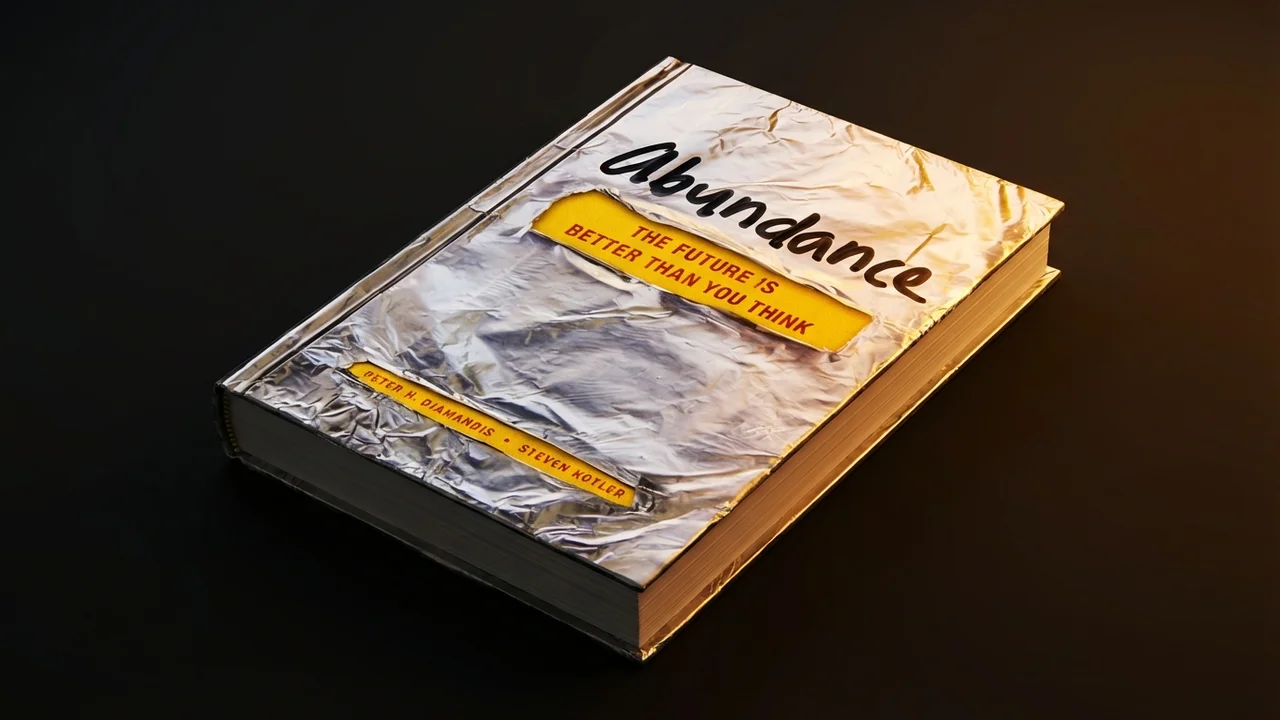
Peter Diamandis and Steven Kotler wrote Abundance to smack that pessimism right out of you. And honestly? It worked on me.
So here’s the good news. Things will continue to get better. Maybe not for you, if your life already sucks because you think it sucks. But generally, for the human race, it will only get better and better.
If you are reading this, then you probably live in a pretty great reality. You have practically everything you need to live, prosper, and win at life.
Exponential Technology
Technology itself will continue on an exponential growth curve as it has for the last few decades. Costs decrease, performance increases, and everyone continues to win more and more. Your iPhone or Android is about 1,000 times more powerful than a computer from even 30 years ago.
Furthermore, computers are thinking, doing, and even creating. You will eventually have a robot nurse taking care of you when you are frail and old. But then again, they will also eventually take your job as well.
The key insight is that humans are LINEAR thinkers living in an EXPONENTIAL world. We can’t intuitively grasp how fast things are moving. We look at today and project forward in a straight line, when in reality, the line is bending upward at an insane rate.
Think about it. Twenty years ago, a decent GPS unit cost over a thousand dollars. Now it’s free on your phone. A high-definition camera used to require thousands in equipment. Now every teenager has one in their pocket. This pattern — expensive technology becoming essentially free — is not slowing down. It’s accelerating.
The Rising Billions
But what is really changing is the remaining billions of people who have nothing, or close to nothing, and will eventually be eating like you, partying like you, buying iPhones like you, driving nice cars, and everything else in between. These are the real winners in the abundance equation.
Asia is one of the most amazing examples of this phenomenon. Apparently, Shanghai is now even more status-driven and materialistic than Las Vegas.
And with several billion people in Asia all buying, consuming, creating, and living longer, that is where abundance is really displayed.
Couple this with the internet, and they will eventually be smarter and more dedicated than you — these rising billions.
This is the part of the book that really hit me. When you connect the next few billion people to the internet, you’re not just giving them access to cat videos. You’re giving them access to ALL of human knowledge. Every textbook, every lecture, every piece of open-source code. And out of those billions, there are going to be MILLIONS of geniuses who never had a shot before. Imagine the innovations that come from that.
Diamandis and Kotler argue that this is the single biggest force multiplier in human history. Not governments. Not charities. The simple act of connecting people to information and to each other. That’s abundance in its purest form.
Energy, Education, and Health
Green and sustainable energy will continue to evolve, education will continue to become more personalized and better, healthcare technology will make you live longer than you really need to, and freedom will supposedly be granted to the masses.
The education section was particularly interesting to me. As someone who has always been skeptical of traditional education — I’ve said it before and I’ll say it again, the best education I ever got was from BOOKS, not classrooms — the idea that technology is democratizing learning is incredibly exciting. Khan Academy, Coursera, YouTube tutorials — these platforms are doing more for global education than most universities combined. And they’re free.
On health, the book paints a picture where diagnostics become cheaper, treatments become more precise, and diseases that currently kill millions get wiped out the same way smallpox was. Is it optimistic? Sure. But the trajectory is there if you look at the data instead of the headlines.
The DIY Innovators
One chapter that stuck with me was about DIY innovators and small teams doing what used to require massive corporations. Diamandis calls them “techno-philanthropists” — dedicated individuals who can now leverage exponential technology to solve problems that governments and big institutions have failed at for decades.
This resonated with me as an entrepreneur. The barrier to entry for EVERYTHING is dropping. You don’t need a publishing house to write a book. You don’t need a record label to release music. You don’t need a billion-dollar budget to launch a satellite. The tools are becoming accessible, and that changes the game entirely.
The Catch
One thing is for certain: abundance is great as a principle for humanity. Everyone deserves more, and luckily, all of these technologies, ideas, and freedoms are being spread very quickly.
Unfortunately for you, that means you need to work harder now, because sooner rather than later, there will be 10,000 others who are more dedicated than you, more skilled than you, and more driven than you. And they will want the same freedoms as you.
That’s the part Diamandis doesn’t dwell on too much, but it’s worth thinking about. Abundance for humanity is fantastic. But abundance also means MORE competition, more noise, and more pressure to stand out. The rising tide lifts all boats — but you still have to row.
Final Thoughts
If you read my review of The Rational Optimist by Matt Ridley, you know I’m already wired to believe the world is getting better. Abundance takes that thesis and supercharges it with data, technology roadmaps, and real-world examples that are hard to argue with.
Is the book a bit TOO optimistic at times? Maybe. Diamandis is a futurist and an entrepreneur, so his natural bias leans toward techno-utopianism. But even if you discount half of his predictions, the remaining half is still incredibly exciting.
If pessimism is your default setting, read this book. It won’t turn you into a naive optimist, but it might recalibrate your sense of what’s actually possible. 4/5
Thanks for reading.
— Leonidas
