
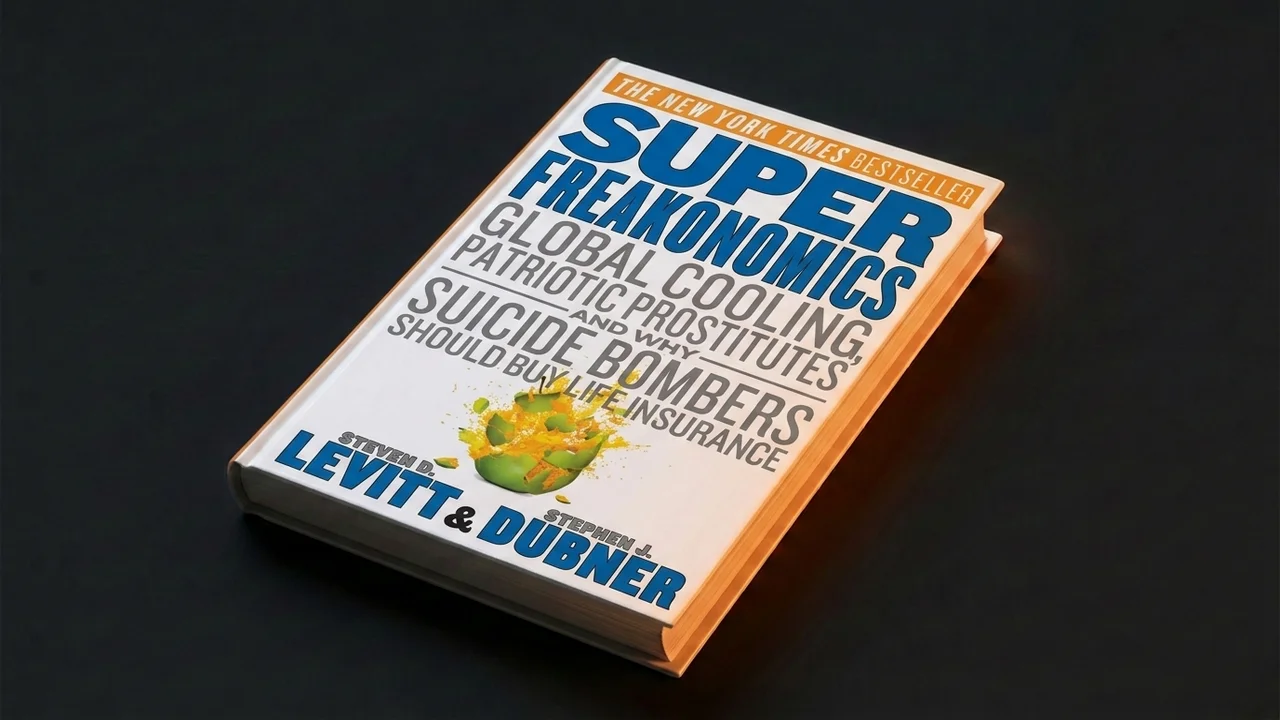
“People are people, and they respond to incentives.”
I devoured the first Freakonomics. Loved it. It was the kind of book that quietly rewires how you look at everyday life, where the incentives behind real estate agents and crack dealers suddenly snap into focus.
So the moment I turned the last page, I ordered the sequel. No hesitation.
Did it live up to the original? Mostly. But this one is messier, and I want to be honest about why.
What This Book Is Actually About
If you have never read either book, here is the one-sentence pitch. An economist and a journalist team up to point the cold tools of economics at the strange corners of everyday life, the stuff nobody usually measures.
Levitt is the data guy. Dubner is the storyteller. The whole franchise lives on that tension between hard numbers and good narrative.
The thesis never changes across either book. People respond to incentives, and once you find the real incentive (not the one people claim drives them), the world gets a lot easier to read. SuperFreakonomics just aims that lens at sex, money, charity, terrorism, and the weather.
The Prostitution Chapter Is the Star
The opening chapter on the economics of prostitution is easily the juiciest part of the book.
Levitt and Dubner dig into a street-level study of Chicago sex workers and treat the whole thing like any other labor market. Supply, demand, pricing, seasonal spikes. They even look at why the trade pays less than it used to, and what that says about how the world has changed.
It is the franchise at its best: taking something most people only moralize about and asking the cold, useful question instead. What are the actual incentives here?
The detail that stuck with me is the seasonal pricing. Demand spikes around big holidays and local events, so part-time workers flood in to catch the surge, exactly like any retailer hiring extra hands for the rush.
As someone who has spent years in business and marketing, that hit home. Pricing power, supply gluts, demand spikes. The same forces that move ad costs and product margins move this market too. Strip away the taboo and it is just a market, and markets behave the way markets always behave.
Monkeys Invent Money (and Then Sin)
The other standout is the closing chapter on capuchin monkeys.
Researchers taught the monkeys to use small coins as currency. Within no time the monkeys figured out theft, hoarding, and (I am not making this up) the first recorded act of monkey prostitution, a male trading a coin for sex.
Why did I love it? Because it lands the book’s entire thesis without a single graph. Incentives are not some human invention layered on top of civilization. They are baked deep into the brain, ours and theirs. Give a creature money and watch the oldest behaviors come roaring back.
There is a darker echo here too. The monkeys also showed loss aversion, hating a loss far more than they enjoyed an equal gain, the exact bias that wrecks human investors. We did not learn that from spreadsheets. It is older than language, older than our species. That is a genuinely unsettling thing to sit with.
A Jumble of Ideas Stitched Together
Here is my main gripe. Everything between those two chapters felt like a pile of loosely related ideas forced into a narrative.
My honest suspicion? It reads like the authors gathered a stack of their best blog posts and tried to weave a cohesive thread through them after the fact. In several chapters I genuinely lost the plot, simply because of how many stories and tangents were getting thrown at me at once.
The first book had a gravitational center. This one sometimes feels like channel surfing.
I do not think that makes it a bad book. It makes it an uneven one. There is a difference, and the difference matters when you are setting expectations before you buy.
The Altruism Chapter Surprised Me
One section I did not expect to enjoy was the takedown of altruism experiments.
For years, lab studies suggested people are naturally generous, happily sharing money with strangers in controlled games. SuperFreakonomics pokes holes in that warm story. Tweak the experiment, remove the feeling of being watched, and the generosity quietly evaporates.
The point lands hard. A lot of what looks like kindness is really a response to being observed. We perform decency. I have watched this play out in business more times than I can count, where people behave beautifully when the deal is public and very differently when nobody is looking.
It is a cynical read, sure. But it is also the kind of honest, uncomfortable conclusion the franchise was built to deliver.
The Global Warming Detour
The weakest chapter, by a mile, is the one on global warming.
I expected the usual treatment: cold data, surprising correlations, a counterintuitive conclusion backed by numbers. Instead it reads more like an editorial profile of one clever guy and his pet idea for cooling the planet, with a little economics sprinkled on top for flavor.
The pitch is geoengineering, essentially a long hose pumping sulfur into the upper atmosphere to mimic a volcanic eruption and dim the sun a touch. Clever and cheap on paper. The chapter sells it with the breathless energy of a startup pitch deck rather than the careful skepticism the rest of the book wears so well.
And here is the kicker. Almost two decades later, nothing really came of that idea. It got quietly shoved into the “would be nice” bin once the research caught up. For a book that sells itself on rigorous, contrarian analysis, this chapter felt like the one place the rigor went missing.
It is a useful lesson in its own right. Being contrarian is not the same as being right. Sometimes the consensus is boring because the consensus is correct.
Haven’t I Read This Before?
A few chapters also felt rehashed, like I had already met them in other books.
The Kitty Genovese story is one. You probably know the version where a woman is murdered in New York while dozens of neighbors watch and do nothing. The authors revisit it with a fresh angle, showing that the famous tale was partly myth, and that part genuinely was interesting to read.
The seatbelt chapter is another. How a simple strap ended up saving enormous numbers of lives, and how fiercely people resisted the idea of being made safer. Useful, but familiar.
None of it is bad. It just did not feel as fresh and dangerous as the first book did.
The One Idea Worth Stealing
If you take a single thing from this book, make it this. The cheap fix usually beats the heroic one.
Over and over, the authors show that the elegant, simple, almost embarrassingly small solution outperforms the grand, expensive, virtuous one. A few cents of intervention can save more lives than a billion-dollar program.
That idea has stuck with me far longer than any single chapter. In business, in health, in policy, the instinct is always to do something big and visible. SuperFreakonomics keeps whispering the opposite. Look for the lever almost nobody is pulling, the one that costs next to nothing, and pull that instead.
Final Thoughts
SuperFreakonomics is a good book carrying the weight of a great one before it. The high points (prostitution and the money-grubbing monkeys) are worth the price of admission on their own. The low points sag because the original set the bar so high.
Read it for the way it trains your brain to spot the hidden incentive in everything. That skill outlasts any individual chapter, and it is the real gift of this franchise.
I give it a solid 4 out of 5. If you loved the first Freakonomics, read this too. Just go in expecting a sequel, with all the unevenness that word implies, rather than a second lightning strike.
Thanks for reading.
— Leonidas
