
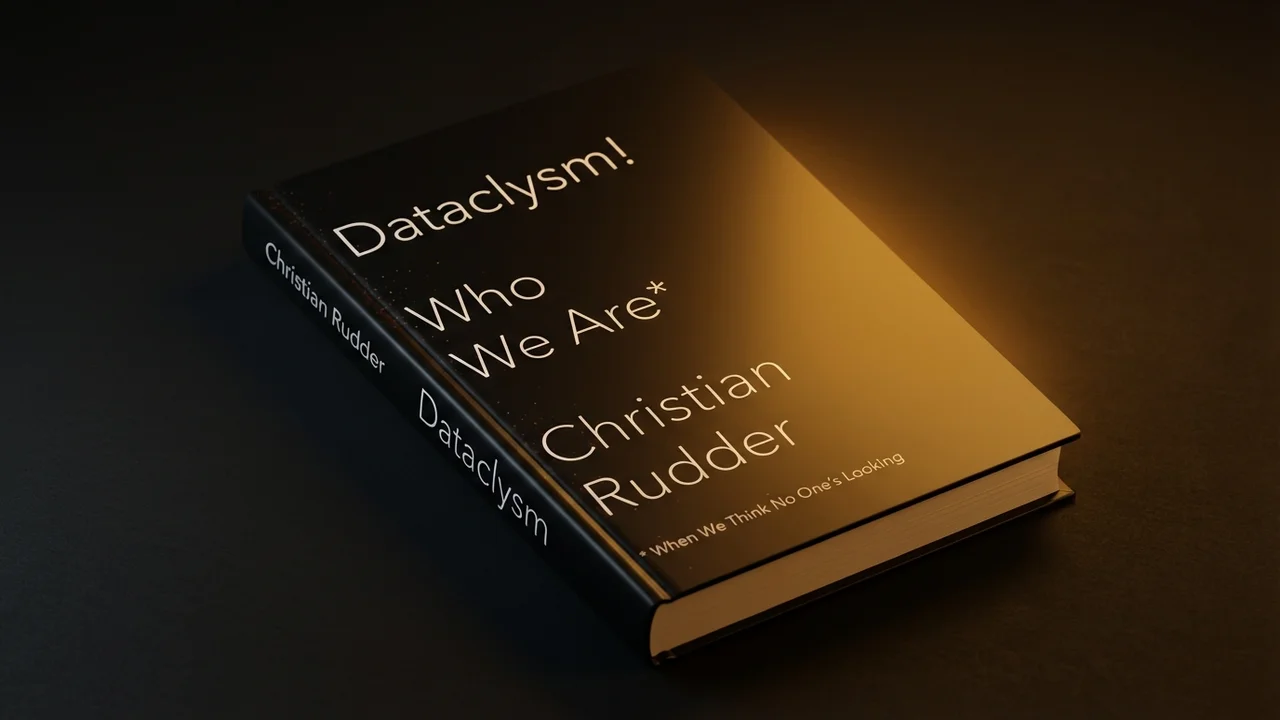

“Digital data can now show us how we fight, how we love, how we age, who we are, and how we’re changing. All we have to do is look.”
What does everything you do on the internet really say about you? More specifically, what does it say about our society? That is what Dataclysm answers from the perspective of dating websites and various social media.
Christian Rudder is one of the co-founders of OKCupid, and this dude had access to MILLIONS of data points on human behavior — what people click on, who they message, what they lie about, and what they secretly desire when they think no one is watching. The result is a book that reads like a psychology experiment meets a confessional booth.
I picked this up because I’ve always been fascinated by the gap between what people SAY they want and what they actually DO. And if there’s one thing online data reveals with brutal clarity, it’s that gap.
Online Dating Insights
Let’s take, for example, online profiles. When OKCupid decided to experiment by hiding everyone’s profile images, suddenly response rates from males and females shot up — an online version of a blind date. Yet, bring those profile images back, and within one to three messages, most of the conversations died off. Further analysis showed that people are mostly interested in your perceived online looks rather than what you write in your profile.
Think about that for a second. People KNOW they should care about personality, shared interests, compatibility — all the stuff we tell ourselves matters. But the moment a photo appears, monkey-brain takes over and everything else goes out the window.
Furthermore, men of all ages found women of 21 to be most attractive. Despite this, men will message women within their own age range. Women, on the other hand, found men who were slightly older than them most attractive.
Apparently, copy-and-pasting canned messages was most effective when considering time versus performance benefits, despite being one of the most impersonal approaches you could take.
There’s something almost depressing about that. The most efficient way to get a date online is to NOT personalize your messages. Yet every dating coach in the world tells you to write something unique. The data says otherwise — volume beats quality. Whether you like it or not, the numbers don’t lie.
What People Lie About
One of the most entertaining sections is about what people misrepresent on their profiles. Men add about two inches to their height. Women subtract about eight pounds from their weight. People round their income up to the nearest impressive-sounding bracket.
None of this is surprising, but seeing it laid out in actual data — across HUNDREDS OF THOUSANDS of profiles — hits differently than just suspecting it. We are all performing a slightly polished version of ourselves online. The data just confirms it at scale.
And here’s the kicker — Rudder shows that the people who are most “honest” in their profiles actually get fewer messages. The game rewards exaggeration. That tells you something about human nature that no self-help book ever will.
Race, Attraction, and Uncomfortable Truths
The book dived into which ethnic backgrounds were most attracted to each other, while certain ethnic background and gender combinations were either the most attractive across the board or least attractive to all.
This is the section that probably made the most people uncomfortable — and rightfully so. Rudder presents the data without sugarcoating it, and the patterns are stark. Racial preferences in dating are REAL, they are measurable, and they persist even among people who explicitly claim to have no racial preference.
It’s the classic disconnect between stated preferences and revealed preferences. What you check on a survey versus what you actually do when swiping through profiles at 11 PM on a Tuesday — two completely different things.
Racism, Trolling, and Reputation
Then the phenomenon of racism. According to Google search data, certain states in the U.S. show higher searches for racially charged terms. Yet, there is a huge statistical drop after Obama was elected.
Did attitudes actually change, or did people just become more careful about what they search for? Rudder raises this question and doesn’t pretend to have a definitive answer. But the data suggests that cultural shifts — even symbolic ones like a presidential election — can alter behavior at a measurable level. That’s powerful.
Viral internet trolling was another interesting observation. If you decide to write something offensive on social media, expect to be virally trolled and threatened by just about everyone who may hate themselves and decide to exert their energy onto you. After the trolling is complete, the “horde” moves quickly onto the next victim or quickly dissipates into nothingness.
This was written in 2014, and it’s only gotten WORSE since then. The mob mentality online is essentially a digital version of pitchfork-wielding villagers from centuries ago. Same instinct, different tools.
Finally, a slight tangent talks about “being your own brand.” This relates to not messing up your online image, because once you mess it up, reputation management does not come cheap. And everything you do online is permanent.
The Bigger Takeaway
What I appreciated most about Dataclysm is that Rudder doesn’t moralize. He doesn’t tell you what you SHOULD do with this information. He just holds up a mirror and says, “Here’s what the data shows about who we are.” And sometimes that mirror is unflattering.
As someone who’s spent years in internet marketing, I found the underlying lesson incredibly relevant. Data doesn’t care about your feelings or your brand messaging. It reveals what people actually want, not what they say they want. And if you can learn to read that gap — between stated intent and actual behavior — you have a massive advantage in business and marketing.
Final Thoughts
The book does have its flaws. Some sections feel like extended blog posts rather than proper chapters, and Rudder occasionally goes on tangents that don’t quite land. But the core material is fascinating.
If you’re into behavioral science or just want to understand why people behave the way they do online, this is well worth your time. It pairs nicely with books like Predictably Irrational and Social — both of which I’ve reviewed and both explore the irrational side of human decision-making.
I would recommend this book to sociology enthusiasts seeking interesting observations based on a data-driven approach.
3.5/5 — Good, insightful, and occasionally eye-opening. Not a must-read, but a solid pick for anyone curious about what the internet reveals about human nature.
Thanks for reading.
— Leonidas
