

“Narratives are major vectors of rapid change in culture, in zeitgeist, and in economic behavior.”
Have you ever noticed how a single STORY can move an entire economy?
Not data. Not policy papers. Not central bank announcements. A story. A narrative that spreads from person to person — at the dinner table, on social media, on the news — until suddenly millions of people are making the same financial decision at the same time, and nobody can fully explain why.
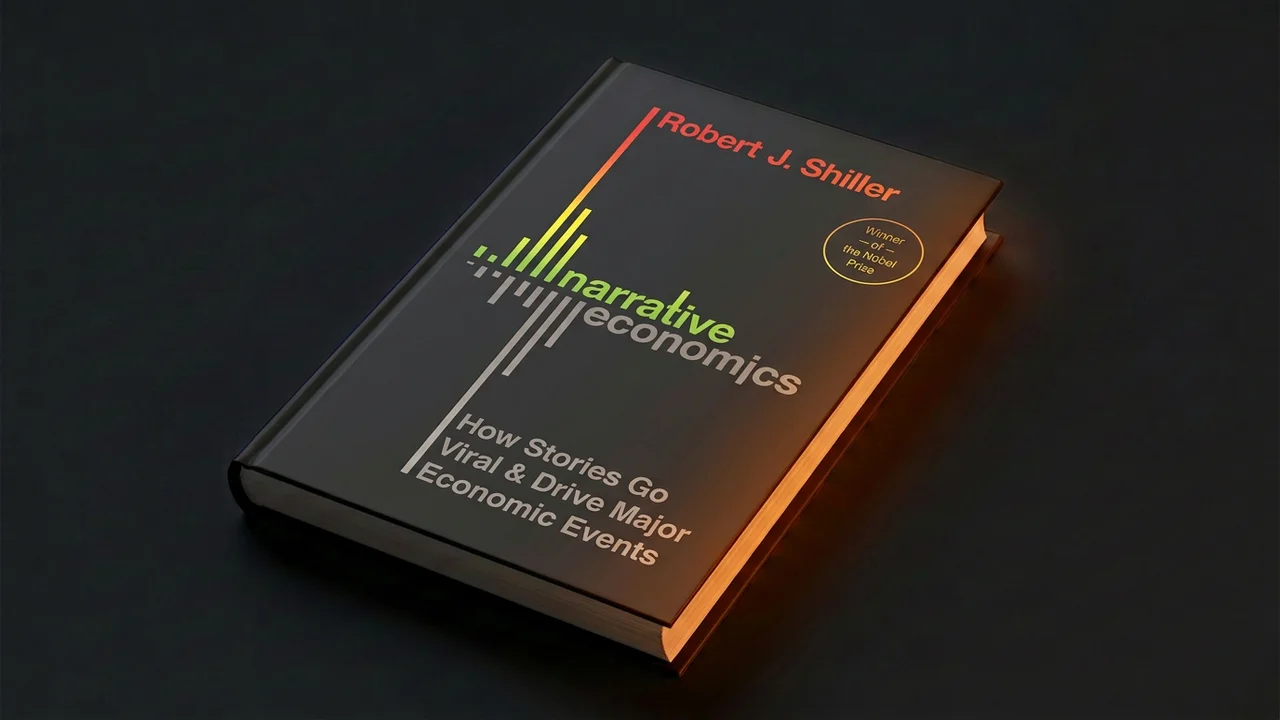
That’s the thesis of Narrative Economics by Robert Shiller — Nobel Prize-winning economist and the guy who predicted both the dot-com crash and the housing bubble. When this dude talks about how markets work, you listen.
The Big Idea
Shiller’s core argument is deceptively simple: economic events — recessions, bubbles, panics, booms — are driven not just by fundamentals, but by the stories people tell each other. These narratives go viral, just like a disease, spreading through populations and shaping how people spend, save, invest, and panic.
Think about it. The 2008 housing crisis wasn’t just about subprime mortgages and CDOs. It was fueled by a NARRATIVE — “housing prices always go up.” That story spread for years. Your neighbor believed it. Your uncle believed it. Your barber believed it. And because everyone believed the same story, they all acted on it. They bought houses they couldn’t afford, banks lent money they shouldn’t have, and the whole thing collapsed when reality caught up with the fiction.
Shiller treats narratives the way epidemiologists treat viruses. They emerge, they spread, they mutate, they peak, and eventually they fade — only to resurface years later in a slightly different form. He literally uses contagion models to map how economic stories move through society. It’s brilliant.
Narratives That Shaped History
The book walks through several major economic narratives and shows how they drove real-world behavior. The “machines are taking our jobs” panic? That’s been going viral since the 1810s. Every generation has its own version — the Luddites smashing looms, factory workers fearing robots, and now everyone freaking out about AI replacing white-collar jobs.
Same narrative, different technology. Same fear, different century.
He also covers the gold standard narrative, the real estate boom-and-bust cycle, the “stocks for the long run” story that fueled the dot-com bubble, and the austerity vs. stimulus debate. Each one follows the same pattern — a compelling story takes hold, drives collective behavior, and the economic consequences are MASSIVE.
What I found especially fascinating was how narratives mutate. A story that starts as genuine concern about automation gets twisted into political ammunition. A housing success story in one city gets amplified into a nationwide mania. The narrative evolves as it spreads, picking up emotional weight and losing factual precision along the way.
Why Economists Keep Getting It Wrong
This is where Shiller really sticks the knife in. Traditional economics largely ignores narratives. Models are built on “rational expectations” and hard data — interest rates, GDP, employment figures. But those models consistently FAIL to predict the biggest economic events.
Why? Because they leave out the human element. They leave out the stories.
Shiller argues that if economists actually tracked viral narratives the way they track inflation, they’d have a much better shot at predicting recessions and bubbles. It’s a radical idea — essentially saying that the field of economics has been ignoring one of the most powerful forces in the economy: human storytelling.
As someone who’s spent years in internet marketing, this resonated deeply with me. I’ve SEEN how narratives drive behavior. A good story sells more than a good product. A compelling angle moves more inventory than a better price. The marketing world figured this out decades ago — Shiller is telling economists to catch up.
Bitcoin and the Narrative Machine
One of the most interesting chapters covers Bitcoin and cryptocurrency. Shiller doesn’t take sides on whether Bitcoin is legitimate or a bubble — instead, he examines it as a NARRATIVE phenomenon. The story of Bitcoin — decentralized, anti-government, freedom money, early adopters becoming millionaires overnight — is one of the most contagious economic narratives in modern history.
It doesn’t matter whether the technology is sound. What matters, from a narrative economics perspective, is that the STORY is irresistible. And irresistible stories move markets.
I remember the 2017 crypto boom vividly. Everyone and their grandmother was suddenly a blockchain expert. People who’d never invested in anything were throwing money at coins they couldn’t explain. That’s narrative contagion in real time.
And here’s the kicker — old narratives come back. The “this time is different” story has emerged in EVERY speculative bubble for the last 400 years. Tulips, railroads, dot-coms, housing, crypto — same story, different asset class. We never learn because the narrative mutates just enough to feel new.
My One Critique
The book is academic at times. Shiller is a professor, and it shows. Some chapters read more like journal papers than a narrative about narratives — which is ironic. He lays out his framework methodically, but there are stretches in the middle where the pace drags and you find yourself wanting him to just tell another story instead of explaining another model.
If you’ve read Michael Lewis or Dan Ariely, you’ll notice the difference. Those guys are storytellers who use research. Shiller is a researcher who uses stories. The substance is there, but the delivery is occasionally dry.
Final Thoughts
Despite the occasional academic heaviness, Narrative Economics fundamentally changed how I think about markets and human behavior. We like to believe that economies run on logic — supply, demand, rational actors making rational decisions. But they don’t. They run on STORIES. And the person who understands which stories are going viral has a massive advantage over the person staring at spreadsheets.
Shiller connects economics to psychology, epidemiology, history, and media in a way I haven’t seen before. If you’re interested in behavioral economics, this sits right alongside Kahneman’s Thinking, Fast and Slow and Thaler’s Misbehaving as essential reading.
4/5 — essential for anyone who wants to understand why markets REALLY move.
Thanks for reading.
— Leonidas
