
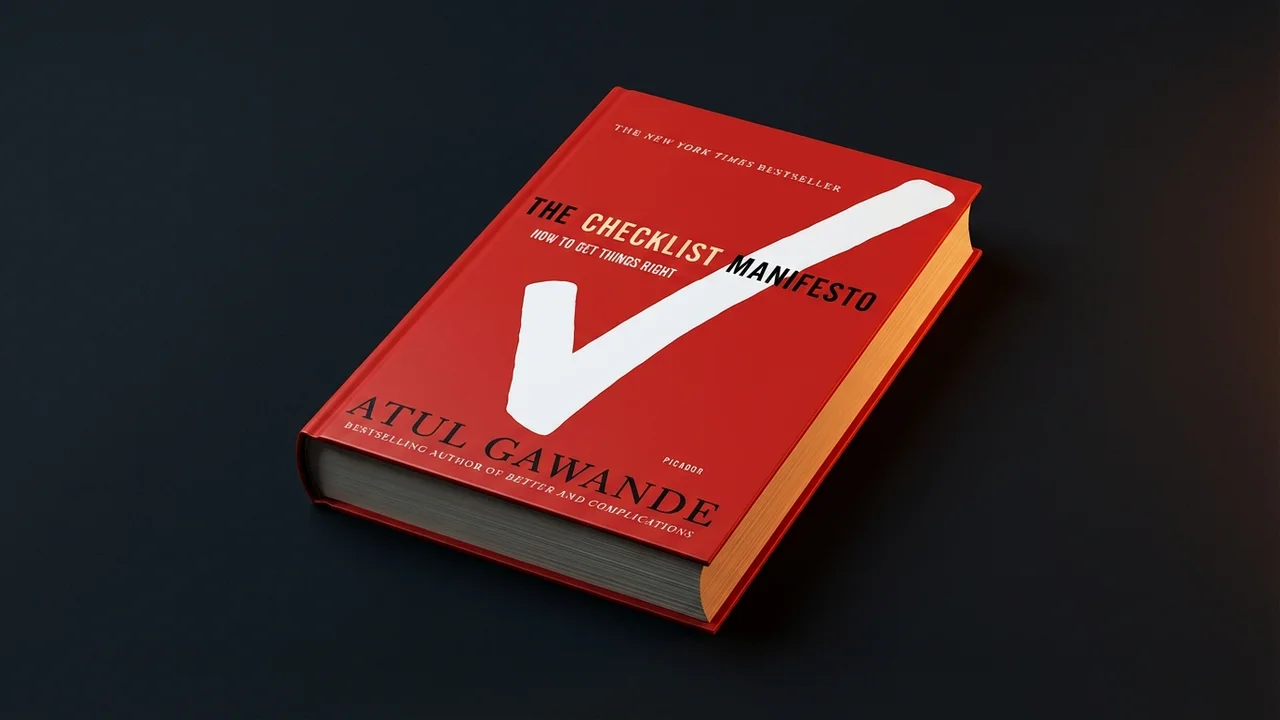

“Good checklists, on the other hand, are precise. They are efficient, to the point, and easy to use even in the most difficult situations. They do not try to spell out everything — a checklist cannot fly a plane. Instead, they provide reminders of only the most critical and important steps — the ones that even the highly skilled professional using them could miss. Good checklists are, above all, practical.”
A lot of really interesting stories about why the checklist is the difference between life and death… literally. The author is a surgeon who realized that having a checklist to avoid errors saved lives and prevented lawsuits (saving millions of dollars).
These stories are not your average connection between a topic and some arbitrary story (i.e., Malcolm Gladwell books) that have a loose connection. These stories are actually quite powerful, practical, and actual (they are relevant to what the author is talking about).
And that’s what separates The Checklist Manifesto from so many other productivity books — Gawande isn’t theorizing. He’s pulling from real operating rooms, real crash landings, and real construction sites where the checklist was the ONLY thing standing between success and disaster.
From Pilots to Surgeons
Originally, the checklist was heavily implemented by pilots to ensure their planes were functioning, and when the plane was in a crisis situation. The checklist has expanded into other industries. From doctors, to financial investment agencies, to construction supervisors, the checklist has ensured things go according to plan.
The aviation story is particularly wild. Back in 1935, the U.S. Army tested the Boeing Model 299 — essentially what became the B-17 bomber. The plane was SO complex that experienced test pilots crashed it on the runway. Not because of a mechanical failure, but because they simply forgot a step. The solution wasn’t more training. It was a simple checklist. And that checklist helped the Allies win World War II.
Think about that for a second. A piece of paper with a few bullet points changed the course of history.
The Surgery Problem
Gawande brings it all back to medicine, which is his world. He describes how surgery — even routine surgery — involves so many steps that human memory alone CAN’T handle it reliably. Surgeons are some of the most highly trained professionals on the planet, yet they still leave sponges inside patients, operate on the wrong limb, or forget to administer antibiotics before an incision.
These aren’t dumb people making dumb mistakes. These are brilliant people overwhelmed by complexity. And that’s the whole point of the book — complexity has exceeded what our monkey-brains can manage on their own.
The WHO surgical checklist that Gawande helped develop reduced deaths and complications by over 30% across hospitals worldwide. Thirty percent! From a piece of paper! No new drug, no billion-dollar technology — just a checklist that takes less than two minutes to run through.
Why We Resist Checklists
Here’s where it gets interesting. You’d think that after seeing those results, EVERYONE would adopt checklists immediately. But they didn’t. And many still don’t.
Why? Ego.
Gawande explains that highly skilled professionals — surgeons, pilots, engineers — often feel that checklists are beneath them. “I don’t need a reminder to do my job. I’ve been doing this for 20 years.” Sound familiar? I’ve caught myself thinking the EXACT same thing when launching campaigns or setting up new websites.
But that’s the trap. The checklist isn’t questioning your competence. It’s acknowledging that even the best of us have limits — and those limits get exposed at the worst possible moments.
Task Lists vs. Checklists
I’ve used “task lists” extensively for several years now. Not so much a “checklist.” A task list is a list with things I need to get done. Checklists being things that you need to double-check for error prevention.
I believe this book is more about those double-check lists. I’m quite error-prone, so maybe a checklist will allow fewer errors during the launching of products, complex technical ideas, or whatever else.
And honestly, after reading this book, I started thinking about all the times I messed up something that should have been obvious. Forgetting to check a landing page link before sending traffic. Leaving test copy on a live page. Launching a campaign without double-checking the targeting settings. Small stuff that costs real money.
The difference between a task list and a checklist is subtle but important. A task list says “do X.” A checklist says “confirm X is done correctly before moving on.” One drives action. The other prevents catastrophe.
The Investment World
One chapter I really enjoyed was about how checklists were adopted by investment firms. Gawande tells the story of Mohnish Pabrai, a value investor who created a checklist of common mistakes that lead to bad investments — things like ignoring management incentives, overlooking debt structures, or getting emotionally attached to a stock.
Before making any investment, Pabrai runs through his checklist. Not because he’s forgetful, but because he knows that in the heat of the moment, when you’re excited about a deal, your brain will rationalize away the red flags. The checklist forces you to slow down and confront what you’d rather ignore.
That concept applies to EVERYTHING — not just investing. How many times have you jumped into a business decision because it “felt right” without running through the basics?
Final Thoughts
P.S. Mental checklists won’t do. You need to get them down on paper.
That’s the single most practical takeaway from this entire book. Your brain will trick you into thinking you’ve got it all covered. You don’t. Write it down.
4/5 — the idea of checklists is simple, but the idea is extrapolated with some really powerful stories within The Checklist Manifesto. If you’re someone who manages complexity in any form — whether it’s surgery, construction, marketing campaigns, or launching products — this book will make you rethink how you approach your process.
Pick it up. And then go make your first checklist.
Thanks for reading.
— Leonidas
