

“Who you are, what you think, feel, and do, what you love—is the sum of what you focus on.”
When was the last time you sat down and focused on something for two hours straight? No phone. No notifications. No “quick glance” at your inbox.
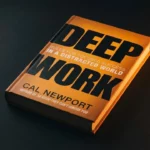
If you’re like most people, you probably can’t remember. And that’s exactly the problem Cal Newport is screaming about in Deep Work.
I picked this book up because I had been noticing something about myself — my attention span was getting worse. Not dramatically, but slowly, like a frog boiling in water. I’d sit down to write or build something for my business, and within 15 minutes I’d be scrolling through some nonsense on my phone. Sound familiar?
What Is Deep Work?
Newport defines deep work as professional activities performed in distraction-free concentration that push your cognitive capabilities to the limit. These are the sessions where you actually CREATE something meaningful — writing, coding, strategizing, problem-solving.
The opposite is “shallow work” — emails, meetings, social media, Slack messages, and all the busywork that FEELS productive but generates almost zero real value.
Here’s the kicker. Newport argues that deep work is becoming increasingly rare at the exact same time it’s becoming increasingly valuable. The people who can master it will dominate their fields. The people who can’t will be replaceable.
That got my attention.
The Distraction Economy
We live in a world that is literally ENGINEERED to steal your focus. Every app on your phone was designed by teams of brilliant engineers whose sole purpose is to keep your eyeballs glued to a screen. Notifications, red badges, infinite scroll — these are not accidents. They are weapons of mass distraction.
Newport makes the case that most knowledge workers have sleepwalked into a lifestyle of perpetual shallow work — checking email every six minutes, attending meetings about meetings, and going home exhausted without having produced anything of substance.
I’ve been guilty of this. Building online businesses means you are SURROUNDED by distractions — analytics dashboards, social media, Slack channels, and the never-ending stream of “urgent” notifications that are almost never actually urgent.
The Focused Few
I’ve only ever met one person who has been able to achieve the level of focus Newport describes. This individual built an incredibly successful internet business, and watching him work was like watching a different species. He would lock himself in a room, turn off everything, and emerge hours later with work that would have taken me a week.
At the time, I thought he was just naturally gifted. But after reading Deep Work, I realize he had simply trained himself to do what Newport prescribes. He had built rituals, eliminated distractions, and treated deep focus as a skill to be developed — not a personality trait you either have or you don’t.
That distinction is important. Focus is a MUSCLE. If you don’t train it, it atrophies. And most of us have let it atrophy to the point where we can barely sit still for 20 minutes.
Newport’s Rules
The book lays out four rules for cultivating deep work, and they are refreshingly practical.
Rule 1: Work Deeply. Create rituals and routines that minimize the willpower needed to maintain focus. Lock your phone in a drawer, work in a specific location, block out the same hours every day — make deep work your default mode, not something you fight for.
Rule 2: Embrace Boredom. This one hit me. Newport argues that if you pull out your phone every time you’re bored — in line at the store, waiting for a friend, sitting on the toilet — you are actively training your brain to NEED stimulation. And a brain addicted to stimulation cannot focus deeply. You have to practice being bored.
Rule 3: Quit Social Media. Or at least be ruthlessly selective about it. Only use a tool if its benefits SUBSTANTIALLY outweigh its negatives. Most people never do this audit. They just use everything because everyone else does.
Rule 4: Drain the Shallows. Aggressively minimize shallow work. Schedule every minute of your day, batch your email, and say no to pointless meetings. Protect your deep work hours like your career depends on it — because it does.
The Osmosis Effect
Here’s what I found interesting about my experience reading this book. Through sheer osmosis — almost like neuro-linguistic programming — I found myself naturally trying to focus more while I was reading it. I would catch myself reaching for my phone and stop. I would notice when my attention drifted and pull it back.
Whether by creating a focus-inducing environment, locking my phone away, or turning off the internet for bouts at a time — the book itself was programming me to practice what it preached. That’s the sign of a genuinely impactful book. It changes your behavior before you even finish reading it.
A Few Honest Critiques
The book is about 90% substance and only 10% filler — which is a great ratio compared to most self-help books. Newport is an academic, and it shows in his writing. He is clear, structured, and doesn’t waste too many pages on generic stories that feed into a point through some convoluted narrative.
That said, some of the examples feel repetitive. Yes, Carl Jung had a cabin in the woods. Yes, various professors isolate themselves to produce great work. After the third or fourth example, the point has been made.
I also think the book could have been consumed as an audiobook or a detailed summary. But sometimes you need the sheer force of osmosis to truly internalize an idea. Reading the full book allowed the concept of deep focus to seep into my subconscious in a way a summary never could.
Final Thoughts
Cal Newport has essentially written a survival guide for the modern knowledge worker. In a world where attention is the most scarce and valuable resource, Deep Work gives you a concrete framework to reclaim it.
I will absolutely be reading more of Cal Newport’s books. I envy his ability for deep focus, but more importantly, I now understand that it’s a trainable skill — not a genetic lottery.
If you find yourself constantly distracted, constantly busy but never productive, and constantly wondering where the day went — this book is for you.
4/5 — highly recommended for entrepreneurs, creators, and anyone who works with their brain for a living.
Thanks for reading.
— Leonidas
