
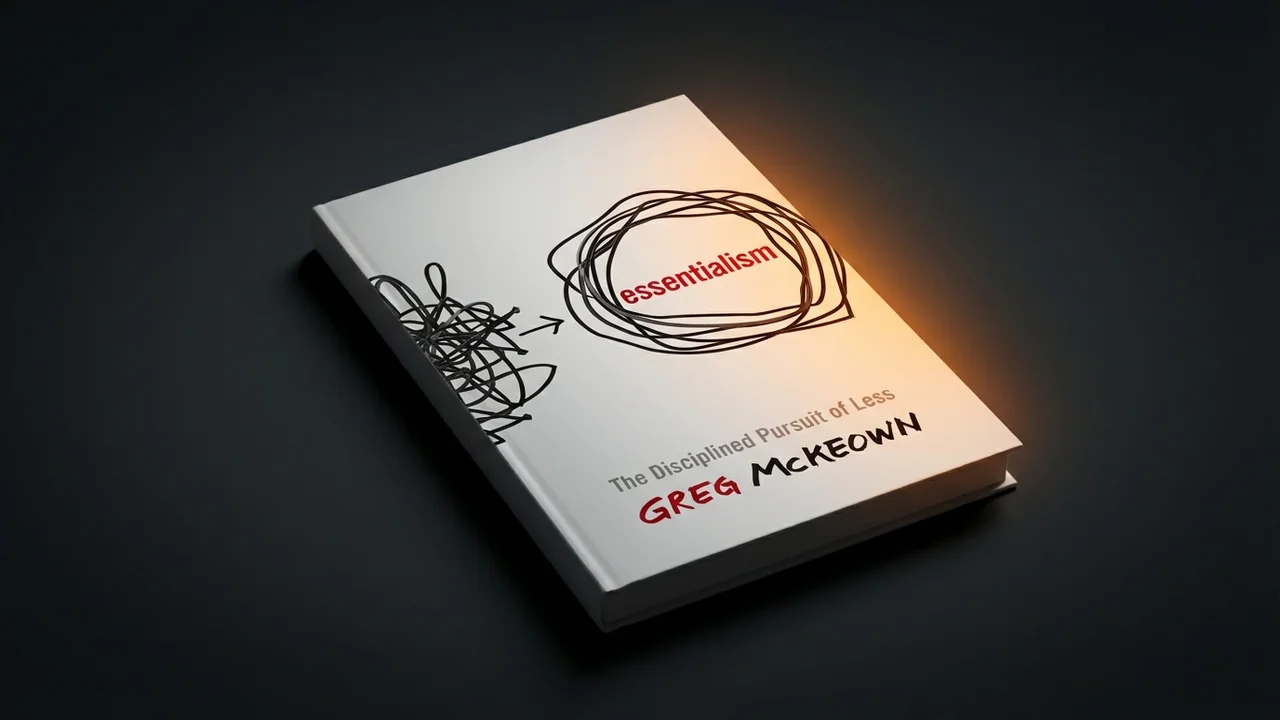
“If you don’t prioritize your life, someone else will.”
I’ll be honest — as I’m writing this book review, I’m also editing another one. So clearly, I didn’t absorb this book deeply enough.
Furthermore, I listened to the audiobook very passively, through multiple false starts while doing other things, such as cleaning my house, walking on the beach, or something else. So probably the focus was never there.
And isn’t that the ultimate irony? A book about doing ONE thing at a time, consumed by a guy who was doing three things at once. Classic monkey-brain behavior.
But that’s precisely why this book matters. Not because it told me something I didn’t already know, but because it exposed just how terrible I am at practicing what I preach.
The Core Premise
McKeown’s argument is straightforward — most of us spread ourselves way too thin. We say yes to everything, try to pursue every opportunity, chase every shiny object, and end up making a millimeter of progress in a million directions instead of meaningful progress in one.
An essentialist, according to McKeown, does the opposite. They ruthlessly eliminate everything that is not absolutely essential and pour all their energy into the few things that actually matter.
Simple concept. BRUTALLY hard to execute.
And that’s where the book both succeeds and stumbles, in my opinion.
The Parts That Hit Home
The strongest sections of Essentialism are the ones that deal with the mechanics of saying no. McKeown explains how we get sucked into commitments we never wanted — social pressure, FOMO, the desire to be seen as a team player, the guilt of turning someone down.
I felt called out. Hard.
As someone who runs multiple projects simultaneously — writing, marketing, travel planning, reading — I am the poster child for non-essentialism. I have genuinely said yes to projects I had no business taking on, simply because the opportunity was there and I didn’t want to miss out.
McKeown would probably look at my browser tabs right now and have a heart attack. Fifteen tabs open, three half-finished drafts, a podcast queued up, and a to-do list that looks more like a novel.
The book made me uncomfortably aware of this pattern. Not in a preachy way — more like holding a mirror up and letting me squirm on my own.
The Trade-Off Mindset
One of the concepts that stuck with me is the idea that trade-offs are not something to avoid — they are something to EMBRACE. Most people treat trade-offs like a negative. “If I focus on this, I’ll miss out on that.”
McKeown flips this completely. Trade-offs are the very essence of strategy. When you choose one thing and deliberately cut another, you are saying, “This matters more than that.” That clarity is what separates people who accomplish extraordinary things from those who just stay busy.
How many entrepreneurs do you know who are running six different side hustles, three social media accounts, two podcasts, and a newsletter — and none of them are really working? I know dozens. I’VE BEEN one of them. The discipline to pick ONE thing and go all in? That’s rare.
The Hero Stories Problem
Now, here is where I have to be honest about what didn’t work for me.
One of the chapters uses “hero stories” — Rosa Parks, Mandela, Greek philosophers — as examples of essentialists. And it felt contrived. The typical “hero story” of relating whatever the topic of the book is to some far-off moment in time.
Look, I get the intent. But stretching the framework to fit historical figures who lived in completely different contexts weakens the argument. Rosa Parks didn’t refuse to give up her seat because she was “practicing essentialism.” She did it because she was fighting systemic injustice.
Retroactively labeling great historical acts as “essentialist” is the kind of narrative gymnastics that makes me skeptical. It’s the same pattern Phil Rosenzweig warns about in The Halo Effect — taking a successful outcome and reverse-engineering a framework onto it.
McKeown is strongest when he sticks to practical, everyday scenarios — boardroom politics, the overloaded schedule, the inability to say no to your boss. That’s where the advice feels real.
Less But Better
The German industrial designer Dieter Rams had a famous philosophy — “less, but better.” McKeown borrows this idea heavily, and it resonates.
Think about it. The best meals you’ve ever had probably had five ingredients, not fifty. The best articles you’ve ever read made ONE point brilliantly. The best trips you’ve ever taken were not the ones where you crammed twelve cities into fourteen days.
Quality over quantity. We all know this intellectually. Yet our monkey-brains keep screaming “MORE.” More projects, more commitments, more options. Because options feel like freedom, even when they are actually chains.
What would happen if you cut 80% of your commitments? Would the world end? Probably not. Would you finally make real progress on the 20% that actually matters? Almost certainly.
The Audiobook Experience
Damn, I wish I had focused a bit more. Probably need to re-listen to the audiobook again.
But here is the interesting thing — even consumed at maybe 60% attention through multiple false starts and background listening, the core message got through. McKeown is a clear communicator. The book is not dense or academic. An essentialist book about essentialism — it practices what it preaches, for the most part.
Even my scattered half-listening extracted enough value to change how I think about my daily priorities. And that is saying something.
Who Should Read This
If you constantly feel overwhelmed, overcommitted, and spread thin — this is your book. If your to-do list grows faster than you can check things off, McKeown wrote this for you.
The people who need this book the most are the ones who will say, “I don’t have time to read it.” And that irony alone should tell you everything.
Final Thoughts
Focus on one thing at a time to be successful? Alright, I’ll try. The practical advice on saying no, embracing trade-offs, and ruthlessly eliminating the non-essential is genuinely useful — even if some historical examples feel forced.
Is it going to transform your life overnight? No. But it will plant a seed. And every time you catch yourself juggling twelve things at once and accomplishing nothing, you’ll hear McKeown’s voice in the back of your head asking, “Is this essential?”
3.5/5 — a solid, practical read with a few overreaches. Recommended for chronic overcommitters and anyone whose default answer to everything is “yes.”
Thanks for reading.
— Leonidas
