Despite only being in Guanajuato for about 3 days, and ultimately visiting dozens of other cities in Mexico, Guanajuato still remains my most favorite of them all.
This could be the ‘fresh car smell’ effect that ultimately wears off, but Guanajuato simply has this charm that really makes it a cool city to venture around, and potentially stay in, for at least 3-4 weeks.
What I really enjoyed about the city was driving into it for the first time, and being enveloped in the complex tunnel system that runs beneath the streets, and through the mountainsides that surround the city.
Once you walk through the city, everything felt very well centralized and compact into the center, with streets winding about like snakes, up and down the hills, through narrow streets, stairs, and alleyways that can only fit a bike or a person or two.
Guanajuato felt like what a city in Italy feels like, surrounded by mountains on all sides, and contradictory to where you would put a city, it somehow exists, and prospers.
The top families of this city became extremely wealthy, thanks to the mines full of silver and other minerals that poured in from the mountains adjacent to the city.
This resulted in architecture that is as colonial and as Italian and as Spanish as you can get!
Guanajuato History
Before the Spanish arrived, this area was occupied by the ‘Otomi’, who were then displaced by the ‘Chichimecas’.
The name ‘Guanajuato’ meant the ‘hilly place of frogs’, and came from the ‘Purepechas’, which was another powerful indigenous empire at the time.
The area was always abundant in gold, and other precious metals which were used for ornamental objects in the Aztec empire, but once the Spanish found it in 1540, they immediately sent an army to build forts.
Despite the constant attacks by Chichimeca tribes, the population of the area grew rapidly, with the aim of exploiting the indigenous populations into mining silver and gold from the mountains.
By 1741, ‘The Most Noble and Loyal City of Santa Fe of the Mines of Guanajuato’ became a city, and then given the title of a province in 1790 because it became ridiculously wealthy.
At its peak, the ‘La Valenciana’ mine in Guanajuato accounted for over 60% of total supply of silver in the world.
This made Guanajuato the richest city in Mexico from the early 1700s into the late 1800s, which resulted in some very fancy examples of colonial-era architecture, both religious and civil.
By the end of the 1700s, a huge divide between the rich and the poor, along with an insane tax from the Spanish empire, and the expulsion of the Jesuit christian organizations caused massive riots in the city, leading into the independence from Spain.
By 1810, the leader of the independence movement, Miguel Hidalgo, lead his forces into Guanajuato, but found it difficult to defeat the royalists who were inside a heavily fortified granary.
As the legend goes, a man nicknamed ‘El Pipila’ strapped a large flat rock on his back, and crawled to the wooden doors, all while under enemy gun fire.
El Pipila then smeared the doors with tar, and set it on fire. The Independence forces stormed the building, and killed the royalist forces – there is a giant statue of him on the mountain adjacent to the city.
Fighting continued in the city, many years later by the Liberal and Conservative forces, and then by the french invasion into Mexico. This caused mining activities to decrease, but was eventually resumed during the era of Porfirio Diaz in the 1870s.
Finally, the city has been under constant threat of flooding, and was nearly destroyed twice in the 1740s and 1760s. Thus, large, really amazing tunnel systems were built under the city to circumvent the constant flooding.
By the 1960s Dam technology was able to mitigate flooding, and now the tunnels act as underground roadways (which are incredible to drive through).
Guanajuato Photos
Entering Guanajuato from the hillsides. I really recommend coming to this city by car, as long as you can find free parking somewhere. Overlooking the ‘Templo de San Cayetano Confesor’
Once I landed in the city, I had to park in the hills, and venture down the hills into the city center through streets such as these in Guanajuato
The ‘Teatro Juarez’, built between 1872 and 1903, and named after ‘Benito Juarez’, an important politician and liberal who fought against conservative thinking in Mexico.
At the top of the ‘Teatro Juarez’ are 8 bronze statues depicting 8 of the 9 Greek muses for Arts and Sciences.
Overlooking the central core, with the ‘Collegiate Basilica of Our Lady of Guanajuato’ as the yellow church.
The city of Guanajuato is surrounded by mountains on all sides
The neighborhoods of Guanajuato scale the surrounding cliffs on all sides
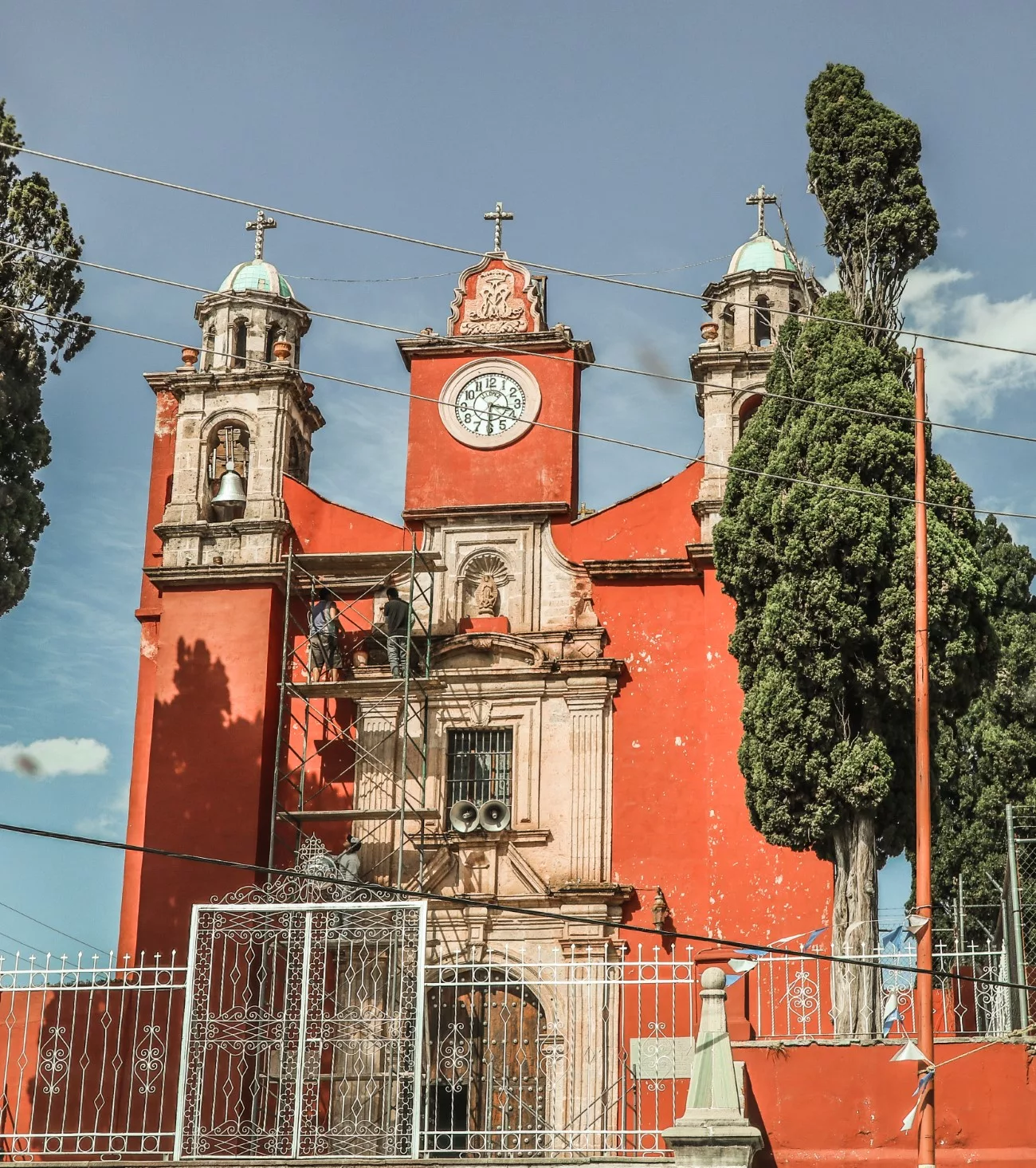
The bright red exterior of the Templo de San Diego de Alcántara in Guanajuato. First built in 1694, and then rebuilt in 1780.
The streets of Guanajuato allow foot traffic to enjoy the beauty of the city interior
The streets of Guanajuato are overlooked on all sides by steep hills and mountains
Mexican police officers act as deterrents for any small-level crimes in Guanajuato. I was told that this city is one of the safest cities in Mexico, due to its high level of tourism.
A mexican flag waves atop the Guanajuato University
In the Plaza De La Paz in Guanajuato
A statue in the Plaza De La Paz in Guanajuato
Leonidas carries a Canon M6 (mirrorless DSLR), with a 18-150mm lens. It’s great for long-distance and short distance day-time, and bright shots. You need a different lens for nighttime shots.
The historic and most popular representation of Guanajuato. Facing the ‘Collegiate Basilica of Our Lady of Guanajuato’ in Plaza De La Paz. During mid-day
The historic and most popular representation of Guanajuato. Facing the ‘Collegiate Basilica of Our Lady of Guanajuato’ in Plaza De La Paz. In the Afternoon.
The front entrance of the ‘Collegiate Basilica of Our Lady of Guanajuato’. Built between 1671 and 1696
The interior of the ‘Collegiate Basilica of Our Lady of Guanajuato’
Any streets that do offer cars movement, is either constantly full of traffic, or is only one-way. As a car, you will need to traverse the entire city again, to return to this point in Guanajuato
Residences in Guanajuato slowly climb from the main center, up into the mountains
Plaza De San Fernando in Guanajuato is circled by restaurants for hungry tourists
The main fountain in Plaza De San Fernando in Guanajuato
The symbolic stairs up into the Guanajuato University. Originally called the ‘Hospice of the Holy Trinity’ in 1732.
Originally, the university of Guanajuato offered degrees in Mining, Law, Painting, Sculpture and Architecture. By 1831, a Library was built.
A view of Guanajuato from the top of the stairs of Guanajuato University
The University of Guanajuato is on the left, residents on the right, and the ‘Temple of the Society of Jesus Oratorio de San Felipe Neri’ in the background.
The towers of the ‘Collegiate Basilica of Our Lady of Guanajuato’ during sunset
The many tunnels that cut through the mountains in Guanajuato
Elderly people await their eventual deaths in Guanajuato, while being watched by their caretaker
A church dome rises into the sky
A cracked bell in a bell tower of a Church in Guanajuato signifies the centuries-old age of this city.
Night-time shots in Guanajuato
The winding steps that lead up to the houses in the hills of Guanajuato city
Leonidas posing with his cowboy hat on the rooftops of Guanajuato, Mexico
The rooftops of Guanajuato, contrasted by the night sky
The lights of Guanajuato contrasted by the blue night sky
A large dome of one of the churches towers over the residences of Guanajuato at night
Houses pile up on top of each other in Guanajuato. Tunnels run right through the hills of the city. Almost like a hamster maze
A boy with his girlfriend walk the steeply inclined narrow streets in Guanajuato. This boy was scared when he saw me taking photos. Probably a good reason for it.
The hills of Guanajuato light up with churches, and residential lights
Climbing up the narrow streets of Guanajuato
Trying out local bread in the streets of Guanajuato. Because I like to try new things, I ended up putting on some weight from my journeys.
A shrine for the Virgin Mary in the narrow streets of Guanajuato
Street lights add a calm ambiance to the pedestrian pathways in Guanajuato
Trying out some expensive tacos in Guanajuato. I ordered extra avocado
These tacos feature fried fish skin with teriyaki sauce on them (I think).
Walking towards the Plaza De La Paz at night in Guanajuato
Restaurants put out tables on the pathways in Guanajuato
The rapid growth of tourism has converted all front-facing buildings into restaurants, coffee shops and stores in Guanajuato
The ‘Basilica Collegiate of Our Lady of Guanajuato’ and its yellow exterior contrast against the night sky
Leonidas sitting on a bench, thinking of what face to make for this photo
The ‘Iglesia de San Diego’ looks very intricate at night time
Further down the streets in Guanajuato. A clear example of the tunnel systems historically built together with the city. The tunnels were used to mitigate the constant flooding of the city
A bus stop on the right, in the city center. This is where most locals go, including many students in Guanajuato
The medieval performers in Guanajuato play some traditional music for tourists passing by.
A residence and restaurant at night time in Guanajuato
The multicoloured houses go up a gradually inclining hill in Guanajuato
The legendary Mexican hero, ‘El Pipila’ overlooking the city of Guanajuato
Don Quixote, a folk-lore anti-hero in popular Spanish literature
A monument to Don Quixote, with a girl playing soccer in the limited free space in Guanajuato
A traditional Mexican dish – Pozole, pronounced, Poh-Zoh-Ley
El Pipila overlooking the bright red dome of ‘Iglesia de San Diego’ in Guanajuato
The ‘Iglesia de San Diego’ in the daytime
A statue commemorating the dedication of entertainers in the city of Guanajuato
Medieval dressed entertainers from the ‘Teatro Juarez’, are tasked to sell you packages for entertainment in the city core. Most are students from the local university, and this is a rite of passage.
In the ‘Plaza De La Paz’, looking towards the ‘Templo De San Roque’
In the ‘Plaza De La Paz’, looking towards the ‘Templo De San Roque’ dome
From the mirador (viewpoint): Collegiate Basilica of Our Lady of Guanajuato
From the mirador (viewpoint): An ocean of reds and oranges and a tint of turquoise in Guanajuato
The statue of ‘El Pipila’ overlooks the entire city of Guanajuato
A mime dresses up in miners clothing, and a sheen of gold colouring in Guanajuato
A sea of boxed houses in Guanajuato. This is the typical construction style of 1-2 floored homes in Mexico. Quick and easy to build, with very little authorization, or stability during earthquakes.
A mixture of early 1900’s architecture, coloured for style, in Guanajuato
From the mirador (viewpoint): The Guanajuato university
From the Mirador (viewpoint): Iglasia De San Diego in Guanajuato
Leonidas in awe at the beauty and intricate design of the city of Guanajuato
I’m actually not sure what that is on the top right, but it could be a castle in Guanajuato
A taxi car or a BMW is parked on the hills of Guanajuato. I thought this was a cool photo
Local mexicans go about their day in Guanajuato
Colouring your house in Mexico, and in Latin America is a popular activity
Bright teal and turquoise houses really stand out in the hills of Guanajuato
Driving towards the ‘Cristo Rey’ statue. It’s tiny from here, but enormous when you get closer
The hills outside of Guanajuato city, towards the statue of ‘Cristo Rey’
Almost every meter of land in Mexico has been converted into a means of production
Driving up the hills, a woman dries her clothing, or sells various cloths along the way
A man sells souvenirs on your way to Cristo Rey in Guanajuato
The statue of Cristo Rey. First built in 1923, then destroyed in 1926, then rebuilt in 1940.
A man looks out at the vast landscape from the Cristo Rey in Guanajuato
A stylized view of Cristo Rey in Guanajuato
2 cherubs statues sit beside Cristo Rey in Guanajuato
The view from the hills of Cristo Rey is amazing
Confess your sins inside the Cristo Rey Church
Don’t look too excited when going to pray to Jesus
Inside the Cristo Rey Church
Everything is tiny from up here. Cristo Rey in Guanajuato
A view from the top
Humans have converted every space of land into a means of production in Mexico, and around the world
Cars are like toys from this high up. Cristo Rey in Guanajuato
A view of Guanajuato city from far far away
A man sits by, waiting for something exciting to happen in Guanajuato
The Cristo Rey is right between Guanajuato and Leon. From here, I start driving back to the city of Guanajuato
The tunnel systems in Guanajuato were some of the most amazing experiences, especially when you are driving through them.
Every tunnel cuts right through the mountains. One minute you only see a mountainous wall, and the next, a full blown deeply historic city center
Some of the tunnels are quite long. Over 7 tunnel systems exist (maybe more), and each goes into a different direction
The tunnel systems blend right into the city itself. You wouldn’t even know there are tunnels, if you simply saw the city from an aerial view
One minute a dark tunnel, the next a colourful vista of colonial houses
Another red church further into the hills of Guanajuato
A typical-looking street in Mexico. Box-like houses line a straight road up a hill
The view of Cristo Rey from the hills of Guanajuato
Houses stacked up on each other, next to something that looks like an ancient amphitheatre, or market in Guanajuato
A mexican man renovates a small part of Guanajuato
Locals going about their day in Guanajuato
This is one part of the tunnel system. In the past it was used to mitigate flooding that was regularly destroying Guanajuato
Literally driving 2-3 levels below the city of Guanajuato
A sculpture representing the rich history of Guanajuato
A young man looks out from a bus into the wild. Looks a bit like a commercial
‘I want you Gringo’! Mexican Revolution advertisement
Stylistic contemporary cowboy boots
A mariachi boy prepares his instrument
Vases that look like skulls or faces, customary in Guanajuato
One last look at the city of Guanajuato
The winding streets of Guanajuato
The final day in Plaza De La Paz, with a bright sunset ready to finish the day
The mountains tower over the city of Guanajuato in the distance
The red church domes of Guanajuato tell the tale of deep religious beliefs in Mexico
Since 2010, Leonidas has been an incredible Web Developer, and amazing Digital Marketer. He is the author of various exciting case studies in digital marketing, most notably in Pay Per Call Marketing.
Make sure to read the case studies to make your life so much better!