

“Look, just because you’re a child of Mother Nature, it doesn’t mean she has to love you.”
Have you ever stared up at the night sky and thought, “wow, how beautiful and peaceful”? Well, Paul Sutter is here to ruin that for you. And honestly, I am glad he did.
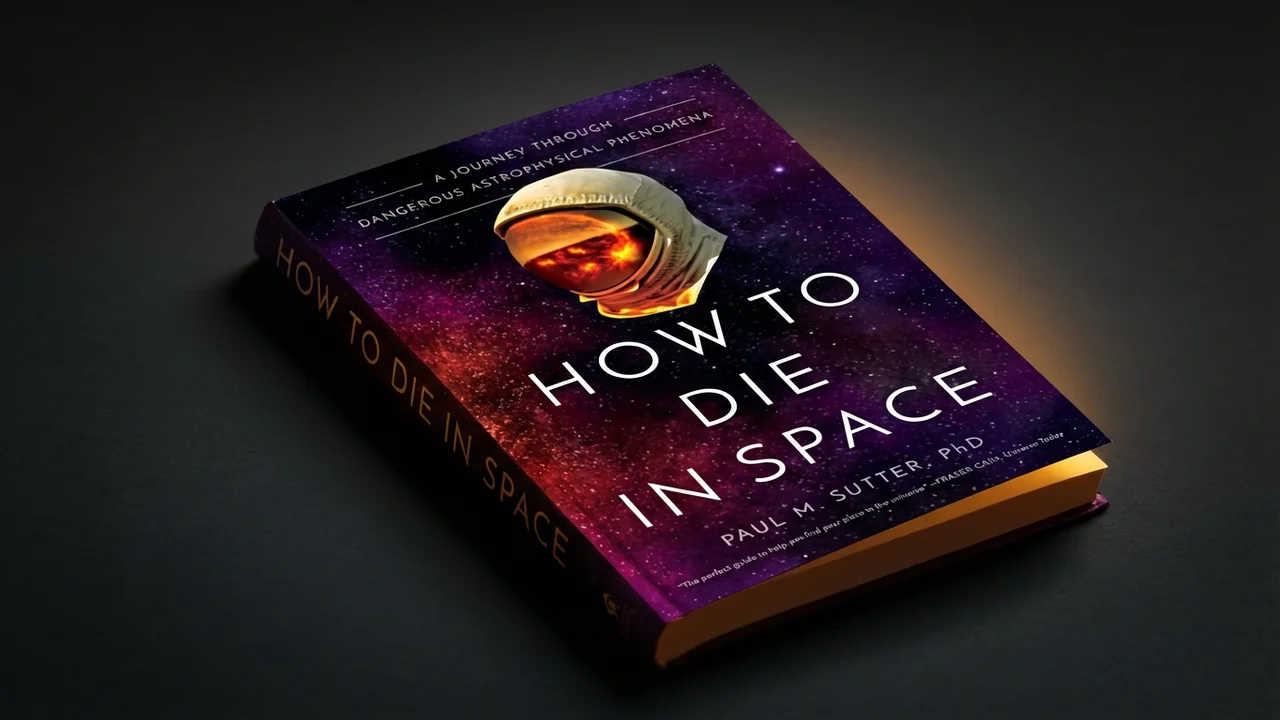
How to Die in Space is a guided tour through every terrifying thing the universe has to offer — from our own Sun deciding to throw a tantrum, all the way out to incomprehensible phenomena at the edge of observable reality. Space is trying to kill you, and this book walks you through EXACTLY how it would do it.
Similar to the idea of “a million ways to die in the west,” we learn about more than a dozen ways that space will completely tear you apart, along with itself. But instead of cowboys and rattlesnakes, you get gamma-ray bursts and rogue black holes.
Science for the Rest of Us
The real focus of this book was on dumbing down the science just enough for someone who is a space hobbyist to understand. And I mean that as a compliment. Sutter takes concepts that would normally require a physics degree and breaks them down into language that a curious sixth grader could follow.
He writes like a comedian doing a TED talk — cracking jokes, using metaphors, and sneaking in REAL astrophysics while you are busy laughing. For someone like me who loves learning about the universe but has zero interest in solving differential equations, this works perfectly.
That said, the humor is a double-edged sword. Sometimes the jokes land, and sometimes they feel forced. But ultimately, I would rather have a book that tries too hard to be fun than one that puts me to sleep.
The Local Killers
Sutter starts with the dangers closest to home. Our own Sun is basically a giant nuclear bomb that we happen to orbit at just the right distance. Solar flares, coronal mass ejections, radiation storms — all of these can wreak havoc on our electronics, satellites, and us. One well-placed solar event and we could lose our entire power grid. No internet, no electricity, no GPS for weeks or months.
Then you have comets and asteroids. We all know the story of the dinosaurs, but Sutter makes clear that this is NOT some ancient, one-time event. Space rocks fly around our solar system constantly, and it is only a matter of time before another big one crosses our path.
These early chapters were my favorites because they feel the most tangible — not hypothetical threats from billions of light-years away, but things that could genuinely affect our lives within our lifetime.
Stars That Want You Dead
Once Sutter moves past the local neighborhood, things get truly wild. When certain massive stars die, they do not just fade away — they EXPLODE. Supernovae release more energy in a few seconds than our Sun will produce in its entire ten-billion-year lifetime.
Some dying stars collapse into neutron stars — objects so dense that a teaspoon of their material would weigh a billion tons. A single teaspoon. A BILLION tons. These things spin at incredible speeds and shoot beams of radiation across the cosmos like lighthouses of death.
Then there are black holes — regions where gravity is so extreme that nothing can escape, not even light. Get too close, and the gravitational difference between your head and your feet would literally stretch you like spaghetti. Scientists actually call this “spaghettification.” I am not making that up.
The Exotic Threats
The last few chapters ramped up the esoteric nature of space, mathematics, and physics, and even then, the author was able to explain how with a couple of mathematical formulas, space can absolutely obliterate itself.
Gamma-ray bursts, quasars, blazars — phenomena so powerful they make supernovae look like firecrackers. A single gamma-ray burst pointed at Earth from within our galaxy could strip our atmosphere and sterilize the planet in seconds. You would not even have time to check your phone.
And then the book goes FULL speculative. Dark matter, cosmic strings, the possibility that the vacuum of space itself is unstable and could spontaneously decay — destroying everything at the speed of light. No warning. No escape. Just nothingness.
The Editing Problem
Other than the constant spelling and grammar mistakes, this was an enjoyable rendition of some complex topics in astronomy. For a published work, this level of errors is hard to excuse. It pulls you out of an otherwise engaging experience — like watching a great movie with subtitles that keep getting the words wrong.
It does not ruin the book. But once you notice, you cannot stop noticing.
The Limits of Text
A book about VISUALLY spectacular phenomena like supernovae, nebulae, and black holes is inherently limited by text format. I kept wanting to pull up YouTube videos and NASA images to accompany what Sutter was describing. If you read this book, keep your phone nearby to look up images of the things he describes. It makes the experience ten times more immersive.
Why This Book Matters
Beyond the entertainment, How to Die in Space puts our existence into perspective. We live on a tiny rock, orbiting an average star, in a galaxy with hundreds of billions of other stars, in a universe with trillions of galaxies. And EVERYTHING out there is trying to destroy us.
Yet here we are. Somehow, against all odds, life emerged and survived long enough for you and me to argue about politics on the internet. That is either incredibly lucky or incredibly improbable — and either way, it should make you appreciate the sheer miracle of being alive right now.
Final Thoughts
Nonetheless, once the author fixes up all of the spelling and grammar mistakes, this is a fun and educational book to read. Sutter has a talent for breaking down intimidating science into bite-sized, humorous explanations that never feel condescending.
If you are someone who watches space documentaries, follows NASA launches, or just likes to nerd out about the cosmos over a drink — pick this up. You will walk away with a healthy respect for just how dangerous the universe really is.
Rating: 3.5 out of 5. Great content, great accessibility, but held back by sloppy editing and the inherent limitation of text-only format for such a visual subject.
Thanks for reading.
— Leonidas
