
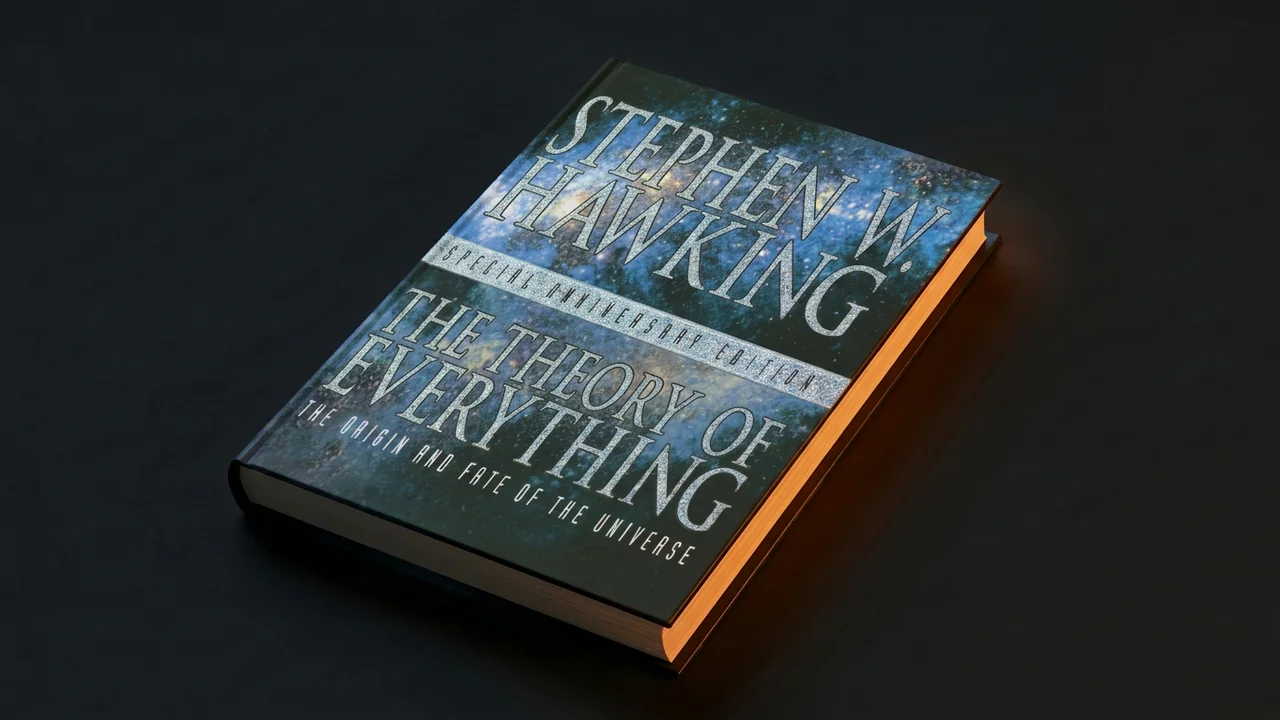

“The most remarkable property of the universe is that it has spawned creatures able to ask questions.”
I’m sure this is a wonderful book, with some really amazing ideas, and although I absolutely love all things space and how physics intertwines with it, sadly this book was way “outside my pay grade,” as the idiom goes.
I’d probably understand this book better with a good YouTube video.
But when Mr. Hawking goes into the nitty-gritty of physics and how it relates to cosmology, I was lost (listening to the audiobook).
Either way, I love watching the YouTube videos that explain these ideas visually.
That said — even though most of it sailed right over my head, there were moments of genuine wonder scattered throughout this book. And those moments are worth talking about.
What Hawking Is Actually Trying to Do
The premise of the book is staggering. Hawking is essentially trying to explain how ALL the forces of the universe — gravity, electromagnetism, the strong nuclear force, the weak nuclear force — could be unified into one single theory. One equation that explains EVERYTHING.
That’s insane when you think about it. One formula to rule them all.
The book is based on a series of lectures Hawking gave, and you can feel that structure. It moves through the history of cosmological thinking — from Newton to Einstein to quantum mechanics to string theory — and builds toward the idea that a unified theory is not just possible but inevitable.
Do I fully understand how we get there? Absolutely not. But the ambition alone is inspiring.
The Big Bang and Expanding Universe
The parts I actually followed were fascinating. Hawking explains how we know the universe is expanding — that galaxies are moving away from each other — and what that tells us about the beginning of everything.
The Big Bang isn’t just some explosion that happened in a specific location. It happened EVERYWHERE, all at once. Space itself expanded. That concept alone took me about three rewinds to process.
And then he gets into black holes. Hawking essentially INVENTED our modern understanding of black holes — the idea that they emit radiation (now called Hawking radiation) and eventually evaporate over unimaginable time scales. The dude was thinking about timescales that make human civilization look like a blink.
Where I Got Lost
I’ll be honest — once Hawking starts talking about imaginary time, quantum gravity, and the no-boundary proposal, my monkey-brain checked out. These concepts require a level of mathematical fluency that I simply don’t have.
It’s not that Hawking writes poorly. He’s actually one of the BEST science communicators who ever lived. The problem is that the subject matter itself is operating at the absolute edge of human understanding. You’re trying to comprehend ideas that even most physicists struggle with.
I found myself rewinding sections three or four times, and still coming away with only a vague sense of what was being said. And I think that’s okay. Sometimes you read a book not to master its content but to get a glimpse of what’s possible at the frontier of knowledge.
Why I Still Loved It
Here’s the thing about Hawking — the man was confined to a wheelchair, communicating through a computer, and yet he was exploring the ENTIRE UNIVERSE with his mind. If that doesn’t inspire you, nothing will.
There’s a humility in reading a book that’s smarter than you. In a world where everyone pretends to be an expert on everything (thanks, social media), sitting with a book that genuinely humbles you is a healthy exercise.
And even when I didn’t understand the physics, I understood the wonder. Hawking has this gift of making you FEEL the magnitude of these questions. Why is the universe the way it is? Why does anything exist at all? Could there be other universes with different physical laws?
These questions kept bouncing around my head for days after I finished the audiobook.
Audiobook vs. Reading
Quick note — I listened to the audiobook, and I think that was a mistake for this particular title. Hawking’s ideas require diagrams, equations, and the ability to go back and re-read a paragraph five times. Audio doesn’t give you that luxury.
If you’re going to tackle this one, get the physical book or the Kindle version. Your brain will thank you.
The Bigger Takeaway
What stuck with me most wasn’t any single concept. It was the AMBITION. The idea that one human being — despite every physical limitation imaginable — could sit down and try to figure out the rules that govern the entire cosmos.
We spend most of our lives worrying about bills, traffic, and what people think about us on Instagram. Meanwhile, people like Hawking are asking whether the universe has a boundary, whether time has a beginning, and whether everything we see is just one possibility among infinite realities.
It puts things in perspective, to say the least.
I think about this whenever I’m stressed about some trivial business problem or scrolling through pointless arguments online. Somewhere, someone is trying to understand the origin of time itself. That realization has a way of shrinking your problems down to their actual size — which is usually pretty small.
Final Thoughts
The Theory of Everything is a short, dense, mind-bending ride through the biggest questions in physics. It’s not an easy read — or listen — and I won’t pretend I grasped even half of it.
But it made me curious. It made me want to learn more. And it reminded me that the universe is far stranger and more beautiful than our everyday monkey-brains can comprehend.
Hawking passed away in 2018, but his ideas are still shaping how we think about the cosmos. If you want to understand why people call him one of the greatest minds in history, this book shows you exactly why — even if you can only follow half the ride.
If you love space, physics, or just want to feel genuinely humbled by the scale of human knowledge, pick this one up. Just maybe don’t start with the audiobook.
3.5/5 — brilliant content, but you’ll need a physics degree (or a lot of YouTube) to fully appreciate it.
Thanks for reading.
— Leonidas
