

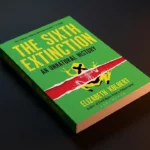
“Right now we are in the midst of the Sixth Extinction, this time caused solely by humanity’s transformation of the ecological landscape.”
Welcome to the Holocene period.
The only time ever, in history, when a single species has influenced the climate on the earth to the point of causing massive extinctions and rapid global climate changes. Let that sink in for a second. Out of the roughly 4.5 billion years this planet has been spinning, ONE species — us — managed to reshape the entire biological landscape in what amounts to a geological blink of an eye.
Elizabeth Kolbert’s The Sixth Extinction introduces you to various species that have, at one point in time, existed, and then within a few generations, gone into extinction… because of human causes. She travels around the world — from tropical rainforests to frozen tundra — documenting the evidence firsthand.
Now, I’ll be honest. There is a lot of “in the field” storytelling, of how the author felt during her adventures, which sometimes feels irrelevant to the greater point of the book. But I’ll get to that later.
A Brief History of Extinction Science
Before diving into the modern-day destruction, Kolbert takes you through the history of how we even came to understand extinction as a concept. And this part genuinely surprised me.
We are introduced to the ignorance of various scientists in the past, and how science gradually progressed when more evidence was discovered. For the longest time, people didn’t even believe species COULD go extinct. The idea that God would allow one of his creations to vanish was considered borderline blasphemous.
It took a French naturalist named Georges Cuvier to establish the concept in the late 1700s — by studying mammoth bones and proving they didn’t belong to any living animal. Before Cuvier, extinction literally wasn’t a thing in scientific thought. Think about that. The entire framework we use today to understand biodiversity loss didn’t exist a few hundred years ago.
Graphic Histories of Extinction
This is where the book gets intense.
The annihilation of the Auk bird of Greenland was extremely graphic, with humans completely decimating and abusing the birds in every possible way. Sailors would herd them onto planks, club them to death, and boil them down for oil. These birds couldn’t fly and had zero fear of humans — which made them the easiest targets imaginable. They were essentially wiped off the planet because they were convenient to kill.
We culminate with the discovery of human ancestors from many hundreds of thousands of years ago, as well as how humans committed potential mass genocide and “assimilation” of the Neanderthals (which are about 1–4% of European DNA). So not only have we been driving other species to extinction — we may have done it to our own cousins. That’s a heavy realization.
Invasive Species — Our Accidental Weapons
Another interesting point is human involvement with introducing invasive species to new ecosystems. This chapter really got me thinking about how interconnected everything is.
What happens is the new species has no natural predators in the new ecosystem, or the existing animals have no defenses, and therefore, the new species quickly dominates its surroundings. Kolbert gives the example of a fungus that’s wiping out frog populations across the globe. Frogs that survived MILLIONS of years of evolution are being destroyed in a matter of decades because of a pathogen that humans spread through international trade and travel.
It’s the same pattern every time — humans move stuff around the planet at a speed that evolution simply cannot keep up with. We’ve essentially collapsed the natural barriers that kept ecosystems separate for millions of years.
Climate Change and the Bigger Picture
Here’s what surprised me about this book. I wouldn’t say the author places a big emphasis on climate change due to pollution and other human-induced causes. The focus is more on telling the story of the various animals that modern humans have annihilated — and how.
Whether it was through climate change, hunting, or the spread of diseases and predatory animals that are non-native to an ecosystem — the common thread is always US. Every chapter, different species, different continent, same culprit.
Kolbert also discusses ocean acidification — how increased CO2 levels are literally changing the chemistry of the sea. Coral reefs, which support an enormous percentage of marine biodiversity, are dissolving. This isn’t a prediction about the future. It’s happening RIGHT NOW.
The Pattern We Can’t Ignore
What stuck with me most is the pattern Kolbert reveals across all five previous mass extinctions. Each one was caused by a dramatic change to the environment — asteroid impacts, volcanic eruptions, ice ages. The sixth one? It’s us. We ARE the asteroid.
And the speed at which it’s happening is unprecedented. Previous extinctions played out over hundreds of thousands or even millions of years. We’re doing it in centuries. The rate of species loss today is estimated to be hundreds of times higher than the natural background rate. That’s not a small margin of error — that’s a MASSIVE acceleration.
Final Thoughts
This is a great book if you want to learn about the annihilation of various species caused by humans. Kolbert is a talented writer, and her reporting is thorough. She won the Pulitzer Prize for this one, and I can see why — the research is solid and the scope is ambitious.
But it can get boring with the storytelling of the author’s adventures. Some chapters spend too much time describing the logistics of getting to a remote field site when I just wanted to hear more about the science and the extinction itself.
As well, the author does not make a clear point of why we should preserve species that are about to go extinct, other than because “it feels good” or because of “being one with nature” (my own opinion of her emphasis in this book). I would have liked a harder argument — economic, ecological, practical — for why biodiversity matters beyond sentimentality. But maybe that wasn’t the book she was trying to write.
Ultimately, The Sixth Extinction is one of those books that shifts your perspective. You walk away looking at the natural world differently — and feeling a bit more responsible for what’s happening to it.
4/5
Thanks for reading.
— Leonidas
