
“We sometimes forget that though the data should be pure and straightforward, science is done by people, who are never either.”
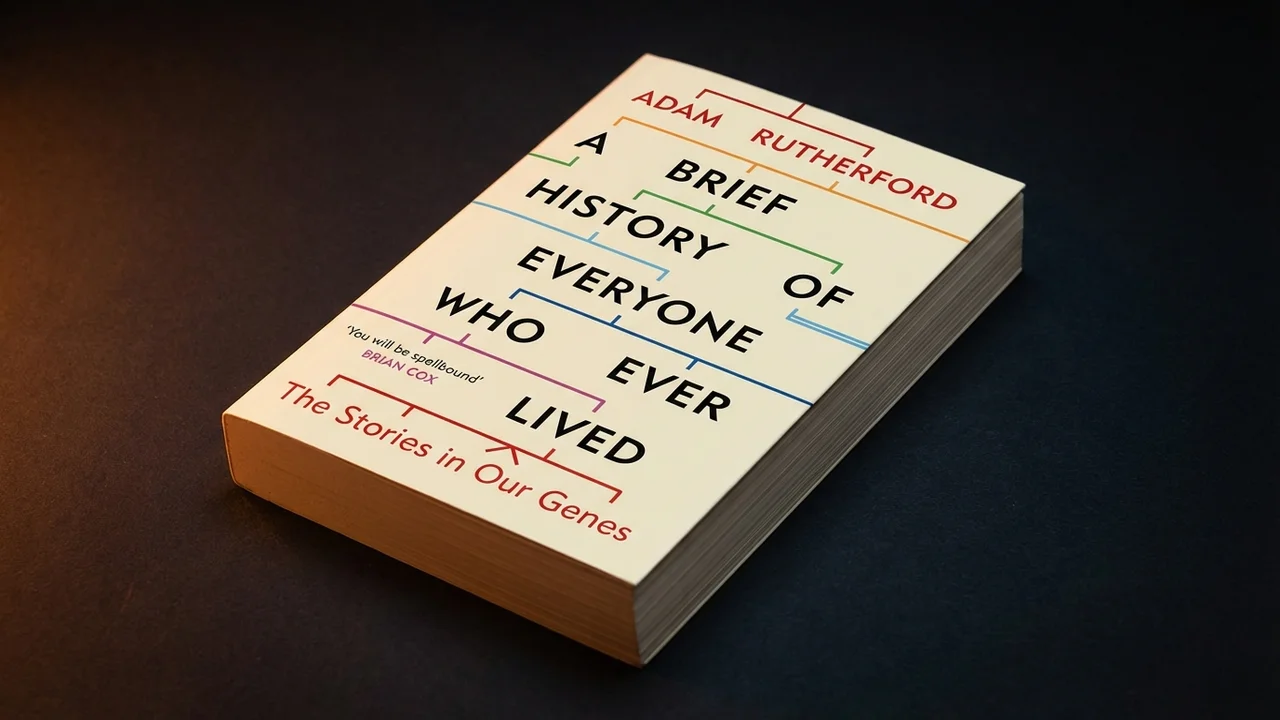
This is definitely one of my most favorite books of all time now. I read this while taking out my friend’s dog for walks on a daily basis, so it’s a good walk-and-read kind of book as well. There are many interesting deep discoveries, that I’ll share with quotes from the book:
Sex with Everything
Around a million years ago, somewhere in Africa, a group of humans lived who were to be separated into us, the Neanderthals, and the Denisovans. Just like with Homo sapiens, the Neanderthals mated with the Denisovans too. Whenever humans met — sapiens, Neanderthal, Denisovan — they had sex. The observation that there is less Neanderthal DNA on our X chromosomes implies that the first encounters we had with them that resulted in procreation were male Neanderthals with female Homo sapiens. Our genomes are slowly purging themselves of Neanderthal DNA, which suggests that these matings were not to our advantage, but not massively disadvantageous. Our DNA around Neanderthal chunks is undergoing weak negative selection. The seven billion of us alive today are, according to all the evidence available to us, the last remaining group of human great apes from a set of at least four that existed 50,000 years ago. We carry the past with us. There was no beginning, and there are no missing links, just the ebb and flow and ebb again of living through epochs. Those ancient people never went extinct — we just merged.
On a Diet
The “Paleo Diet” is a popular fad that eschews processed foods and carbohydrates in favor of the only foods imagined to be available to the hunter-gatherers of the Paleolithic: no dairy or processed grains, no lentils, beans, peas, or other human-designed veg. Nuts are OK, but no peanuts, as they’re a farmed product. It is almost certainly built on bunkum foundations, as indeed most fad diets are. The absence of lactase, or its reduced activity, means that the lactose doesn’t get digested in the small intestine, so it passes into the colon, where it encounters bacteria that can break it down and it ferments, causing gas buildup. That’s the direct cause of the bloating and fartiness, but also the increased pressure triggers diarrhea, and so on. This is called lactose intolerance, and admittedly, though not particularly pleasant, it’s not the worst condition someone can have, and is pretty normal for most people if they drink milk into adulthood. Which is why most people don’t.
Early Europeans
The Yamnaya (the Proto-Indo-Europeans) came from the Russian Steppes, driving sheep, riding wagons, making bronze jewelry, and covering their dead in ochre as part of ritual burials. They came and rapidly their way of life spread into middle Europe, bringing their culture and genes, and their fair skin. We can say with confidence that the Africans who populated the Middle East and southern Europe 50,000 years ago were dark-skinned. We also know from the DNA of burials in Hungary and Spain and the man from Loschbour in Luxembourg that these hunter-gatherers had dark skin around 8,000 years ago. There’s no trace of genetic fair skin between those two dates. This supports the idea of a single, small population seeding the continents, and — unlike in Europe or Asia — these people being cut off, with little admixture from new populations for thousands of years, at least until Columbus.
Who Are the British
The acres and tons of archaeological evidence for 400 years of the Roman Empire in Britain are rich and wondrous. But the biological traces are comparatively absent (of Roman genetics).
Native Americans Came from the North
All Native Americans, north and south, have versions of genes relating to diet that are suited to their current environments, but born of an ancient population subject to local adaptation in the frozen north, thousands of years ago.
Early Relatives of Everyone
Chang factored that into a further study of common ancestry beyond Europe and concluded in 2003 that the most recent common ancestor of everyone alive today on Earth lived only around 3,400 years ago.
Racism
Racism is hateful bullying, and a means of reinforcing self-identity at the expense of others: whatever you are, you’re not one of us. There are no essential genetic elements for any particular group of people who might be identified as a “race.” As far as genetics is concerned, race does not exist.
Review of Nicholas Wade
The book frequently misrepresents much of the work that is used to defend his assertion that recent evolution within so-called races explains why certain people appear to be better or worse at certain things. According to Wade, the English display a “willingness to save and delay gratification” and this is absent from certain tribal cultures. Jewish genes are “adapted for success in capitalism.” The Chinese are predisposed to obey authority (how similar this sentiment is to that of Galton expressed in the letter to the Times in the nineteenth century). These statements are unsupportable in any form based on our knowledge of history, genetics, and cognitive ability. They are also clumsy and gross stereotypes and, in my opinion, straightforward racism.
The Virgin Birth
In early versions of the Book of Isaiah, written in Hebrew, there is a prophecy that uses the word almah to describe the mother of a boy named Immanuel, meaning “God is with us.” Almah has no direct translation in English, nor in ancient Greek, but broadly means “young woman,” or “woman who has not yet borne a child.” By the time of Jesus, the Jews had adopted Greek and Aramaic, and no longer spoke Hebrew. Almah became the Greek Parthenos, which has a more specific meaning as “virgin.” It’s the root of a good biological term, parthenogenesis, used to describe the generation of young in some insects and reptiles in the absence of a male: a virgin birth. But in a mutated translation of a single word, the woman becomes a virgin, and the child becomes the Messiah, and the story of Jesus has instantaneously been transformed. Matthew and Luke render it true in the New Testament, a billion Catholics hold this as gospel, and that’s what we all sing in Christmas carols.
On the MAOA Violence Gene
The Chinese had the highest rates of defective MAOA — 77 percent — and white Caucasians the lowest at 34 percent. Do the Chinese have a reputation as being genetic warriors?
On Passing Genetics from Times of Starvation
People who were conceived during the Hongerwinter are now in their seventies, and many of them had children who are also now adults. It was not startling that so many of the survivors had so many health problems, but the fact that their children did too was a surprise. In mammals, epigenetic modifications tend to get reset each generation, but some, very limited, rare epigenetic tags appear to be passed down from parent to child, at least for a couple of generations.
On Science and Religion
Pope John Paul II pontificated, as popes do, in 1996 that evolution was more “than just a theory,” which, while being a generous bridging gesture between the magisteria of science and religion, misunderstands that theories in science, unlike in the vernacular, are the top of the intellectual pile, the zenith of descriptions of the true nature of nature. Theories are the best we’ve got. What a senseless phrase is “curiosity killed the cat.” To be incurious is to be inhuman. We did look inward into the hidden kingdoms of anatomy, then cells, and now genes. We also looked up to the skies, and down into the ground and seas, and into the invisible worlds of the atoms, and subatoms, and now the quantum realm. We are the explorers, and science is exploration.
Conclusion
I personally found this book to be an amazing look into human history from a genetic point of view. You understand humans from what they are on a biological, scientific level, rather than on a political, biased, and opinionated point of view — rather than from a human perspective. A++ Must Read.
Thanks for reading.
— Leonidas
