
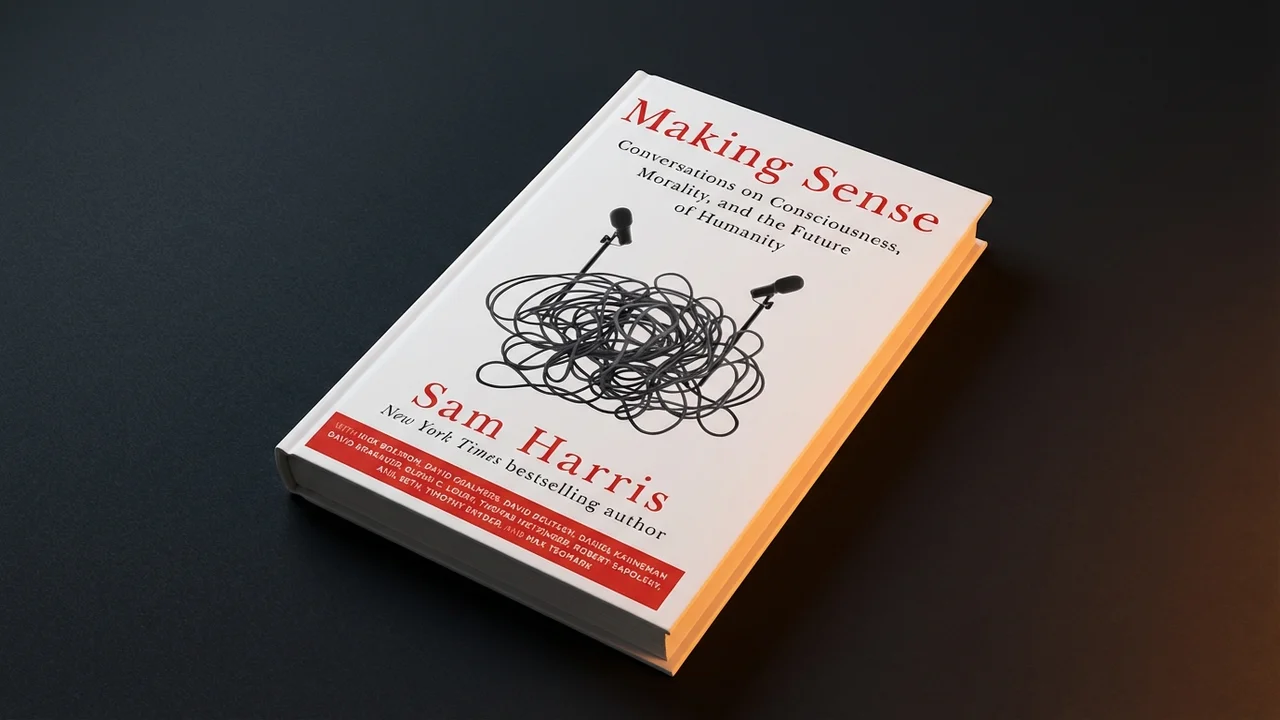

“How we pay attention to the present moment largely determines the character of our experience and, therefore, the quality of our lives.”
Have you ever sat in complete silence and tried to watch your own thoughts? Not think about your thoughts — just WATCH them? Like sitting on the bank of a river, observing whatever floats by without jumping in?
If you haven’t, Sam Harris would argue that you’re missing the single most important skill a human being can develop. And after spending years exploring meditation and consciousness — partly because of this book — I’m inclined to agree with him.
I listened to Making Sense while driving around El Salvador in July 2021. Winding mountain roads, volcanoes in the background, and Sam Harris in my earbuds calmly explaining why free will is an illusion. Quite the combination.
The Consciousness Problem
Here’s the thing that most people never stop to consider — you have NO idea what consciousness actually is. Neither does anyone else. Not neuroscientists, not philosophers, not the smartest people who have ever lived. We know that neurons fire. We know that brain activity correlates with experience. But WHY there is something it’s like to be you — why you experience anything at all rather than being a biological robot running on autopilot — nobody can explain.
Harris dives deep into this mystery and doesn’t pretend to solve it. What he does instead is argue that this mystery is precisely why you should pay attention to your own mind. Because consciousness is the one thing you can’t escape. Every experience you’ll ever have — every joy, every heartbreak, every boring Tuesday afternoon — happens WITHIN consciousness. It’s the arena for everything.
And yet most of us never bother to examine it directly.
Free Will — The Uncomfortable Truth
This is where it gets uncomfortable. Harris makes a compelling case that free will — the way most people understand it — simply doesn’t exist.
Think about it. Your decisions are influenced by your genetics, your upbringing, your environment, your brain chemistry, your mood that morning, what you ate for breakfast, and a thousand other factors you had ZERO control over. You can pop a dopamine pill and suddenly feel more motivated to tackle a project. Does that motivation come from “you” or from the chemical?
Harris isn’t saying you’re a helpless puppet. He’s saying that when you actually look for the “self” that’s supposedly making all these decisions, you can’t find it. Thoughts just appear. Intentions arise. And the feeling that “you” are the author of your thoughts is itself just another thought.
I remember the first time this really clicked for me. I was meditating — trying to focus on my breath — and I noticed a thought pop up about what I wanted for lunch. I didn’t CHOOSE to think about lunch. It just appeared. And then the thought “I should get back to focusing” appeared. I didn’t choose that one either. So who exactly is running the show?
Once you see this, you can’t unsee it. And surprisingly, it’s not depressing — it’s liberating.
Meditation Without the Mysticism
What I appreciate most about Harris is that he strips meditation of all the woo-woo nonsense. No crystals. No chakras. No incense and chanting required. He approaches it as a scientist and a skeptic who happens to have spent years studying with Buddhist and Hindu teachers across Asia.
His argument is simple — meditation is a tool for examining the nature of your own mind. That’s it. You don’t need to believe in anything supernatural. You don’t need to join a religion or wear special robes. You just need to sit down, pay attention, and notice what’s actually happening in your experience, moment to moment.
And what you’ll find, if you practice consistently, is that the constant chatter in your head — the planning, worrying, rehashing, fantasizing — is not “you.” It’s just noise. And you can learn to step back from it.
As someone who has built businesses online and traveled across dozens of countries, I can tell you — this skill is MORE valuable than any marketing tactic, productivity hack, or business strategy I’ve ever learned. Because every decision you make, every relationship you navigate, every creative problem you solve — it all starts with the quality of your attention.
AI, Morality, and the Big Questions
Harris doesn’t stop at meditation. The book pulls from his best podcast conversations on artificial intelligence, morality, and what it means to be human in an increasingly bizarre world.
The AI discussions have aged incredibly well. Harris was sounding the alarm on superintelligent AI years before it became a dinner-table conversation. His core point? We’re building systems that may surpass human intelligence, and we have ZERO guarantee their goals will align with ours.
The morality conversations are equally sharp. Harris argues that science CAN answer moral questions — that well-being is measurable, suffering is real, and we don’t need ancient texts to figure out right from wrong. Whether you agree or not, it’ll make you think.
Who Should Read This
If you’re the type of person who reads broadly — psychology, neuroscience, philosophy, technology — this is a goldmine. A curated collection of the deepest conversations from one of the sharpest thinkers alive today.
If you’re new to meditation or skeptical about it, this is the BEST entry point I can recommend. Harris doesn’t ask you to believe anything. He asks you to look. There’s a massive difference.
And if you’ve ever laid awake wondering whether you actually have free will or what consciousness even is — you won’t find definitive answers here, but you’ll find someone asking the right questions.
Final Thoughts
My only gripe is that because this is drawn from podcast conversations, some sections feel more like transcripts than polished prose. The flow isn’t always as tight as a book written from scratch. But that’s a minor trade-off for the depth and quality of the ideas.
Sam Harris is one of those rare thinkers who can take the most complex topics — consciousness, morality, the nature of self — and make them accessible without dumbing them down. He respects his audience enough to challenge them, and that’s increasingly rare.
4/5 — highly recommended for anyone interested in understanding their own mind. Which, if Harris is right, should be ALL of us.
Thanks for reading.
— Leonidas
