Despite arriving at about 7-8 am in the morning, the hotel allowed me to check in regardless, which was amazing (they didn’t let me get eaten in the lobby by mosquitoes).
Where Is Merida, Yucatán, Mexico?
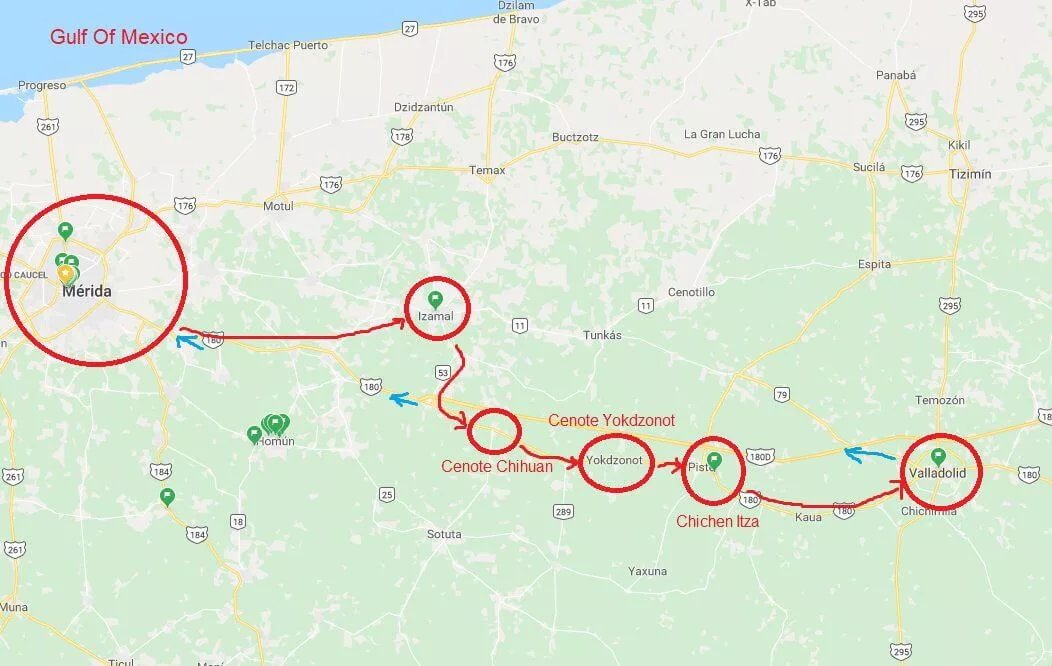
Once again, despite having 6 points of interest, we will use Merida, Mexico as our main map point.
Adventure from Merida, Izamal, 2 cenotes, Chichen Itza, and Valladolid
Mérida, Yucatán, Mexico (“The White City”)
Merida, Mexico, is/was called the ‘White City’ because of racial intolerance from the colonial Spaniards, who detested the indigenous and African populations.
Hence, the government in Merida attempted to keep itself as ethnically white as possible, for the longest time.
Yet, as of 2018, the city is composed of 60% indigenous Mayans, which is the highest percentage of any city in Mexico.
Furthermore, Merida is the capital city of the state of Yucatan, not to be mistaken with the city of Merida in Venezuela, the Philippines, and Spain.
Architecturally, the city is composed of Mayan, Spanish, French, British, and Lebanese influences throughout its history.
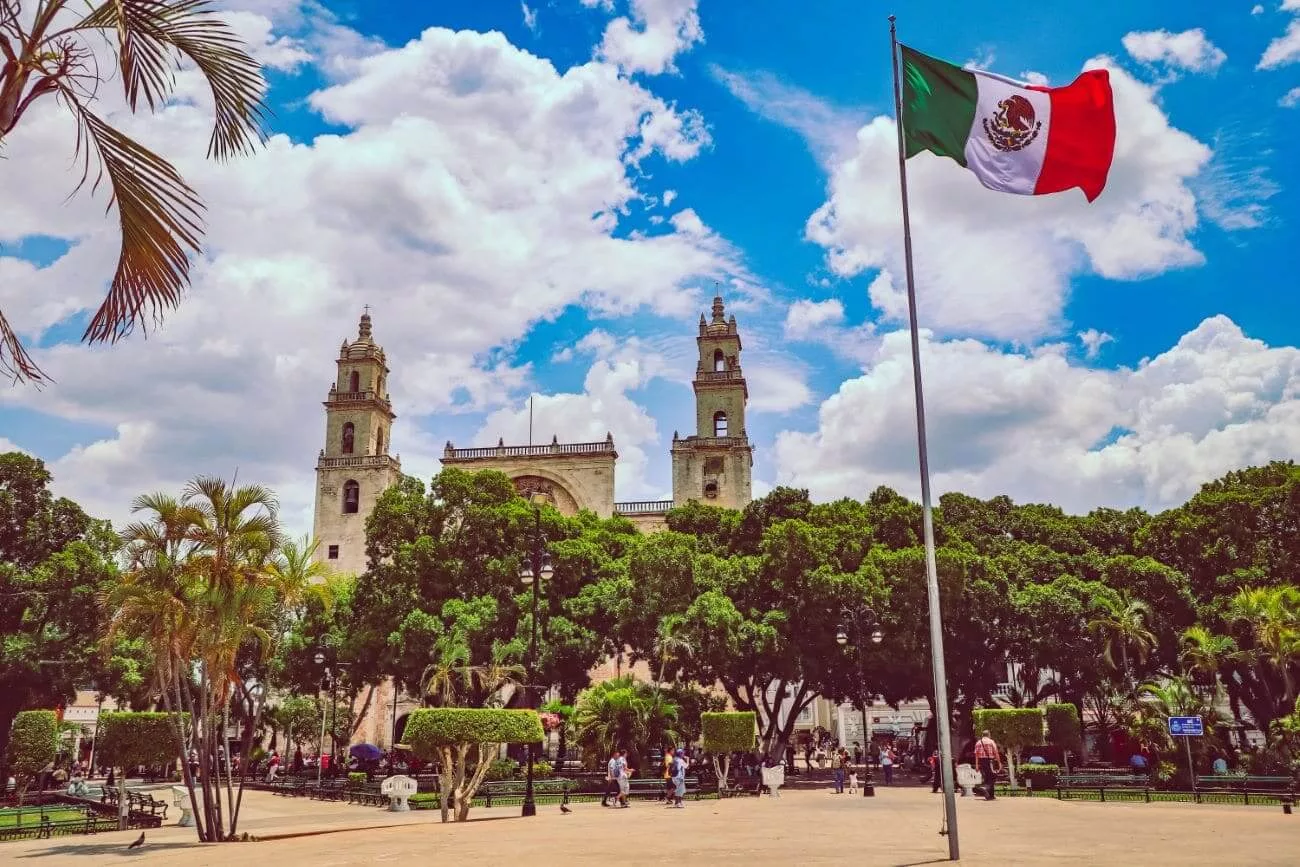
Central plaza in Merida, Mexico
The House of Montejo in the central Merida plaza
The Cathedral of Merida, finished in 1598
Palatial-style architecture in Merida is very prevalent. The ‘Palacio Canton’ for the Canton family.
Indigenous Mayan boys in the city of Merida
A statue in Merida depicting unity between the indigenous and political elite
Another colonial-era home in Merida
Colonial-era housing in Merida
Américas Park Merida, Completed in 1945, with Mayan influence
Another palatial-style home in Merida
The InterContinental Presidente Merida hotel
Buildings that look like palaces in Merida, definitely need external detailing and renovations.
The ornaments that adorn the palaces of Merida
Statues of conquistadors in Merida, examining the land during conquest
The Ermita De Santa Isabel, the yellow church in Merida
The San Sebastian cathedral in Merida (1796)
A map of all of the tourist destinations you can see from the bus in Merida
The Monumento à la Patria (Monument to the Fatherland) is probably the most beautiful sight in the city of Merida
The Monumento à la Patria (Monument to the Fatherland) is probably the most beautiful sight in the city of Merida
The Monumento à la Patria (Monument to the Fatherland) is probably the most beautiful sight in the city of Merida
Representing the indigenous populations on the Monumento à la Patria in Merida
The Monumento à la Patria in Merida
The Casa Museo Montes Molina (Museum) in Merida
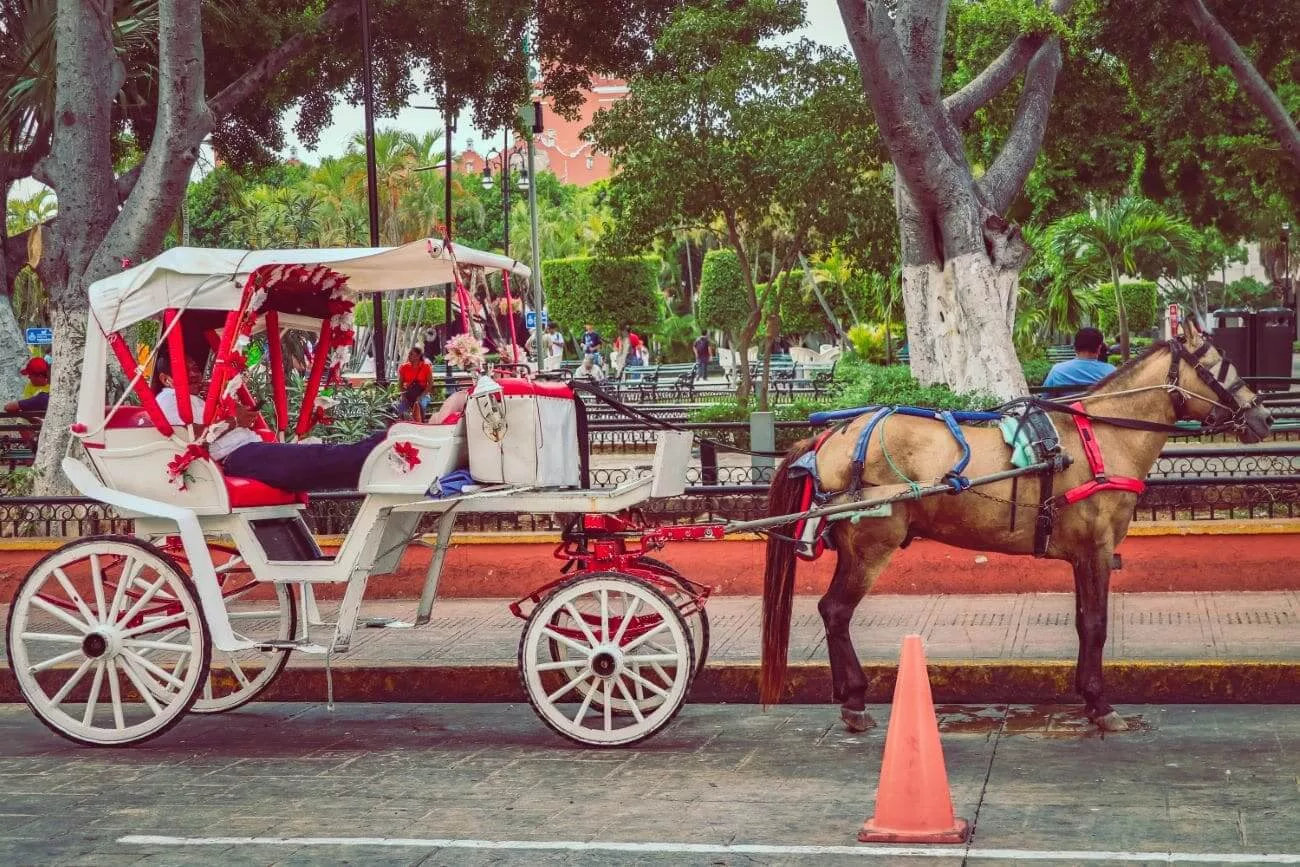
A horse-drawn carriage awaits customers in the center of Merida
Another colonial-era church in the city of Merida
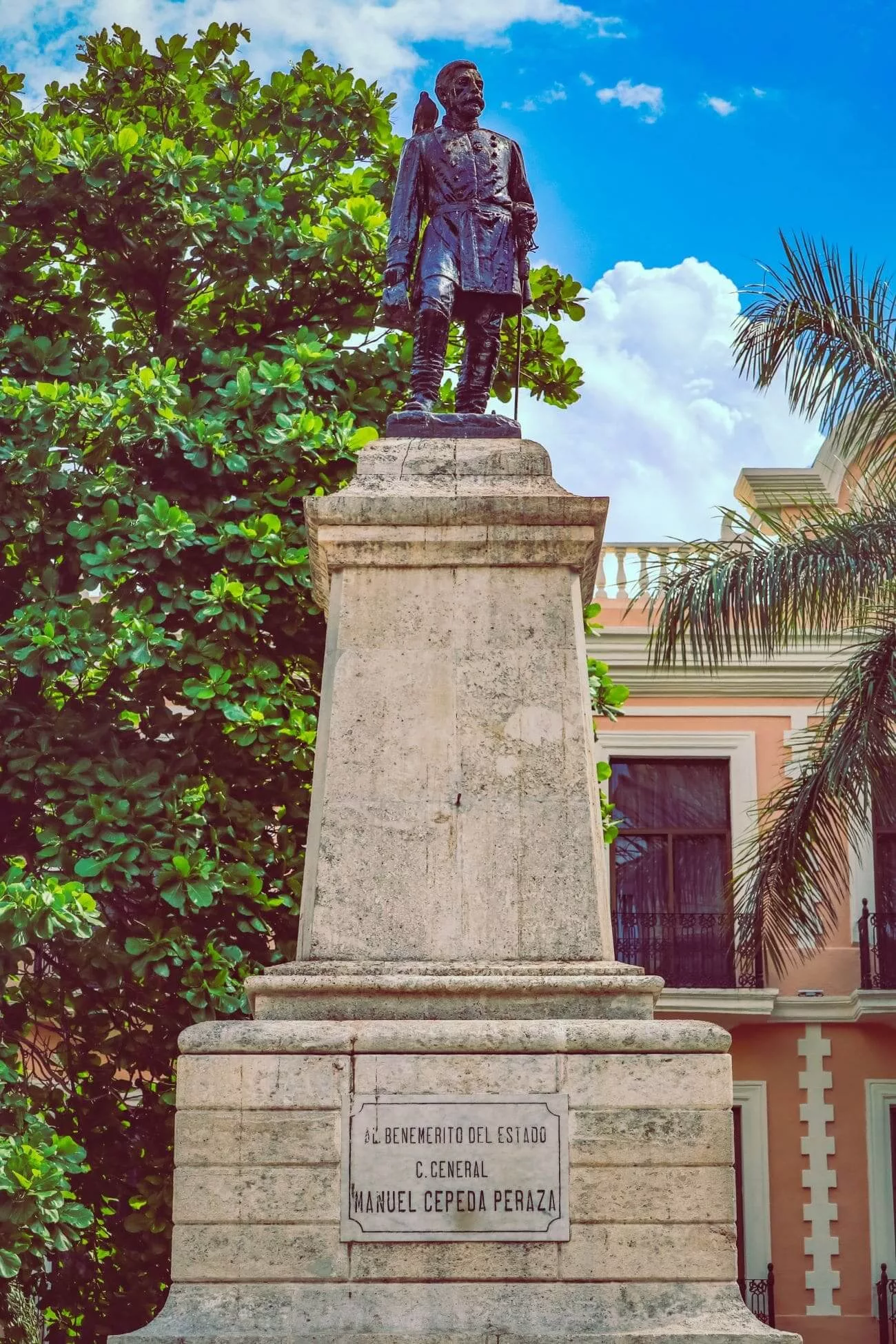
Manuel Cepeda Peraza fought during the Mexican revolution, for Independence against the Spanish empire.
A very old cathedral in the center of Merida
A statue to the ‘maternity’ or to women in Merida
Expensive tacos in the city of Merida are more stylish than usual
The bottle dance in Merida originates from the days of the Spanish Conquistadors.
Mayan performers in Merida
Mayan slaves were forced to balance bottles on their heads, while under threat of being shot, whipped, or other nasty behavior
The bottle dance eventually became a staple of Yucatan culture, despite its vicious past.
Mayan dancers perform for hundreds of tourists in Merida
Independence plaza in Merida (1821 was when Mexico gained Independence)
The ‘Yellow city’ of Izamal, Yucatan, Mexico
The city itself was created right next to giant pyramids, and is also often called the ‘city of hills’. At its pre-Colombian peak, it was the largest city in the Northern Yucatan.
The temples that existed were for the god of creation ‘Itzamna’, and for the sun god, ‘Kinich Ahua’.
Once the Spanish conquest was over, it was decided that deconstructing the temples would take too much work, so instead, a giant Franciscan Monastery was built on top instead.
The city was painted yellow to represent the brilliance of the sun, according to ancient Mayan culture.
Izamal, with the Monastery of San Antonio De Padua in the background, built atop a giant Mayan pyramid
Horses love wearing hats with flowers in Izamal, Mexico
Horse-drawn carriages await their next passengers in Izamal, Mexico
A fleet of horse-drawn carriages in Izamal, Mexico
A panorama of the courtyard in the San Antonio Monastery in Izamal
Pope John Paul the 2nd visited Izamal in 1993, giving the Virgin of Izamal a golden crown.
Inside the San Antonio Monastery in Izamal
Pope John Paul II overlooks the courtyard of the monastery
Another section of the San Antonio Monastery in Izamal
A statue of San Antonio De Padua
Christian ornaments inside the monastery
A statue of San Antonio De Padua in Izamal
Another angle of the San Antonio De Padua Cathedral in Izamal
The Parque 5 de Mayo (5th of May) in Izamal
Souvenirs for sale in Izamal
The crest of Izamal. These pyramids existed before the Spanish conquest
The yellow streets of Izamal, Mexico
Overlooking the Monastery in Izamal from the streets. You can get an idea of how large the pyramid underneath was
It’s pink-hat day for this horse in Izamal
A yellow food vendor, on yellow streets, surrounded by yellow houses in Izamal
This way to Kinich Kak Moo Pyramid in Izamal
It’s teal hat day for this horse in Izamal
Climbing up Kinich Kak Moo pyramid in Izamal
Climbing up Kinich Kak Moo pyramid in Izamal
The city of Izamal from atop the Kinich Kak Moo pyramid
Cenotes
Cenotes are underground caverns that were fed with rainwater over millions of years. In some cases, the ceiling of the cenotes never collapses, and you get a completely underground experience.
In other cases, the ceiling collapses and continues to grow over time into a pit of fresh water.
There are over 6000 cenotes in the Yucatan peninsula – some small enough for a quick dip, while others incredibly expansive enough to go scuba diving in.
Inside the Chihuan cenote. The first cenote on the tour bus
Inside the Chihuan cenote. The first cenote on the tour bus
The various gods of the Mayan calendar
The various gods of the Mayan calendar
The various gods of the Mayan calendar
The various gods of the Mayan calendar
Looking into the Yokdzonot cenote. In this case, the ceiling of the cenote collapsed, resulting in an open-air lake
The Yokdzonot cenote features very fresh and cool water. Great for a typical hot day in the Yucatan of Mexico
The depth of the Yokdzonot cenote, Mexico
Yokdzonot cenote selfie, Mexico
Chichen Itza & Intense Souvenirs
Upon arriving at Chichen Itza, there is an absolute flood of tourists (about 2.6 million+ per year), since this is the most popular pyramid to visit in all of Mexico.
The name translates to ‘At the mouth of the well of the Itza’, Itza was a powerful political and economic family in the northern Yucatan, but also translates to ‘enchanter of water’.
The city of Chichen Itza was most active from 600-1200 CE and was supported by an abundance of underwater cenotes full of fresh water.
The political elite of Chichen Itza would sacrifice victims into the cenotes for better harvests, as discovered in 1904-1910.
The rise of Chichen Itza is thought to be in correlation with the decline of the major centers of power in the southern Yucatan regions.
A nice clear-day shot of the ‘El Castillo’ (the castle) pyramid in the middle of the Chichen Itza complex
There must be at least 10,000 new Chichen Itza pyramid selfies every day being uploaded to the internet.
The Castillo Temple, photograph by Teobert Maler, 1892 (source: Wikipedia)
El Castillo as seen from inside the ball court
The entrance to the ‘Grand ball court’ in Chichen Itza
A description of the Grand Ball court in Chichen Itza
A serpent head adorns the grand ball court of Chichen Itza
Where high-status Mayans sat in the ball court in Chichen Itza
Souvenirs for sale in Chichen Itza. Here we have representations of 2 different cultures; Christianity, and Pre-Colombian.
Souvenirs for sale in Chichen Itza. A stylistic representation of Mayan warriors
Mayan souvenirs don’t all have to make sense
A good scale of El Castillo in the center of the Mayan ruins
Obesity has hit the indigenous population in Mexico quite hard
Mayan face masks for sale in Chichen Itza
Very colourful face masks for sale in Chichen Itza
Loads of souvenirs for sale in Chichen Itza
Up close to El Castillo in Chichen Itza. The dimensions and edges are done quite well
Various lizards make Chichen Itza their home
Probably the mother lizard of the lizard above
Up close and personal with El Castillo in Chichen Itza
Looking through the columns of warriors in Chichen Itza
Temple of the warriors. Each column represents a warrior
The stairs leading up to the temple of the Warriors. There is a connection between here and the Toltec capital in Tula, which uses the same cultural narrative
Leonidas and El Castillo in Chichen Itza
Valladolid, Yucatan, Mexico
Finally, the tour bus drove us to Valladolid for a quick 1.5-hour stop over to walk around and see this small town.
After exploring Mexico extensively, it looks like your average, very typical city in Mexico, with a plaza, a massive cathedral, and a ring of colonial buildings surrounding the center.
The name is derived from the Arabic ‘Ballad Al-Walid’, ‘the city of Al-Walid, referring to Al-Walid the 1st (back when the Moorish/Muslim empire controlled most of Spain).
Furthermore, the town was built on top of a Mayan town called Zaci-Val, using the stones and resources of that town.
Finally, Valladolid had 2 attempted revolts by the Mayan populations, in 1546, and in 1847, where many Europeans and Mayans died during the conflicts.
The Cathedral of “San Servacio o Gervasio” in Valladolid, Mexico at night
A Mayan woman attempts to sell her goods in Valladolid Mexico, with her baby in the back
Conclusion
Another amazing trip.
Getting here also involves the least expensive flights from the northern Americas, so if you have a chance, I definitely recommend visiting.
Nonetheless, most Canadians and Americans (from the USA) will have mentioned visiting the Yucatan, and its ruins and cenotes, since these are among the most tourist-driven areas in all of Mexico.
While the Yucatan has an abundance of Mayan ruins, and enough cenotes to visit for an entire lifetime, at this point, I wanted to start concluding my adventures in Mexico and getting back to work.
During this brief escapade, you will witness the ‘White City’ and its palatial buildings that once housed super racist Europeans, large crystal-blue fresh water caverns that were carved out by nature over millions of years, the world-famous Chichen Itza pyramids and its dozens of surrounding temples and imperial palaces, and finally two colonial towns; one that is almost completely colored in yellow, and another that witnessed two revolts by its Mayan inhabitants.
Since 2010, Leonidas has been an incredible Web Developer, and amazing Digital Marketer. He is the author of various exciting case studies in digital marketing, most notably in Pay Per Call Marketing.
Make sure to read the case studies to make your life so much better!