

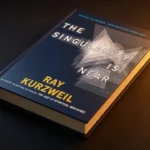
“We are entering an age of acceleration. The models underlying society at every level, which are largely based on a linear model of change, are going to have to be redefined.”
Not for the scientifically faint of heart! This book goes into such detail and precision of constructing a case for the exponentially accelerating advancement of technology that by the time you put it down, your mental model of the future has been completely rewired.
I picked this up because I kept hearing the word “singularity” thrown around in tech circles, and I had no idea what it actually meant beyond vague sci-fi hand-waving. Kurzweil doesn’t do vague. This dude brings CHARTS, data, and hundreds of pages of scientific argumentation to make his case. Whether you agree with him or not, you can’t say he didn’t do his homework.
GNR: Genetics, Nano-Technology & Robots
The key technological advancements of the 21st century, according to Kurzweil, involve GNR: Genetics, Nano-Technology, & Robots. He goes into what has already been achieved in these fields and what was underway at the time — keep in mind, this was 2005, before Watson, before AlphaGo, before ChatGPT, before any of the AI breakthroughs we now take for granted.
What’s wild is how many of his predictions have actually come true. Not all of them, sure — but a surprising number. He predicted that by the 2020s, computers would be beating humans at increasingly complex cognitive tasks. Check. He predicted that nanotechnology would start playing a role in medicine. Check. He predicted that genetic sequencing would become dirt cheap. MASSIVE check.
He wrote this two decades ago and half of his predictions are materializing. That’s either impressive or terrifying. Maybe both.
The Law of Accelerating Returns
This is the backbone of the entire book. Kurzweil argues that technological progress isn’t linear — it’s exponential. And our monkey-brains are simply NOT wired to think exponentially. We think in straight lines. We assume the next ten years will look roughly like the last ten years. But that’s not how technology works.
Moore’s Law is just one example. Computing power doubles roughly every two years for the same cost. But Kurzweil extends this concept far beyond just computer chips. He applies it to genetics, communications, brain scanning, and essentially EVERY information-based technology.
The implications are staggering. If you plot these curves forward, you arrive at a point where progress becomes so rapid that it fundamentally transforms what it means to be human. That point is the Singularity.
A Paradigm Shift
The all-encompassing volume of the Singularity is ridiculous, to the point of producing a paradigm shift in how you think about the future.
In effect, the “Singularity” is the point at which technology is doubling in performance and price efficiency so quickly that even the exponential curve exponentiates itself, and the speed of doubling becomes perceivably infinite to humans. Your brain literally can’t keep up with the rate of change.
Think about that for a second. We already feel overwhelmed by how fast technology moves today. Now imagine that pace ACCELERATING. Every year. Compounding on itself. That’s not science fiction — that’s the mathematical trajectory we’re on.
Strong AI and What Comes After
More emphasis is placed on the exponential development of “Strong” Artificial Intelligence — AI that matches or exceeds human-level intelligence across the board. Kurzweil lays out the technological and political benefits and consequences of this, and honestly, this section reads completely differently today than it must have in 2005.
Back then, strong AI felt like a distant dream. Now? We have large language models that can write code, pass medical exams, and hold philosophical conversations. We’re not AT the Singularity yet, but you can start to see the curve bending upward in real time.
Kurzweil argues that once AI reaches human-level intelligence, it won’t stay there. It will improve itself, and that self-improvement will accelerate exponentially. The gap between “as smart as a human” and “incomprehensibly smarter than all humans combined” could be shockingly small.
The Big Questions
What happens when technology supports us into the average age of 120 years? What happens when we start duplicating our consciousness into a virtual medium after our physical bodies reach their limit?
Kurzweil doesn’t shy away from these questions. And his answers, while optimistic, are grounded in the same exponential logic that drives the rest of the book.
There will always be a market for life extension and consciousness transfer in a capitalist system. The rich will be the first adopters, and quickly it will become feasible for everyone else — just like computers, cell phones, and cars before them. The pattern repeats.
Metaphorically speaking, you would be paying a fee to get into a heaven — a parallelism to the Roman Catholic Church of the 8th to 15th century. Except this time, the “heaven” might actually be real, built with silicon and code instead of faith and fear.
And if World of Warcraft had 12 million subscribers paying monthly to live in a virtual world back in 2005, it would be inevitable that people would pay to extend their consciousness into one. We’re already halfway there.
Who Should Read This
If you are into the exponential pace of technology from a scientific or innovation perspective, or want to read the details to develop a big-picture point of view, this book is definitely for you.
Fair warning though — it’s DENSE. This isn’t a casual weekend read. Kurzweil packs in an enormous amount of technical detail, graphs, and data. Some sections read more like a research paper than a book. But that’s what makes it credible. He’s showing his work.
Even if you disagree with Kurzweil’s timeline or think he’s too optimistic, the FRAMEWORK is invaluable. Once you start thinking in exponential curves instead of straight lines, you see the world differently. You ask better questions about where things are headed. And for an entrepreneur, that’s pure gold.
Final Thoughts
This is one of those books that changes how you think. Not just about technology — about the future itself. Kurzweil makes you confront the possibility that the world your grandchildren live in will be unrecognizable. Not dystopian doom-and-gloom, but genuinely transformative and mind-bending.
Is he right about everything? Probably not. But he’s right about enough that ignoring his framework would be intellectually irresponsible.
5/5 Stars — a must-read for anyone who wants to understand the trajectory of human civilization.
Thanks for reading.
— Leonidas
