
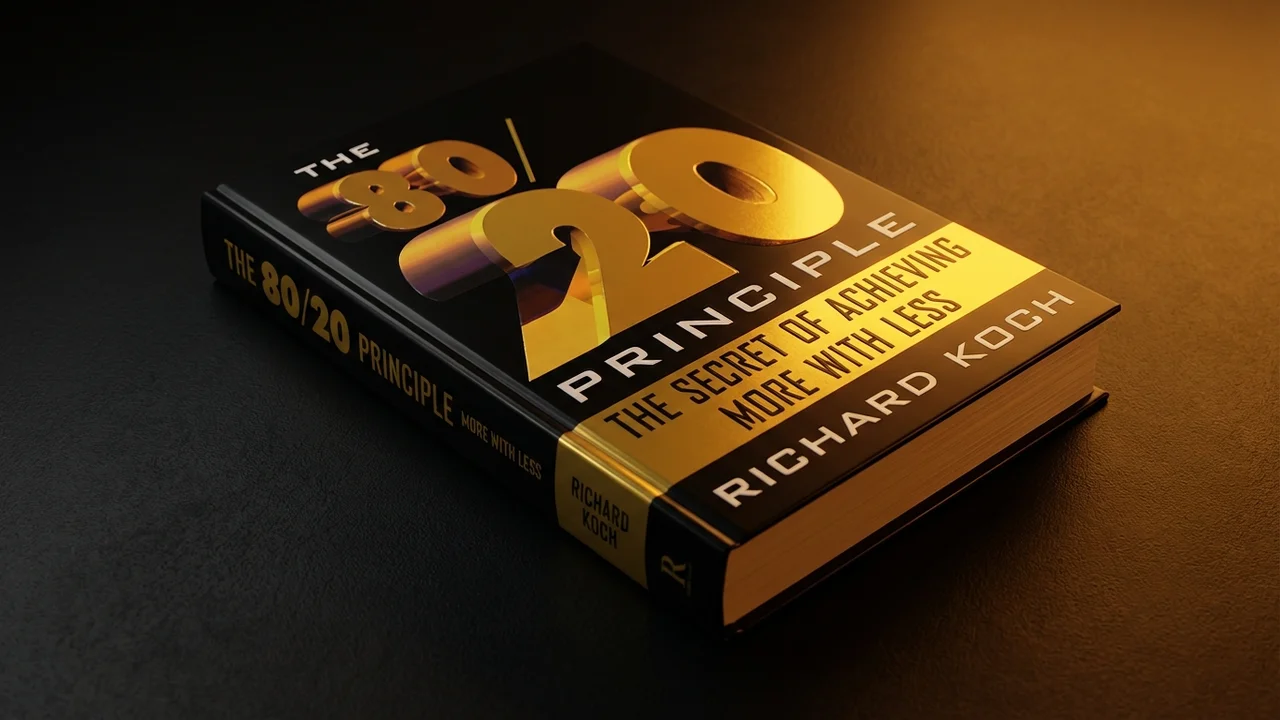

“It is not shortage of time that should worry us, but the tendency for the majority of time to be spent in low-quality ways.”
Listened to the audiobook version of this book. Honestly, only 5% of the content of this book had any real value (at least for myself). The other 95% of it was fluff. One of those books that should simply be made into an easy-to-read article.
But here’s the thing — the 5% that DID land? It landed hard. And it’s stuck with me for years. So let me tell you about that 5%, because it’s genuinely worth your time even if the book itself tested my patience.
The Concept
Based on statistical averages, 80% of your results come from 20% of your actions. Now apply this to everything. 20% of your successes, business ideas, real estate investments, friends, family, life decisions, etc. — all result in 80% of whatever.
Of course, an overgeneralization. Sometimes the ratio can be 5% action to 95% results, and so forth.
But the overall concept is: 20% of your time, investments, and ideas result in 80% of your results.
The only real reason to listen to the audiobook, or read the book, would be to build a deep conscious awareness and really dig the concept into your head. Other than that, the previous paragraph sums it all up.
Richard Koch calls it the 80/20 Principle, based on the Pareto distribution — named after Italian economist Vilfredo Pareto, who noticed that 80% of Italy’s land was owned by 20% of the population back in the 1890s. Koch takes that observation and runs with it across business, time management, relationships, happiness, and basically everything else you can think of.
Where It Actually Clicks
Here’s where the book got me thinking, despite my frustration with it. Koch argues that most people spend the MAJORITY of their time on activities that produce almost nothing. We confuse being busy with being productive. And he’s absolutely right.
I think about this constantly with my own work. When I look back at the businesses and projects I’ve been involved with, the pattern is undeniable. A handful of decisions — choosing the right niche, building the right partnerships, doubling down on what was already working — generated almost ALL of the results. Meanwhile, the hundreds of hours I spent tweaking, overthinking, and chasing shiny objects? Virtually worthless.
That’s the 80/20 Principle in action. And once you see it, you can’t unsee it.
Apply It to Your Time
The most practical takeaway from the book is about time management. Koch’s argument is simple: identify the 20% of your activities that generate 80% of your results, and then RUTHLESSLY eliminate or delegate the rest.
Sounds obvious, right? But almost nobody does it. We fill our days with emails, meetings, busywork, and obligations that feel important but contribute almost nothing. Koch would say you should spend your mornings on the ONE thing that actually moves the needle and let the rest sort itself out.
I’ve tried this approach myself. Some days I nail it — I focus on one high-impact task, knock it out, and the whole day feels productive. Other days I fall back into the trap of checking every notification and feeling “busy” while accomplishing nothing meaningful. The difference between those two types of days is enormous.
The Business Angle
For anyone running a business — especially online — the 80/20 Principle is non-negotiable knowledge. Koch points out that roughly 20% of your products generate 80% of your revenue. About 20% of your customers create 80% of your headaches. And 20% of your marketing efforts drive 80% of your traffic.
I’ve seen this play out EXACTLY in internet marketing. You launch ten campaigns, and maybe two of them carry the entire account. You build out a content library, and a handful of pages bring in the vast majority of organic traffic. You test fifty ad variations, and three or four winners generate almost all the conversions.
The smart move? Kill the losers fast and pour fuel on the winners. That’s 80/20 thinking. It sounds cold and clinical, but it’s how you stop wasting money and time on things that will never perform.
Why the Book Frustrated Me
So if the concept is this powerful, why did I say only 5% of the book had value? Because Koch falls into the classic trap of stretching a brilliant insight into 300+ pages of repetitive examples, abstract theorizing, and filler.
He applies the 80/20 rule to happiness, to relationships, to society, to corporate strategy, to negotiation — and while some of those applications are interesting, many feel like the same point repackaged in slightly different wrapping paper. By chapter eight, you GET it. You don’t need twelve more chapters.
Ironically, the book itself violates its own principle. About 20% of the content delivers 80% of the insight. Koch could have written a killer 50-page manifesto and it would have been one of the best business books ever written. Instead, he wrote a full-length book that drags in the middle.
The Concept That Keeps Giving
Despite my complaints about the book’s length, I have to give credit where it’s due. The 80/20 Principle as a MENTAL MODEL is incredibly powerful. It’s one of those frameworks that, once internalized, changes how you evaluate everything.
Should I keep working on this project? Well, is it in my top 20%? Should I maintain this friendship that drains my energy? Is this person in the vital few or the trivial many? Should I keep optimizing this underperforming campaign? Or should I cut it and redirect those resources to what’s already winning?
These are the questions the book trains you to ask. And asking the right questions is often more valuable than having the right answers.
Final Thoughts
Look, I can’t rate this book highly as a READING experience. It’s repetitive, it’s padded, and it could have been condensed dramatically. But the core concept? The core concept is an ABSOLUTE GAME-CHANGER for anyone in business, anyone managing their time, or anyone trying to get more results with less effort.
My advice: read the first few chapters, absorb the principle, and apply it to your own life. You don’t need to finish the whole thing. Koch himself would probably agree — after all, 20% of the book delivers 80% of the value.
3/5 — the concept gets a perfect score, but the execution holds it back.
Thanks for reading.
— Leonidas
