
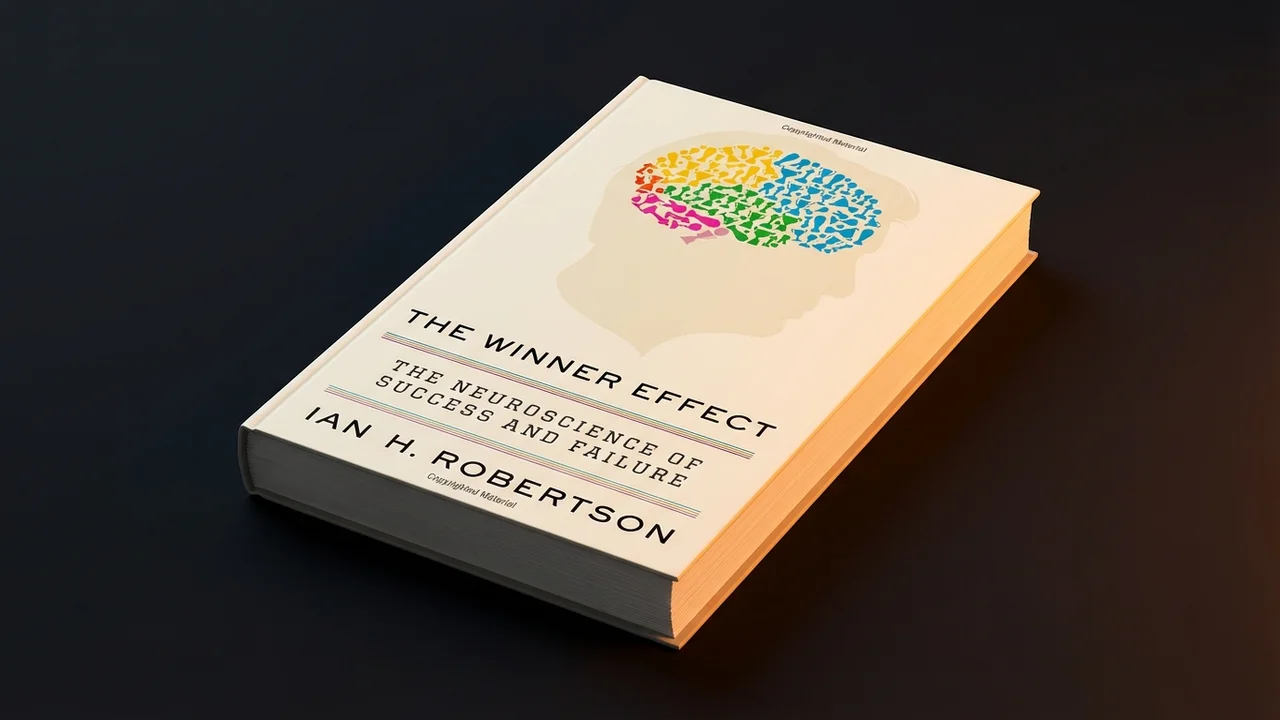

“Success changes the chemistry of the brain, making you more focused, smarter, more confident, and more aggressive. The effect is as strong as any drug.”
Have you ever noticed that some people just seem to keep winning? They get one break, then another, then another — and before you know it, they’re operating on a completely different level. Meanwhile, the people who lose once tend to keep losing, spiraling further and further down.
Is that luck? Talent? Connections?
According to neuroscientist Ian Robertson, it’s CHEMISTRY. Literal brain chemistry. And once you understand the mechanism, you’ll never look at success — or failure — the same way again.
The Winner Effect — The Core Loop
Here is a quick subjective summary of the winner effect. The more you win, the more likely you are to win in the future. Winning increases your testosterone levels, which makes you better at winning.
Losing decreases your testosterone, thus making you worse at winning.
Skilled and experienced winners react more strongly to testosterone increases, while reacting less to cortisol increases (the stress molecule). Inversely, unskilled and inexperienced winners react less to testosterone and more to cortisol.
Furthermore, skilled and experienced winners start craving more winning experiences because their risk tolerance increases as a result of their increased testosterone.
Think about that for a second. It’s essentially a biological feedback loop. Win once, and your brain reshapes itself to make the next win easier. It’s not just confidence — it’s a physiological change in your brain’s dopamine system. Robertson compares it to a drug, and honestly, that analogy is spot on. Winners get hooked on winning the way addicts get hooked on their substance of choice.
This explained SO much for me. I’ve seen it in business, in sports, in relationships — that momentum people build when things start going right. It’s not mystical. It’s testosterone and dopamine doing exactly what evolution designed them to do.
The Dark Side of Winning
But here’s where it gets interesting — and a little terrifying.
Robertson doesn’t just celebrate the winner effect. He warns about it. Because the same chemical cocktail that makes winners sharper and more confident ALSO makes them more reckless, more aggressive, and less empathetic.
This is the part of the book that really stuck with me. The idea that winning itself — unchecked, unexamined winning — can turn someone into a monster. Not because they’re inherently bad, but because their brain chemistry is literally rewiring them to care less about other people.
You can see it everywhere. CEOs who started out passionate and purpose-driven, and slowly morphed into ruthless machines. Politicians who entered office with genuine ideals and ended up corrupted beyond recognition. Athletes who dominated their sport and then self-destructed off the field.
The winner effect explains ALL of it.
Power and Empathy
The display of power and exertion of power is also a function of the winner effect, heavily influenced by increased levels of testosterone.
Powerful people also have a larger reaction to wins (testosterone-level increase) and smaller reactions to losses (cortisol-level increases).
But power causes people to turn off their empathy, and thus begin to objectify people and animals around them.
Objectification is useful during times of leadership when tasks need objective reasoning and minimal emotional influence. But objectification also regularly results in the mass sickening of people, the environment, and everything else.
Thus, power needs to be coupled with conscious awareness and greater moral judgments (although morality is relative to the culture as well).
Robertson essentially argues that power without self-awareness is a ticking time bomb. And I think he’s right. The leaders who last — the ones who don’t crash and burn spectacularly — are the ones who maintain some degree of empathy and humility even as their status climbs. That’s INCREDIBLY rare, by the way. The biological pull toward objectification is strong.
Why Losers Keep Losing
The flip side of the winner effect is equally brutal. If winning floods your brain with testosterone and dopamine, losing does the exact opposite. It raises cortisol, kills confidence, and makes you MORE risk-averse — which means you take fewer chances, which means you win less, which means you lose more.
It’s a downward spiral, and Robertson backs it up with study after study. Animals who lose territorial fights become submissive and fearful. Humans who experience repeated failure start to exhibit learned helplessness. The biology is stacking the deck against them.
This has massive implications for everything from education to entrepreneurship. If you set people up for early wins — even small ones — you’re literally changing their brain chemistry in a way that makes future success more likely. Conversely, systems that punish early failure (looking at you, traditional schooling) are biologically programming people to stay down.
Writing Style
The book itself is written in a similar format to The Power of Habit, with initial stories being sporadically connected throughout. In The Power of Habit, this was executed nicely, but in The Winner Effect, you get too many stories going on at the same time.
Sometimes the connection between the topic of the chapter is somehow loosely and esoterically tied in with some historical event. I will admit, I was confused and lost more than once due to this configuration of writing.
It’s not a dealbreaker, but it does slow you down in spots where the science is actually fascinating and you just want Robertson to get to the point.
Final Thoughts
Nonetheless, The Winner Effect is a great book to satiate your understanding of how your body works in relation to winning, and how it relates to your circle of influence and societies.
If you’re into psychology, neuroscience, or just understanding WHY some people seem to have all the momentum in the world — this book delivers. It’s one of those reads that gives you a framework for seeing patterns you’ve always noticed but couldn’t explain. The winner effect is real, it’s biological, and once you see it, you can’t unsee it.
The big lesson? Start small. Stack wins. Build momentum. And if you ever find yourself on a losing streak, recognize that your brain chemistry is working against you — and deliberately engineer a small victory to break the cycle.
4/5 stars.
Thanks for reading.
— Leonidas
