

“The only way to win is to learn faster than anyone else.”
I’ll be honest — I picked this book up expecting a manifesto for scrappy entrepreneurs. Something with battle stories, hard-won lessons, and a framework that would change how I think about building products online. And to be fair, the CORE idea here is solid. But the execution? That’s where things get complicated.
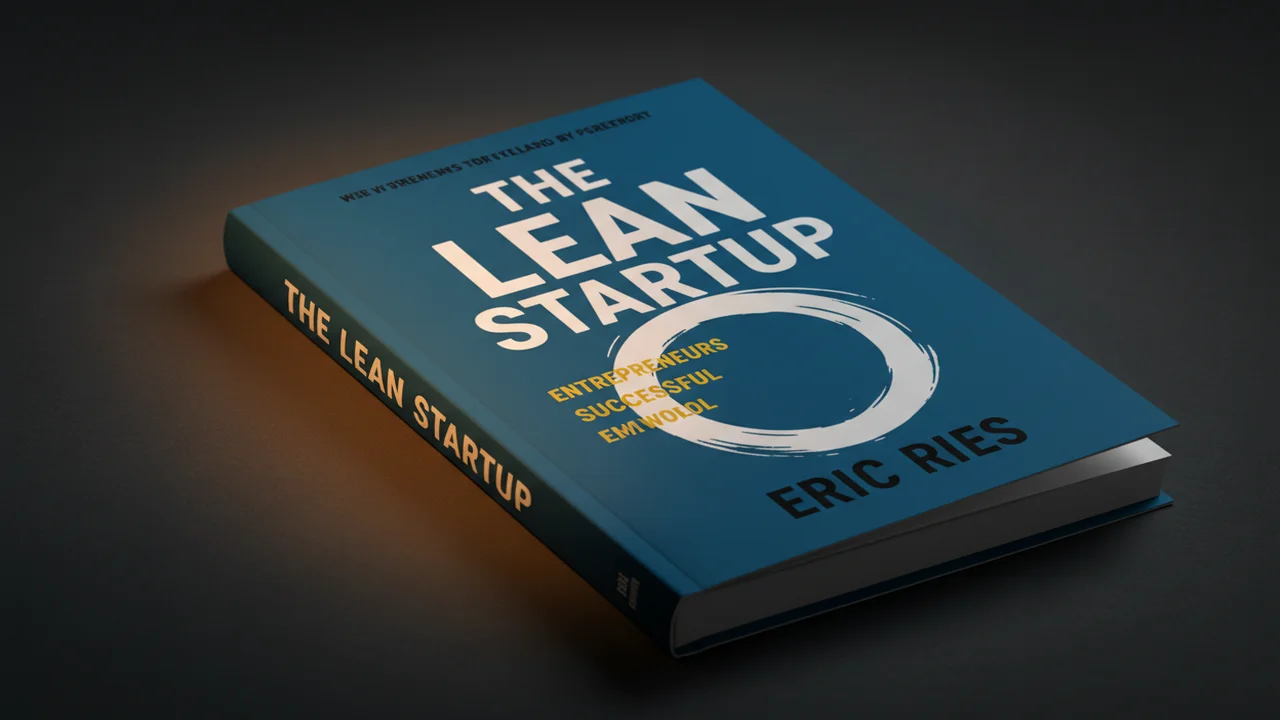
Eric Ries wrote The Lean Startup as a guide for anyone building something new under conditions of extreme uncertainty. Startups, side projects, internal corporate ventures — he argues they all follow the same principles. Build fast, measure everything, and learn from real customers instead of guessing what they want.
Sounds great on paper. But let me walk you through what actually stuck and what didn’t.
The Build-Measure-Learn Loop
The backbone of the entire book is this loop: Build, Measure, Learn. You create a minimum viable product — the simplest version of your idea that actually works — put it in front of real users, collect data on how they use it, and then decide whether to keep going or change direction.
Ries calls that direction change a “pivot,” and honestly, it’s one of the more useful concepts in the book. A pivot isn’t failure. It’s a strategic course correction based on evidence. You’re not giving up — you’re getting smarter.
I’ve done this myself with online projects more times than I can count. You launch something, nobody cares, and you either tweak it or move on. The difference is that Ries gives you a FRAMEWORK for making that decision instead of just going with your gut. That part I can get behind.
MVP — The Most Misunderstood Acronym in Tech
MVP apparently does not mean “just do it,” which the author clarifies, yet this causes some confusion. And I think that confusion extends well beyond the book. Every startup bro on the internet has turned “MVP” into an excuse to ship garbage and call it strategy.
What Ries actually means is more nuanced. The MVP isn’t the crappiest version of your product — it’s the SMALLEST version that lets you test a specific hypothesis. There’s a difference. You’re not launching half-baked junk into the wild. You’re running an experiment.
The problem is that Ries doesn’t always make this distinction clearly enough. He gives examples from companies like IMVU and Dropbox, and while they’re interesting, they feel very Silicon Valley specific. If you’re an internet marketer or a solo entrepreneur, the translation to your world requires some mental gymnastics.
Validated Learning
One concept I actually found valuable is “validated learning.” The idea is simple — instead of measuring progress by how many features you shipped or how many hours you worked, you measure it by what you LEARNED about your customers.
This hit me because I’ve fallen into that trap myself. You grind for weeks on something, feel productive because you were busy, and then realize you never actually tested whether anyone wanted what you built. Ries argues that if you can’t prove you learned something that moves the needle, you wasted your time. Period.
That’s a hard pill to swallow, but it’s true.
Launch and Optimize
Nonetheless, the author throws in some arbitrary historical “lean startup” moments and relates them to technological startups. We are then showered with attempts at shifting corporate thinking to better streamline their workflow.
I thought this was going to be an innovative book, but you can really summarize the whole thing into a single diagram for the logical thinkers that it’s geared towards.
Launch, and optimize, indefinitely. That is the concept of this book. Oh, and to make a product viral, you simply need to have an incentive for sharing.
And that’s my biggest gripe — the book takes what could be a sharp, concise playbook and stretches it into something that feels padded. By the time you hit the chapters on corporate innovation and “innovation accounting,” you’re reading the same ideas repackaged with different anecdotes.
The Silicon Valley Bubble
Here’s the thing that bugged me the most. The Lean Startup reads like it was written exclusively for venture-backed tech companies in San Francisco. The examples, the language, the assumptions about scale — it all screams Silicon Valley.
If you’re a solo founder, an internet marketer, or someone bootstrapping a business from a laptop in Southeast Asia — which was literally my situation when I read this — a lot of the advice feels disconnected from your reality. You don’t have a team of engineers. You don’t have investors breathing down your neck. You don’t need “innovation accounting” — you need revenue.
I think Ries could have made this book ten times more powerful by including examples from small businesses and solo operators. Instead, it feels like a playbook for people who already have resources. And those people, frankly, have a lot more room for error.
What I Took Away
Despite my criticisms, I walked away with a few things worth keeping.
First — stop building in the dark. Get your product in front of people as early as humanly possible. Your assumptions about what customers want are almost certainly wrong. The faster you find out, the better.
Second — pivoting is not failing. Changing direction based on data is the smartest thing you can do. Stubbornly sticking to a plan that isn’t working is the real failure.
Third — measure what matters. Vanity metrics like page views and sign-ups are meaningless if they don’t translate into actual engagement or revenue. Focus on actionable metrics that tell you whether your hypothesis is right or wrong.
Those three lessons alone are worth the read. Everything else is padding.
Final Thoughts
A very dry read, I find. Ries is not a natural storyteller — he’s an engineer who writes like an engineer. If you’ve read Michael Lewis or Malcolm Gladwell, the prose in The Lean Startup will feel like chewing cardboard by comparison.
But the IDEAS are important, especially if you’re new to the concept of iterative product development. If you’ve been in the startup world for a while, most of this will feel like common sense repackaged with a catchy acronym.
3/5 stars. Read it once for the core framework, then move on. You don’t need to come back.
Thanks for reading.
— Leonidas
