
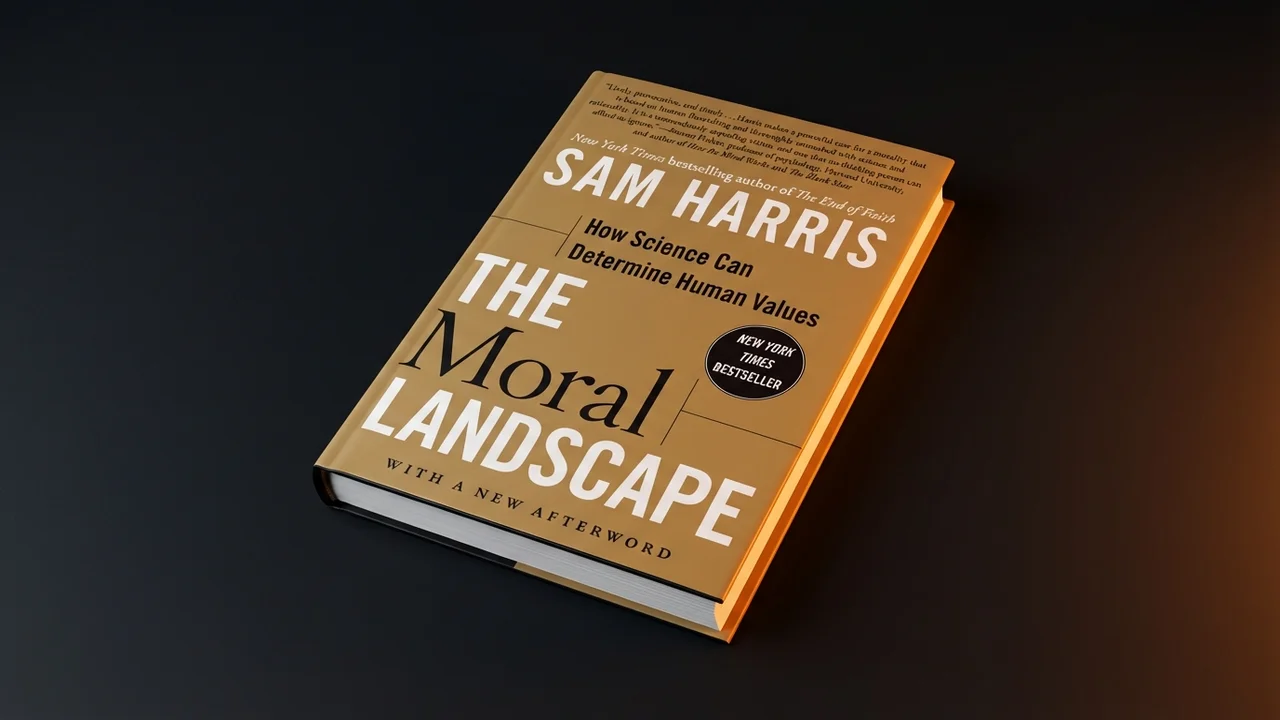
“If our well-being depends upon the interaction between events in our brains and events in the world, and there are better and worse ways to secure it, then some cultures will tend to produce lives that are more worth living than others; some political persuasions will be more enlightened than others; and some world views will be mistaken in ways that cause needless human misery.”
Blazing through all of Sam Harris’s books is on my agenda, so I admit I took this on at 1.5x audio-listening speed.
Most of it was a blur because of the high-level philosophy and mental gymnastics (I’m a huge fan of Sam Harris nonetheless).
But here’s the thing — even at 1.5x speed, the core argument of The Moral Landscape hit me like a freight train. And it’s one of those arguments that, once you hear it, you can’t unhear it.
The Big Idea
Harris’s central claim is bold and simple: science can — and SHOULD — determine human values. Not religion. Not cultural tradition. Not some dusty holy text written thousands of years ago by people who didn’t know where the sun went at night.
Science.
He argues that questions of morality are really questions about the well-being of conscious creatures. And if that’s the case, then there are objectively better and worse ways to organize a society, raise children, treat each other, and build a life. These aren’t just opinions — they’re claims that can, in principle, be studied and measured.
My main takeaway was that the moral relativism of science compared to what religion can provide is “relatively” much better.
The Moral Landscape Metaphor
The “landscape” in the title is a metaphor I keep coming back to. Imagine a landscape of peaks and valleys. The peaks represent states of maximum well-being — societies where people flourish, where suffering is minimized, where human potential is actually realized. The valleys? Those are the nightmares — oppressive regimes, widespread suffering, preventable disease, ignorance.
Harris’s point is that there are MANY peaks. There isn’t just one “right” way to live. Different cultures can reach different peaks through different paths. But there are definitely valleys. And pretending that all moral frameworks are equally valid — that we can’t say a society that stones women to death is objectively worse than one that doesn’t — is intellectual cowardice.
That’s moral relativism, and Harris absolutely demolishes it.
Why Religion Fails as a Moral Guide
With science, you try to aim for an empirical good vs. bad using studies, technology, and a general understanding of what provides humans and animals with happiness.
As opposed to Abrahamic religions (or the other ones as well), which conjure up some fantastical stories with wishy-washy ambiguous verses that have for millennia provided anything but a clear happiness for humans.
Think about it — how many wars, crusades, inquisitions, and honor killings have been justified by “God’s will”? MILLIONS of people have suffered and died because someone believed their particular holy book gave them the moral authority to inflict pain on others.
Harris doesn’t tiptoe around this. He says it plainly: if your moral framework produces more suffering than it alleviates, it’s a BAD moral framework. Full stop. Doesn’t matter how ancient or sacred it is.
The Problem With Moral Relativism
This is where the book really got under my skin — in a good way.
We live in an era where saying “that culture’s practices are wrong” is considered offensive. Harris pushes back hard on this. He argues that the reluctance to make moral judgments across cultures is itself a form of moral failure.
If a society practices forced marriage of 12-year-old girls, we don’t need to “respect their culture.” We need to call it what it is — a moral catastrophe. And we can do that not because of Western arrogance, but because we can MEASURE the suffering it causes.
As someone who has traveled extensively and seen how differently the world operates from one country to the next, this resonated deeply with me. I’ve been to places where human rights are an afterthought, and I’ve been to places where people genuinely thrive. The difference isn’t random — it’s the result of the values a society chooses to prioritize.
The Neuroscience Angle
One of the more fascinating parts of the book is when Harris brings in neuroscience. He argues that moral truths are ultimately truths about the brain — about what produces well-being and what produces suffering at a neurological level.
This is where it gets dense, I’ll admit. Harris is a neuroscientist himself, and he digs into research on empathy, belief formation, and how the brain processes moral decisions. Some of it flew over my head at 1.5x speed. But the core insight is powerful: morality isn’t some floating abstraction. It’s grounded in the physical reality of conscious experience.
If we can study consciousness, we can study morality. That’s a RADICAL claim, and I think Harris makes a compelling case for it.
Where I Slightly Disagree
Harris is incredibly optimistic about science’s ability to answer moral questions. And while I’m on his side philosophically, I think the practical reality is messier than he admits.
We can’t currently measure well-being with the precision needed to settle most moral debates. Is it better for a society to prioritize individual freedom or collective security? Science can inform that question, but it can’t settle it definitively — at least not yet.
That said, the DIRECTION Harris points us in is absolutely right. Even if we can’t answer every moral question with a brain scan today, framing morality as a question about well-being rather than divine commandments is a massive step forward.
Final Thoughts
The Moral Landscape is one of those books that challenges you to think harder about things you assumed were settled. It’s dense, it’s philosophical, and it requires your full attention — maybe don’t do 1.5x speed like I did.
But if you’re interested in the intersection of science, ethics, and religion — and if you’ve ever wondered whether morality can exist without God — this book gives you a framework that actually holds up under scrutiny.
Sam Harris is one of the sharpest thinkers of our generation, and this book is a prime example of why. Whether you agree with every argument or not, it will MAKE you think. And that’s worth the price of admission.
3.5/5 — recommended for anyone interested in philosophy, neuroscience, and the case for secular morality.
Thanks for reading.
— Leonidas
