
“The things that go well are largely unintended; the things that go badly are largely intended.”
Every single epic or terrible idea that you have ever had in your life has never been your own.
In fact, every idea in human society has been a collection of ideas that have “evolved” from a long history of ideas.
But the most successful and prominent ideas that pervade our societies have not come from the top levels of power, but instead, from the very small, slow processes of millions of humans doing little things.
The idea that successful ideas are created from the top comes from a human tendency for assuming everything has an intelligent design and designer.
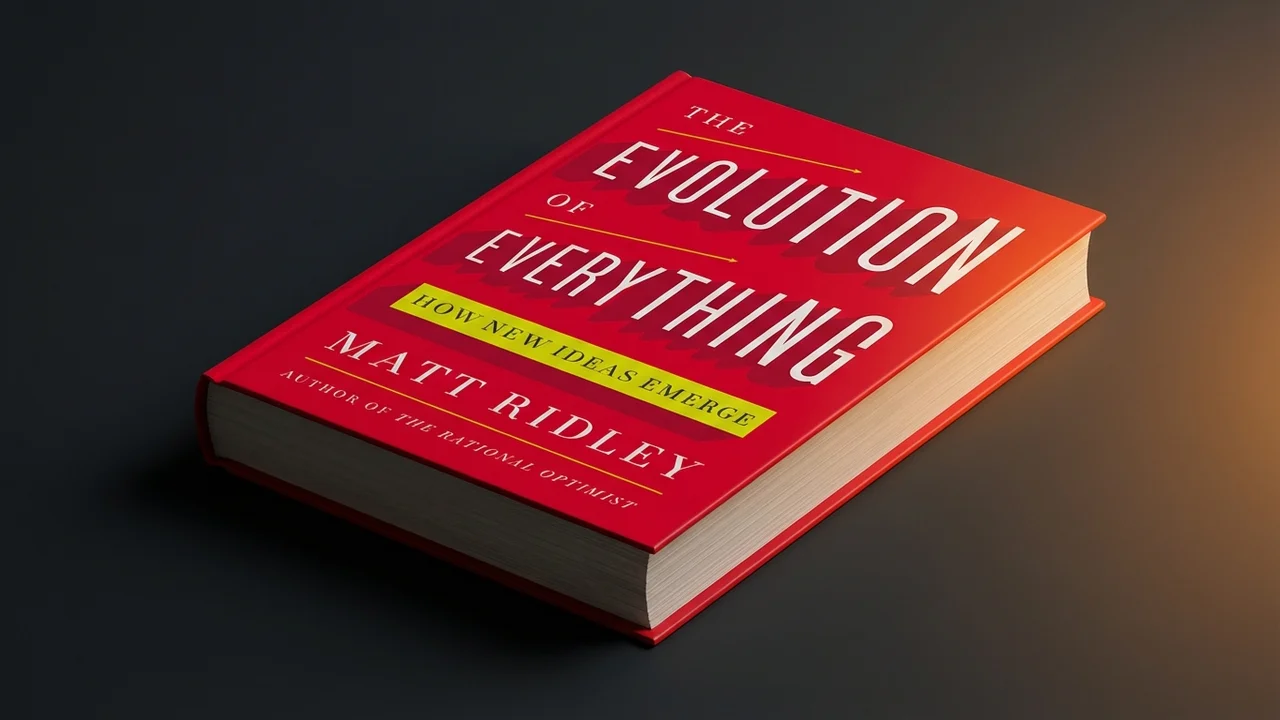
If you read my review of The Rational Optimist — also by Matt Ridley — you already know this dude is one of the most compelling science writers alive. The Evolution of Everything takes his ideas even further. Instead of just arguing that life is getting better, he asks WHY it gets better — and his answer is evolution. Not just biological evolution, but the evolution of literally everything.
Survival of the Best Ideas
The theory of this book is that our ideas on everything in life came from an evolutionary process of many other ideas — the ones that worked lived on, and the ones that didn’t would mostly die out.
This process of survival of the best ideas, or evolution, pertains to the “universe, morality, genes, the economy, culture, technology, the mind, personality, population, education, history, government, God, money, and the future.”
Ultimately, even the ideas we have now will eventually evolve, change, or die out.
Thus, holding on conservatively to ideas and making them part of your personality doesn’t constitute a winning strategy, especially when a better idea may come along in the future.
That last point is HUGE. How many people do you know who cling to their beliefs like a life raft? Politics, religion, business strategies — once something becomes part of your identity, you stop evaluating it rationally. Ridley’s message is clear: let ideas compete, and let the best ones win.
Bottom-Up vs. Top-Down
This is the central theme of the book, and it’s the one that stuck with me the most. Ridley argues that the greatest advances in human civilization — technology, culture, morality, economics — were NOT designed by some genius at the top. They emerged from the bottom up.
The internet wasn’t invented by a government committee. It evolved from thousands of engineers, hackers, and entrepreneurs tinkering in garages and labs. Language wasn’t designed by a linguist — it evolved from millions of people needing to communicate. Even morality evolved gradually as societies figured out which rules helped them cooperate and survive.
As someone who builds businesses online, this resonated deeply with me. The most successful marketing strategies I’ve ever used weren’t top-down master plans. They were small experiments — test this headline, try that offer, adjust the landing page — that evolved through iteration. The market tells you what works. You just have to listen.
The Illusion of the Great Man
Ridley takes a sledgehammer to the “Great Man” theory of history. You know the one — the idea that progress happens because of singular geniuses like Edison, Einstein, or Steve Jobs.
His argument? Most major inventions were discovered simultaneously by multiple people working independently. The lightbulb, the telephone, calculus, natural selection — all had multiple inventors racing toward the same breakthrough. Why? Because the conditions were ripe. The IDEAS were ready to evolve, and someone was bound to stumble onto them.
This doesn’t mean individuals don’t matter. It means the ecosystem matters MORE. Put the right conditions in place — freedom, exchange, competition — and innovation becomes inevitable. Kill those conditions with top-down control, and you get stagnation.
Evolution of Religion, Government, and Money
Some of the most fascinating chapters deal with religion, government, and money. Ridley traces how each of these evolved — not by design, but by trial and error across centuries.
Religion evolved as a social technology for binding groups together. Government evolved from tribal hierarchies into increasingly complex systems of rules. Money evolved from barter to gold to paper to digital currencies — nobody sat down and planned Bitcoin centuries in advance. Each step was an improvised response to the needs of the moment, not a master plan handed down from above.
The education chapter was particularly eye-opening. Ridley argues that formal schooling systems have barely evolved in over a century, precisely because they’re controlled from the top. Meanwhile, self-education — through books, the internet, mentors — is evolving at light speed. As someone who’s learned more from reading than from any classroom, that hit home.
And here’s the kicker — when powerful institutions try to FREEZE the evolutionary process, things go sideways. Central planning fails. Rigid dogma creates conflict. Controlled economies stagnate. The pattern repeats across every domain Ridley examines.
What I’d Push Back On
No book is perfect, and I think Ridley occasionally oversells the bottom-up narrative. Some things genuinely DO benefit from deliberate, top-down action. Public health campaigns that eradicated smallpox. Infrastructure projects like interstate highways. The space program. These weren’t evolutionary accidents — they were intentional.
Ridley acknowledges this here and there, but he could give it more weight. His enthusiasm for spontaneous order sometimes blinds him to the cases where coordination from above actually works.
That said, his overall thesis is rock solid. More often than not, the best outcomes emerge from decentralized experimentation rather than centralized planning.
Final Thoughts
If you enjoyed The Rational Optimist, this is the natural next step. Where The Rational Optimist argued that life is getting better, The Evolution of Everything explains the mechanism behind it — evolution as a universal process, not just a biological one.
Ridley writes with clarity and conviction, and his ability to connect dots across disciplines — biology, economics, technology, culture, religion — is genuinely impressive. This is the kind of book that changes how you see the world. After reading it, you start noticing evolutionary patterns EVERYWHERE.
5/5 Stars — highly recommended for anyone interested in understanding why the world works the way it does.
Thanks for reading.
— Leonidas
