
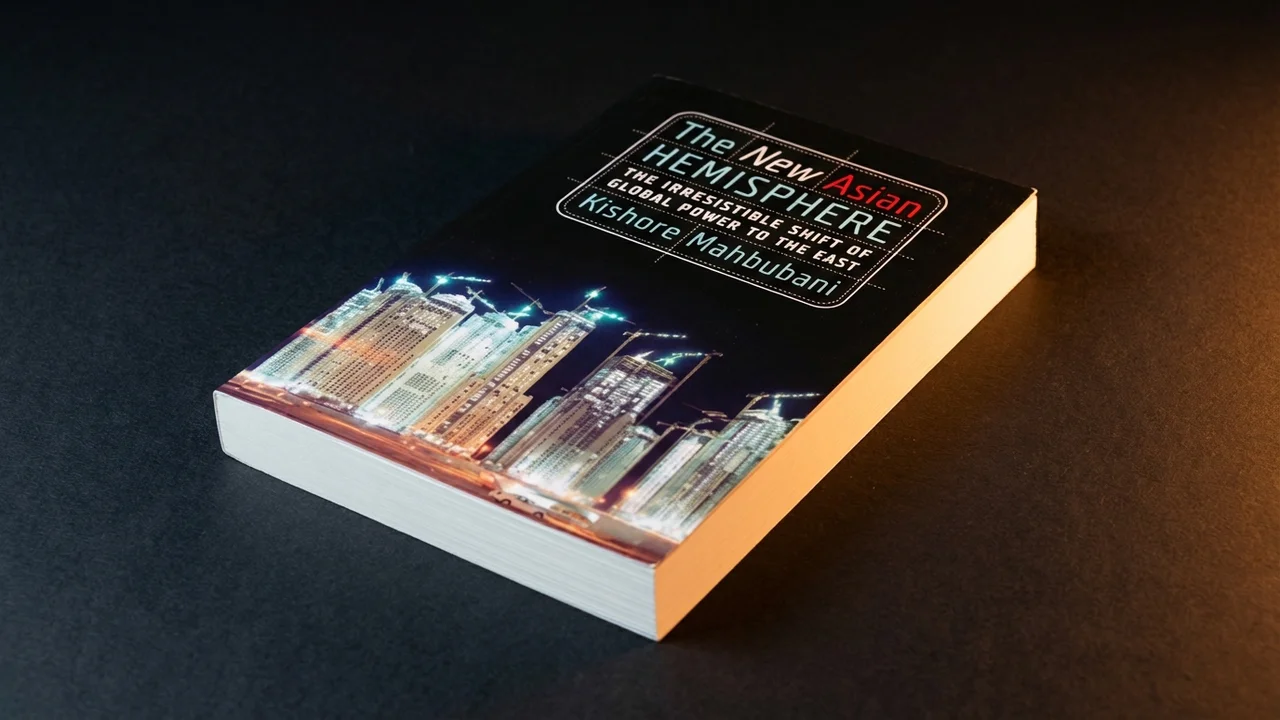

“The good news is that Asia wants to replicate, not dominate, the West. For a happy outcome to emerge, the West must gracefully give up its domination of global institutions, from the IMF to the World Bank, from the G7 to the UN Security Council.”
If you’ve travelled abroad, in particular to East Asia, this book will provide a lot of relevance to you — in particular, the rapid growth of East Asia and how it will eventually become wealthier and more powerful than the current Western societies.
I picked this up after spending time in Southeast Asia and being blown away by the pace of development in places like Singapore, Kuala Lumpur, and Bangkok. You walk around these cities and you see skyscrapers going up, infrastructure expanding, and a general energy that feels like everyone is building something. Then you fly back to the West and half the roads are crumbling and every other headline is about political gridlock. Something doesn’t add up.
Kishore Mahbubani — a Singaporean diplomat who spent decades at the United Nations — wrote this book to explain exactly what’s happening. And his central argument is simple: the era of Western dominance is ending, and Asia’s rise is not a threat but an INEVITABLE shift that the West needs to accept gracefully.
Initially, I found the generalization of the West, and in particular the United States as being the bad guy, to be slightly interesting, and perhaps a bit hyperbolic and annoying.
But the deeper I got into the book, the more I realized Mahbubani isn’t anti-Western. He’s anti-hypocrisy. And there’s a big difference.
Western Dominance and Representation
But Kishore makes some great points about the corruption of power and perceived “moral high ground” of the West — specifically, every Western and European nation adhering to what the United States wants.
Furthermore, Kishore makes some points about the United Nations and the IMF being simple puppets for Western vested interests. Both the UN and IMF are overrepresented by “Western” nations and contain minimal representation from the other regions of the world such as Asia, Latin America, and Africa.
Most importantly, Western powers try to dominate about 80% of the world, yet only comprise about 12% of the world’s population. The rest of the world, comprising 88% of the world’s population, has a limited voice within the UN and IMF.
Think about that for a second. Twelve percent of the world’s population controls the institutions that govern the other eighty-eight percent. And we call this “the rules-based international order.” Rules made by whom? For whom?
Mahbubani argues that these institutions were designed in 1945 for a very different world. The five permanent UN Security Council members? All Western or Western-aligned powers. The IMF leadership? Always a European. The World Bank? Always an American. Meanwhile, Asia has BILLIONS of people, rapidly growing economies, and virtually no proportional say in how global rules get written.
The Rise of China and India
Another major aspect is the rapid modernization of China, and subsequently India. In only the last 10 to 20 years, China has grown considerably, both economically and liberally. India is of course coming up as well.
So generally, Western interests are overrepresented in the UN, IMF, and other major global organizations. Also, we will all need to learn Mandarin soon as Chinese citizens continue to flourish economically. There will soon be 400 million Chinese citizens in the middle class — the population of the entire USA.
The “Western” nations will need to cede their power to the rising Asian nations and cooperate accordingly.
What makes this so fascinating is the SPEED at which it’s happening. It took Europe roughly 200 years to industrialize. The United States did it in about 150. China? A few decades. India is following close behind. We’re watching the most rapid economic transformation in human history, and most people in the West barely register it because they’re too busy arguing about domestic politics.
The Seven Pillars of Asian Wisdom
One of the most interesting parts of the book is Mahbubani’s framework for why Asia is succeeding. He identifies what he calls key pillars that Asian societies adopted — largely FROM the West, by the way — and are now executing better than the West itself.
Free markets. Science and technology. Meritocracy. Rule of law. Education. These aren’t “Asian values” — they’re universal principles that Asia embraced while the West started taking them for granted.
This is the part that really made me think. The West INVENTED many of these systems, but somewhere along the way it got complacent. Meanwhile, hundreds of millions of people across Asia are studying harder, working longer, and investing more aggressively in their futures. This isn’t about cheap labor anymore. It’s about ambition, discipline, and long-term thinking.
Why the West Struggles to Adapt
Mahbubani doesn’t just praise Asia — he also diagnoses why the West has such a hard time accepting the shift. And his answer is essentially: ego.
For 200 years, Western civilization has been THE dominant force on the planet. That creates a deep psychological assumption that Western ways are simply the best ways. Democracy, free speech, individual rights — treated as universal truths rather than one civilization’s approach to governance.
Are they good ideas? Absolutely. But Mahbubani’s point is that you can’t FORCE them onto other societies and then act surprised when it doesn’t work. Iraq, Afghanistan, Libya — the track record of Western-imposed democracy isn’t exactly stellar.
Singapore didn’t become one of the richest countries on Earth by copying American democracy. China didn’t lift 800 million people out of poverty by following a Western playbook. These countries found their own paths, and the results speak for themselves.
Final Thoughts
Near the end of the book, it felt more like a giant news article dated for 2007–2008 (time of writing) and the events and politics of that particular time.
That’s the one real weakness. Some of the specific examples — references to the Bush administration, the Iraq War debate, particular UN votes — feel dated now. But the core argument hasn’t aged a day. If anything, everything Mahbubani predicted has only ACCELERATED since the book was published.
I recommend reading this book to become conscious of why the Asian nations will soon transcend Western nations in power and economy.
If you’ve read The Hundred-Year Marathon by Michael Pillsbury — which I also reviewed — pair it with this one. Pillsbury gives you the American perspective on China’s rise. Mahbubani gives you the Asian perspective. Read both for a complete picture of the biggest geopolitical shift of our lifetime.
4/5 stars.
Thanks for reading.
— Leonidas
