
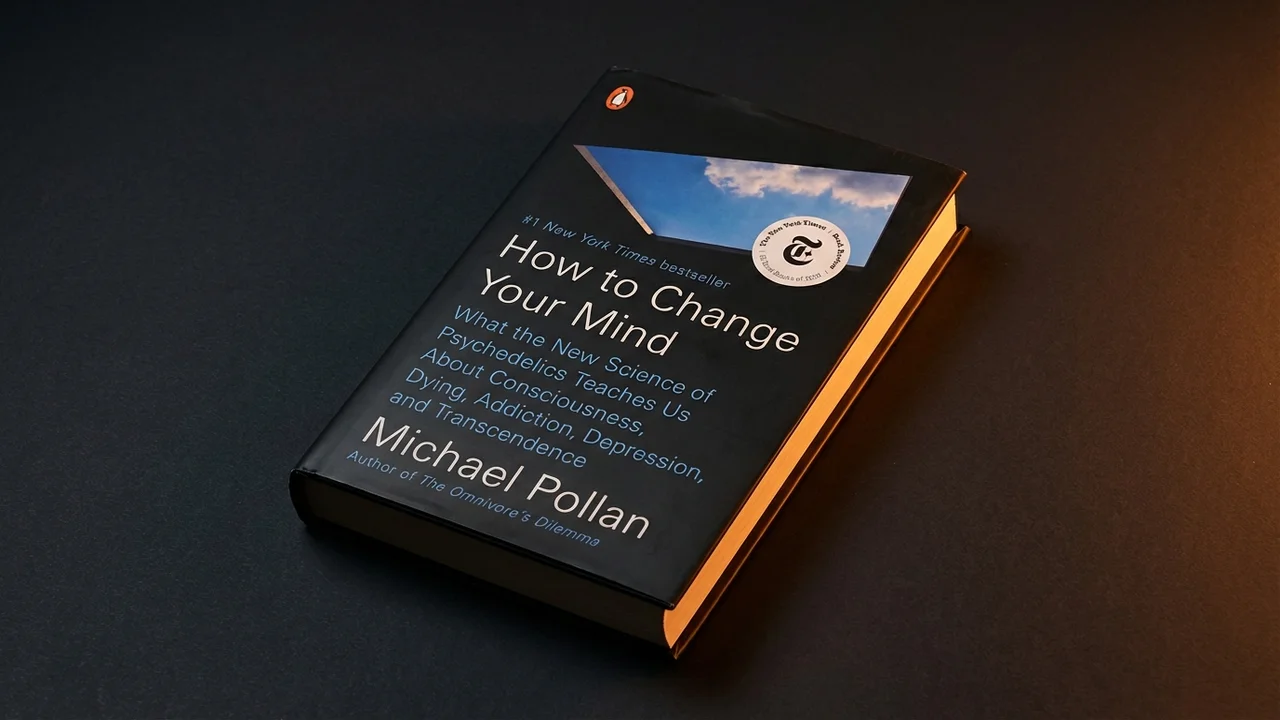

“The betterment of well people, is that not a legitimate use of a drug?”
What if I told you that some of the most promising treatments for depression, addiction, and end-of-life anxiety involve a substance that’s been illegal for over fifty years?
Sounds crazy, right? Well, that’s exactly what Michael Pollan explores in How to Change Your Mind — and by the end, you’ll be wondering why we ever stopped researching psychedelics in the first place.
I picked this book up because I’d already been fascinated by the topic. I’ve traveled through parts of Central and South America where psychedelic plants are woven into indigenous cultures. When I was in Real de Catorce — a tiny Mexican town you can only reach through a mountain tunnel — I almost tried peyote myself but ultimately decided against it. The curiosity has always been there. Pollan gave me the science and history to back it up.
The History We Forgot
Here’s something most people don’t know. In the 1950s and early 1960s, psychedelics were one of the most promising areas of psychiatric research. LSD was being used in clinical settings to treat alcoholism, depression, and anxiety in terminal patients. Thousands of papers were published. The results were remarkable.
Then the counterculture happened. Timothy Leary turned LSD into a political weapon, the government panicked, and by 1970, psychedelics were classified as Schedule I — meaning no accepted medical use and high potential for abuse. Overnight, decades of legitimate research went into the trash.
Pollan traces this entire arc with precision. The rise, the fall, and now — the quiet return. Because starting in the early 2000s, researchers at Johns Hopkins, NYU, and Imperial College London began picking up where the 1960s left off. And the results are, once again, EXTRAORDINARY.
What Psychedelics Actually Do to Your Brain
This is where the book really grabbed me.
Pollan explains the concept of the “default mode network” — essentially, the part of your brain responsible for your sense of self, your ego, your internal narrator. It’s the voice in your head that never shuts up. The one that tells you who you are, what you should worry about, and why everything is about YOU.
Under psilocybin, the default mode network goes quiet. The rigid patterns of thought that define your everyday consciousness begin to dissolve. New connections form between parts of the brain that don’t normally communicate. It’s like shaking a snow globe — everything gets rearranged, and when it settles, the landscape looks different.
For people stuck in loops of depression, addiction, or existential dread, this reset can be LIFE-CHANGING. Not metaphorically — clinically. Patients in the Johns Hopkins trials reported that a single psilocybin session was among the most meaningful experiences of their entire lives.
That’s not hype. That’s peer-reviewed research.
Pollan Goes First-Person
What makes this book more than just a science review is that Pollan doesn’t stay behind the desk. He actually tries psychedelics himself — LSD, psilocybin mushrooms, and 5-MeO-DMT (the toad venom one). And his descriptions of these experiences are some of the best writing I’ve ever read on the subject.
The psilocybin trip where his sense of self completely dissolved? Genuinely moving. He describes losing his ego — not in the casual way people throw that word around, but ACTUALLY experiencing the disappearance of the boundary between himself and the world. And instead of terror, he found… peace. A profound sense of connection to everything.
Now, I’ve read Pollan before. I reviewed This Is Your Mind on Plants and gave it an A+. The man writes like his words are made of silk. But in this book, his prose reaches another level — because he’s describing experiences that push language to its absolute limits. How do you put “ego dissolution” into words? Somehow, Pollan manages it.
The Therapeutic Promise
Let’s talk applications, because this is where it gets real.
Cancer patients facing terminal diagnoses were given psilocybin in controlled settings. Many reported that their fear of death simply… vanished. Not temporarily. Months and years later, they maintained a sense of peace about dying. For people consumed by existential terror, this is nothing short of miraculous.
Smokers who had failed every other cessation method quit after two or three psilocybin sessions — with an 80% success rate. Compare that to the 7% success rate of nicotine patches. Alcoholics, people with treatment-resistant depression, patients with PTSD — the early results are incredibly promising across the board.
Think about that. We’ve spent decades throwing SSRIs at depression — drugs that need to be taken DAILY and come with a laundry list of side effects. Meanwhile, a single guided psilocybin session is showing comparable or better results in clinical trials. The implications are massive.
Why This Matters Beyond Medicine
Pollan raises a question that stuck with me long after I finished the book. If psychedelics can genuinely help healthy people gain insight, creativity, and a deeper sense of connection — should that be considered a legitimate use?
We don’t bat an eye at someone drinking coffee to enhance focus or having a glass of wine to unwind. Yet a substance that could expand your understanding of consciousness remains illegal in most of the world. The hypocrisy is the same one Pollan exposed in This Is Your Mind on Plants — society’s rules about mind-altering substances have nothing to do with science and everything to do with culture, politics, and control.
As someone who practices meditation daily, I was struck by the parallels between psychedelic experiences and deep meditative states. Both quiet the default mode network. Both produce lasting changes in perspective. The difference? Meditation takes years of disciplined practice to achieve what psilocybin can produce in a single afternoon.
Final Thoughts
This is one of those books that genuinely shifts how you think about consciousness, mental health, and the arbitrary lines society draws around what’s acceptable. Pollan doesn’t preach. He investigates, experiments, and reports — with the intellectual honesty and gorgeous prose that make him one of the best nonfiction writers alive.
If you’ve ever been curious about psychedelics but wanted the SCIENCE instead of the hippie mysticism, this is your book. If you’ve already read This Is Your Mind on Plants, consider this the deeper companion piece.
4.5/5 — essential reading for anyone interested in neuroscience, consciousness, or the future of mental health.
Thanks for reading.
— Leonidas
