
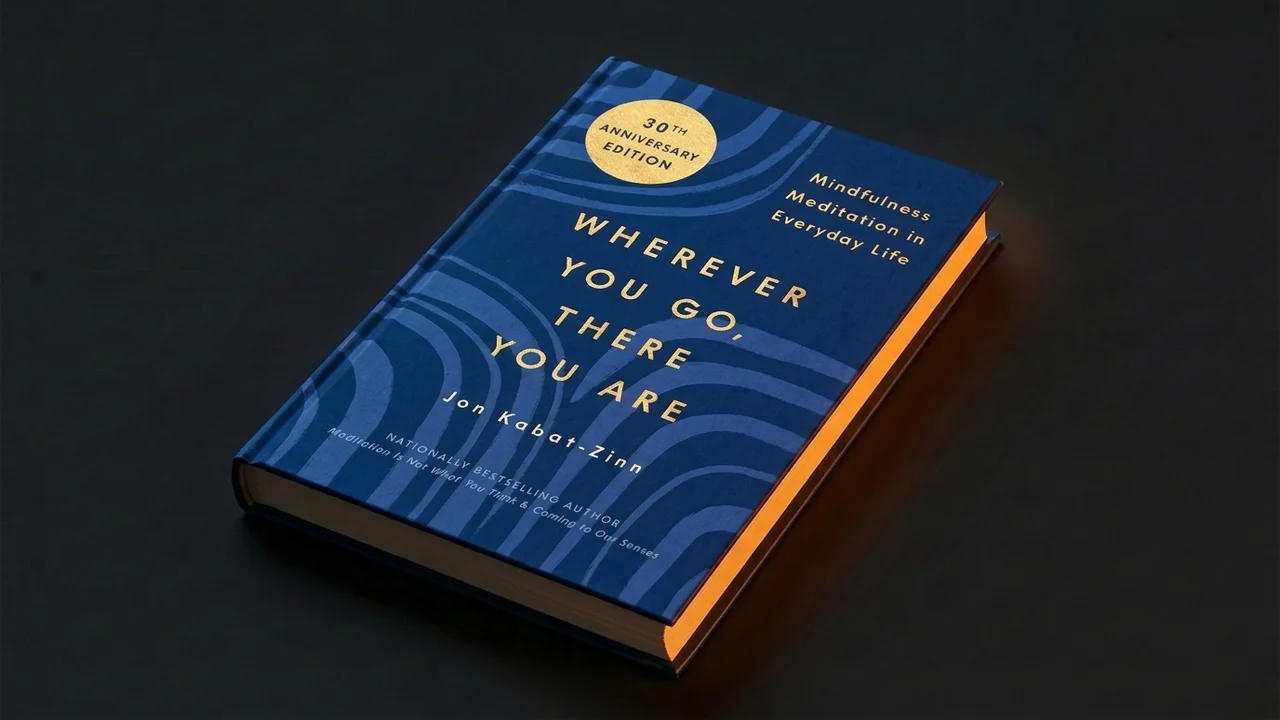

“You can’t stop the waves, but you can learn to surf.”
Here’s a question most people never think to ask: what happens when you just… stop? Not sleep. Not zone out watching Netflix. Actually stop. Sit still. Be present with whatever is going on in your head, no matter how chaotic or uncomfortable it is.
That’s essentially what Jon Kabat-Zinn is asking you to do in Wherever You Go, There You Are. And if that sounds simple, well — it is. But simple doesn’t mean easy.
I listened to the audiobook sometimes actively, but mostly passively in the car. Driving around, running errands, letting Kabat-Zinn’s calm voice wash over me between traffic lights. I think that’s actually a fitting way to consume this particular book — because so much of it is about learning to be aware during the ordinary moments, not just during some special “meditation session” on a cushion.
The Man Behind the Book
Jon Kabat-Zinn came from a doctorate degree and became a practicing monk. So I presumed this book would be a bit more objective — more science, less incense. He’s a molecular biologist by training, which is what drew me to the book in the first place. A scientist who meditates? That’s my kind of author.
He’s the guy who essentially brought mindfulness into mainstream Western medicine through his MBSR program — Mindfulness-Based Stress Reduction. Hospitals around the world use his methods to help people deal with chronic pain, anxiety, and stress. This isn’t some random guru selling crystals. This is an MIT-educated scientist who made ancient Buddhist practices accessible to regular people.
That said — the book doesn’t always live up to that promise.
The Good — A Solid Foundation
The first third of the book explains what meditation is, and the second third gives you some tips and explains what you should experience. And honestly? These two sections are GREAT.
Kabat-Zinn breaks down mindfulness in a way that even a complete beginner can understand. He’s not asking you to become a Buddhist. He’s not asking you to sit cross-legged for hours. He’s simply saying — pay attention. On purpose. Without judgment.
That’s it. That’s the whole practice.
He talks about how we spend most of our lives on autopilot — eating without tasting, walking without feeling our feet on the ground, having conversations while mentally composing our grocery list. And he’s right. I catch myself doing this ALL THE TIME. You probably do too.
One concept that really stuck with me is the idea that wherever you go, there you are. Sounds obvious, right? But think about how often we believe that changing our external circumstances will fix our internal problems. “If I just move to a new city, I’ll be happy.” “If I just get that promotion, I’ll feel fulfilled.” “If I just find the right relationship, everything will fall into place.”
Nope. You bring your mind with you everywhere. Your anxiety, your restlessness, your monkey-brain — it all comes along for the ride. The only way to deal with it is to face it directly, not run from it.
As someone who has traveled to dozens of countries, I can confirm this firsthand. I’ve sat on beaches in Thailand and explored streets in Tokyo — and my overthinking mind was right there with me every single time. No passport stamp fixes that.
The Woo-Woo Problem
Now, here’s where it gets tricky. The book was written and presented a long time ago, so it’s got a bit of a woo-woo feel in the last one-third of the book with the mountain meditation and lake meditation.
Look, I get what he’s going for. Visualization exercises where you imagine yourself as a mountain — solid, unshakable, present through all seasons. Or a lake — calm on the surface, deep underneath. It’s meant to be poetic and grounding.
But it just didn’t land for me. I’m more of a “give me the science and the practical steps” kind of reader. When a book starts asking me to visualize myself as a geological formation, I start checking out. Maybe that makes me closed-minded. Maybe I need MORE meditation, not less. But I’m being honest about my reaction.
This is also where the book’s age shows. It was originally published in 1994, and some of the framing feels dated. The mindfulness movement has evolved since then, and newer authors present the same concepts without the spiritual baggage that turns off skeptical readers.
How It Compares
It’s a good “classic” book, but there are more relevant, presentable books out on the market now. For example, Headspace and 10% Happier.
Andy Puddicombe’s Get Some Headspace — which I’ve also reviewed — takes a much more modern, practical approach. He’s a former Buddhist monk who speaks like a normal human being and gives you a clear 10-day program. Dan Harris’s 10% Happier approaches meditation from the perspective of a skeptical news anchor who had a panic attack on live TV. Both books are funnier, more relatable, and more actionable.
That said, Kabat-Zinn STARTED this whole thing. Without Wherever You Go, There You Are, those other books probably wouldn’t exist. He laid the groundwork, and for that, he deserves enormous credit.
The Takeaway That Matters
The single most important idea from this book is deceptively simple — you don’t need to go anywhere or become anything to start meditating. You just need to start paying attention to THIS moment. Right now. Not tomorrow. Not after your next vacation or career change.
NOW.
In a world that’s constantly screaming for your attention — notifications, emails, social media, news cycles — the ability to just sit still and BREATHE is practically a superpower. Kabat-Zinn understood that decades before the rest of us caught on.
Final Thoughts
Nonetheless, this is a good primer on meditation, as well as a good reaffirmation if you practice actively. If you’ve never meditated before and you want to understand the philosophy behind it, this is a respectable place to start. If you’re already practicing, it’s a nice reminder of why you started.
But if you want something more practical and modern? Start with Headspace or 10% Happier and come back to this one later as a deeper dive into the roots of the practice.
3/5 — a foundational classic that shows its age, but still worth reading if mindfulness is your thing.
Thanks for reading.
— Leonidas
