
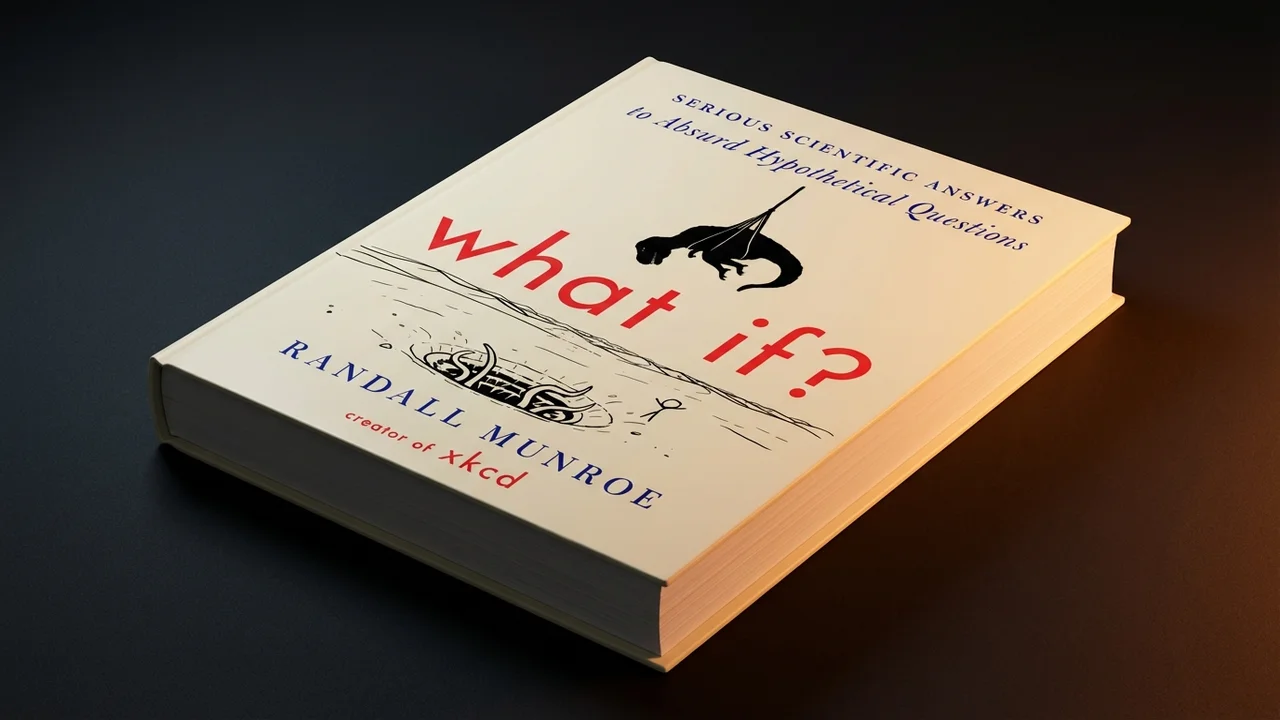

“I’ve never seen the Icarus story as a lesson about the limitations of humans. I see it as a lesson about the limitations of wax as an adhesive.”
Have you ever been lying in bed at 2 AM, staring at the ceiling, and your brain hits you with something like — “What if every person on Earth jumped at the same time?” Or — “What would happen if you tried to hit a baseball pitched at the speed of light?”
Most people would just laugh it off and go to sleep. Randall Munroe, the guy behind the legendary webcomic xkcd and a former NASA roboticist, decided to actually ANSWER these questions. With math. With physics. With engineering-grade precision. And somehow, he made it hilarious.
As the title implies, you are taking ridiculous questions that would never occur in real life and giving them a scientifically plausible solution.
This book is what you get when you ask a former NASA roboticist.
Science That Doesn’t Feel Like School
Here’s what makes What If? different from every other science book on the shelf. Munroe doesn’t lecture you. He doesn’t talk down to you. He treats every absurd question with GENUINE scientific rigor, and the contrast between the silly premise and the dead-serious analysis is what makes the whole thing work.
The author breaks down everything using mathematics, physics, engineering standards, and various other data-driven information that provides potential answers.
And his stick-figure illustrations? They add a layer of dry humor that perfectly matches the tone. You’re learning about thermonuclear explosions and orbital mechanics, but it FEELS like you’re reading a comic strip. That’s a rare gift.
I think this is exactly how science should be taught. Not with boring textbooks and rote memorization, but with curiosity-driven questions that make you genuinely want to know the answer. The dude left NASA to draw stick figures on the internet — he clearly values making knowledge accessible over gatekeeping it.
Favourite Questions
Some of my favourite questions include:
Relativistic Baseball: What happens when you throw a baseball at 90% the speed of light? Spoiler — it essentially becomes a nuclear explosion. The air molecules in front of the ball can’t get out of the way fast enough and undergo nuclear fusion. The batter, the pitcher, and the entire stadium are vaporized. The umpire’s call? “Hit by pitch. Batter takes first base.” Munroe’s deadpan humor is PERFECT.
New York-Style Time Machine: What happens when you go to Manhattan, New York, and travel 100, 1,000, 10,000, or 1 million years into the past, and the same intervals into the future?
Lightning: What would happen if all the lightning in the world struck at one spot?
Common Cold: Is it possible to isolate everyone and essentially destroy the common cold virus?
Alien Astronomers: What would aliens who were looking at our planet see?
Lethal Neutrinos: How close to a supernova do you need to be to get a lethal dose of neutrinos? Interesting because I had no idea what neutrinos were.
Drain the Oceans: What would Earth look like if you drained all of the oceans?
Drain the Oceans 2: What would happen if you dumped all that water on Mars?
Sunless Earth: Actually funny. What would happen if you turned off the sun?
Neutrino Bullet: Similar to lethal neutrinos, but even more epic on what a bullet of neutrinos does to its surroundings.
Richter 15: What would an epic earthquake do? And inversely, what is a Richter -1, -2, -3, and so on?
Why This Book Works
The real magic of What If? isn’t the questions themselves — it’s how Munroe walks you through the reasoning. He doesn’t just give you the answer. He shows you HOW he gets there, step by step, and you actually follow along without your eyes glazing over. That’s incredibly hard to pull off with topics like orbital mechanics, radiation dosages, and thermodynamics.
Each chapter is short — most are just a few pages. Which means you can pick this up, read one question, put it down, and come back later. It’s the ultimate coffee table book for nerds. I found myself reading three or four chapters in a row and then texting friends random facts like “Did you know a mole of moles would weigh about 4 quadrillion kilograms?”
Nobody asked me for that information. But I couldn’t help it.
The xkcd Brain
If you’re already a fan of xkcd, you know what you’re getting. Munroe’s brain operates somewhere between “genius physicist” and “the weird kid in class who asked questions the teacher couldn’t answer.” And I mean that as the highest compliment.
What I appreciate most is his intellectual honesty. When a question leads somewhere uncertain, he says so. When the math breaks down at extreme scales, he acknowledges it. He doesn’t pretend to have all the answers — he just enjoys figuring things out. That kind of humility combined with genuine curiosity is something I wish more authors had.
The Practical Value Problem
Cool and fun book with no practical value other than to tickle your imagination. Recommended for a fun read.
I wrote that line years ago and I stand by it — mostly. There IS no direct practical application to knowing what happens if you pitch a baseball at relativistic speeds. You’re never going to use the “drain the oceans” scenario in a business meeting.
But here’s the thing — books don’t always need to have “practical value” to be valuable. Sometimes a book’s job is to remind you that the universe is INSANELY interesting and that science is the best tool we have for understanding it. What If? does that better than almost any book I’ve read.
It reignites that childlike curiosity we all had before school beat it out of us. And for anyone who works in a field that requires creative thinking — marketing, engineering, entrepreneurship — that curiosity is fuel. Never underestimate the value of a book that makes you THINK differently, even if the subject matter seems impractical on the surface.
Final Thoughts
Randall Munroe took the dumbest questions on the internet and turned them into one of the most entertaining science books I’ve ever read. It’s funny, it’s smart, and it respects the reader’s intelligence without demanding a physics degree.
If you have any curiosity about how the world works — or how it would STOP working under extreme conditions — this is your book. Pick it up, read one chapter, and try not to binge the rest. I dare you.
4/5 — a genuinely fun read that makes science feel like an adventure.
Thanks for reading.
— Leonidas
