
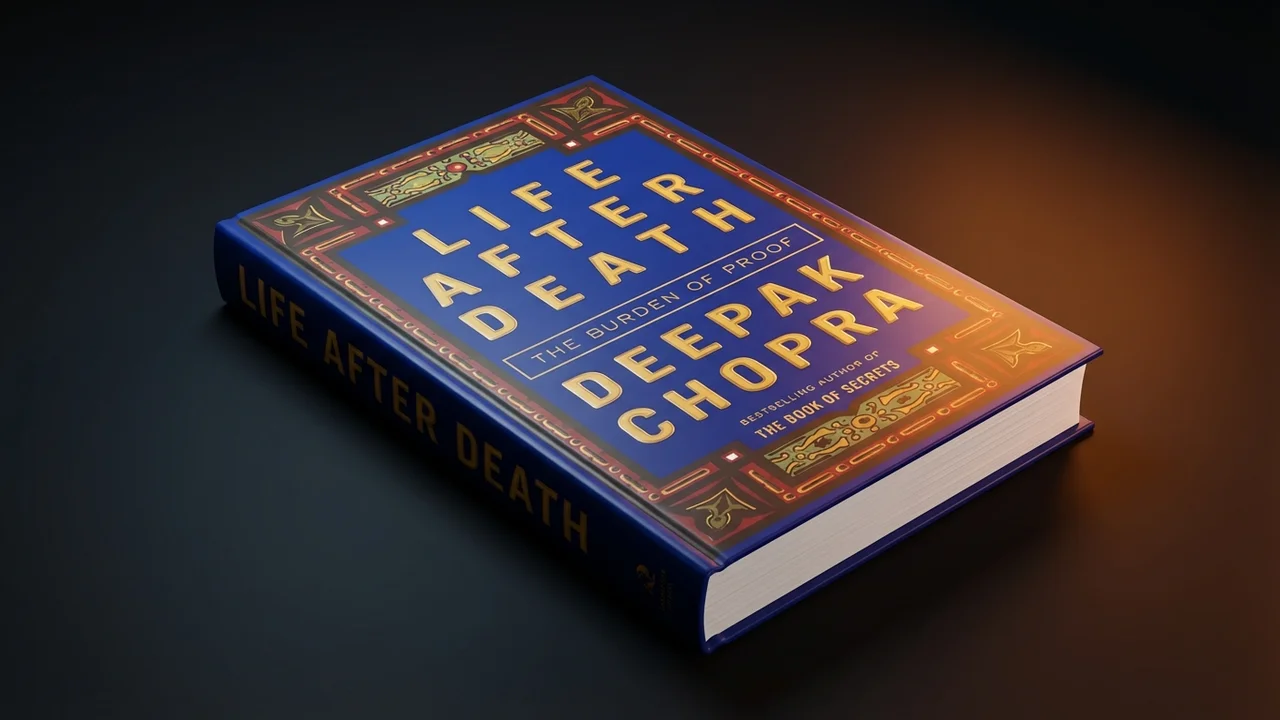

“What keeps life fascinating is the constant creativity of the soul.”
Can we explain what happens after death? Is there really anything after death like many religions believe, or does it end like Western science entails?
These are the questions that have haunted humanity since the very beginning. Every civilization, every tribe, every culture — they all had their own answer. And yet, here we are in the 21st century, and we STILL don’t have a definitive one.
Deepak attempts to clarify our view of death through the many religious, cultural, and spiritual beliefs that exist. He doesn’t necessarily go into each one individually, but instead summarizes them into their core beliefs. And what’s fascinating is how much overlap there is — despite all the theological wars and divisions, most traditions agree on one thing: death is NOT the end.
Near-Death Experiences
When people of various cultures, religions, and beliefs were interviewed about their near-death experiences (usually when they are declared dead for a short time), each person gave a different perspective of what they saw.
Christians spoke to Jesus or saw the pearly gates, Muslims with Mohammed, Buddhists with Buddha, Native Americans to their respective spirits, Indians to their gods, and so forth.
Even individual religions would be divided into their beliefs: Catholics and Protestants would each get their own interpretation of their near-death experience.
So what does this tell us? Either everyone is hallucinating something shaped by their upbringing — which is the skeptic’s position — or consciousness is accessing something real but filtering it through the only lens it knows: its own cultural programming. Chopra leans toward the latter, and honestly, it’s hard to dismiss entirely.
I found this part of the book particularly gripping because it raises a question most people never think about: if your near-death experience is shaped by your beliefs, then how much of your ENTIRE experience of reality is also shaped by them? That’s a rabbit hole worth sitting with for a while.
Consciousness After Death
The core question though is whether human consciousness continues after death — after someone is REALLY declared dead (not just a near-death experience).
Chopra leads us, slowly but surely, into realizing that the entire universe has consciousness. Because the entire universe is made of consciousness, when we die our consciousness simply continues on into the void.
Now, I’ll be honest — this is where the book gets heavy. If you’re a strict materialist, someone who believes consciousness is nothing more than neurons firing in the brain, you’re going to push back hard on this idea. And I get that. I’m generally a science-first kind of reader.
But Chopra makes an interesting case. He points to quantum physics, to the observer effect, to the fact that at the most fundamental level, matter behaves differently when it’s being observed. Does that mean consciousness is woven into the fabric of reality itself? Nobody knows. But the argument is more compelling than I expected going in.
What stuck with me is the analogy he uses — that consciousness is like a radio signal. When the radio breaks, the signal doesn’t disappear. The receiver is gone, but the transmission continues. Whether you buy that or not, it’s a powerful way to think about what we might be beyond our physical bodies.
The Afterlife Across Cultures
One thing Chopra does well is weave together traditions that most people treat as completely separate. He pulls from Hinduism, Christianity, Buddhism, Islam, and ancient Egyptian beliefs — and finds the common threads running through all of them.
The idea of the soul’s journey. The concept of karma or moral accounting. The belief that this physical life is just one chapter in something much, much larger.
I’ve traveled enough to know that people around the world have wildly different views on almost everything — food, relationships, politics, money. But death? Death seems to be the one topic where most cultures converge on a similar conclusion: there’s MORE. Whether that’s reincarnation, heaven, or merging with universal consciousness, the instinct is the same.
That convergence is either the biggest coincidence in human history, or it’s pointing at something real. Chopra clearly believes the latter.
Absolving of Ego
Finally, I found this little aside quite interesting about absolving our beliefs, traditions, and predisposed views of the world — almost absolving of ego:
1. Know that you are going to identify with your worldview at every stage of personal growth.
2. Accept that these identifications are temporary. You will never be truly yourself until you reach unity.
3. Be willing to change your identity every day. Take a flexible attitude. Don’t defend an “I” that you know is just temporary.
4. Allow your ability to quietly observe without judgement to replace the ingrained idea you reach for automatically.
5. When you have the impulse to struggle, use that as an immediate signal to let go. Open a space for a new answer to unfold on its own.
6. When you can’t let go, forgive yourself and move on.
7. Use every opportunity to tell yourself that all viewpoints are valid, every experience valuable, every insight a moment of freedom.
If you’ve read any of my reviews on meditation or mindfulness books — like Get Some Headspace — you’ll know this kind of thinking resonates with me deeply. The ego is the thing that keeps us stuck. It’s the voice that says “I’m right, they’re wrong.” And Chopra argues that death itself is the ultimate ego dissolve. When the body goes, the “I” we’ve been clinging to goes with it. What remains is something far bigger.
That’s a terrifying thought if you’re attached to your identity. But it’s also incredibly liberating if you can sit with it.
Final Thoughts
Interesting read, and definitely something that I hadn’t read before. This isn’t your typical self-help or pop-science book. It’s more philosophical, more speculative, and at times more demanding of the reader. Chopra asks you to set aside your assumptions and genuinely consider possibilities that Western science hasn’t fully explored.
Do I believe everything in this book? No. Some of it feels like a stretch, and Chopra occasionally drifts into territory that’s hard to verify. But that’s kind of the point — death is the ONE subject where nobody can claim certainty. And a book that forces you to sit with that uncertainty is worth your time.
If you’re curious about consciousness, spirituality, or just want to challenge your assumptions about what happens when we check out of this life — pick this one up. 4/5
Thanks for reading.
— Leonidas
