
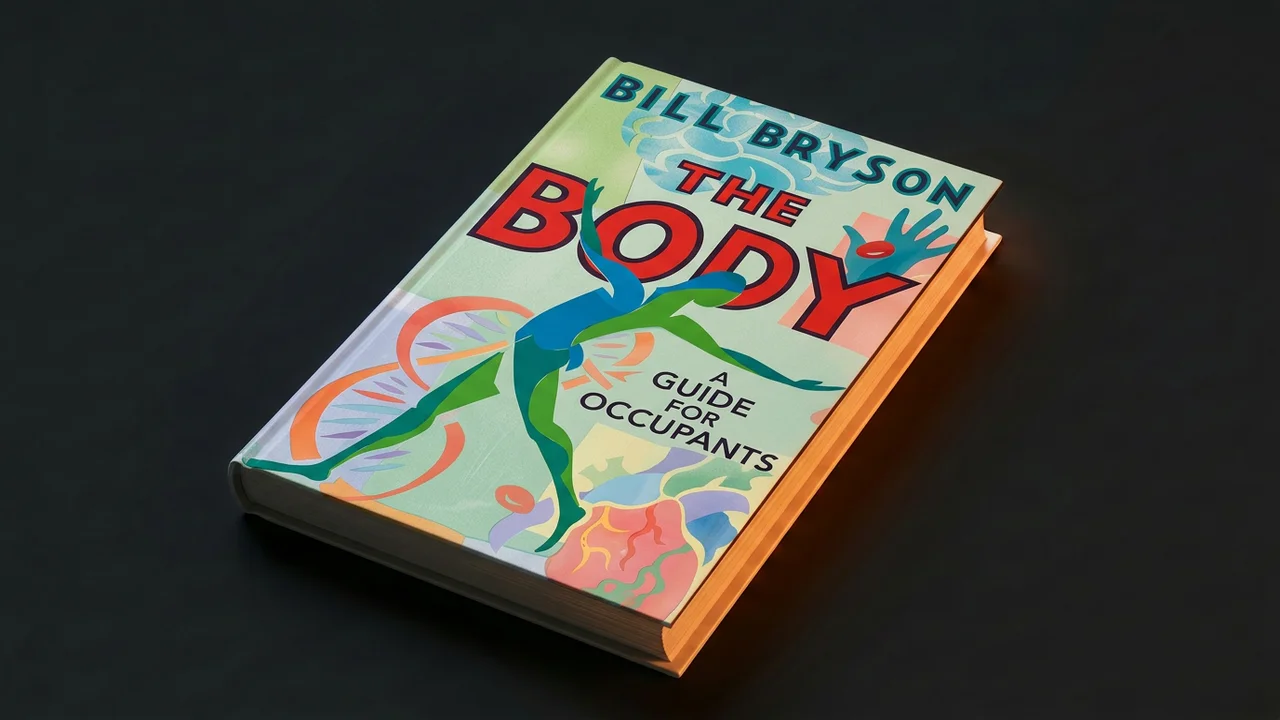

“Every time you breathe, you exhale some 25 sextillion molecules of oxygen — so many that with a day’s breathing you will in all likelihood inhale at least one molecule from the breaths of every person who has ever lived. And every person who lives from now until the sun burns out will from time to time breathe in a bit of you. At the atomic level, we are in a sense eternal.”
Bill Bryson is one of those writers who can make ANYTHING interesting. I gave both A Short History of Nearly Everything and At Home a 5/5 — they’re among my all-time favorites. So when I picked up The Body, I expected another masterpiece.
What I got was… complicated.
The Body is a head-to-toe tour of the human body, and Bryson does what he always does — he digs up obscure facts, quirky historical anecdotes, and absurd statistics to make you appreciate the machinery you walk around in every day. The problem is that this time, the subject matter fights back. The human body is so impossibly complex that even a writer as gifted as Bryson struggles to balance depth with accessibility.
The Good Stuff
Let me be clear — there ARE brilliant moments in this book. Bryson has a talent for finding the ONE fact that makes your jaw drop and reframes everything you thought you knew.
For example, the sheer numbers involved in running a human body are staggering. Your body produces 3.8 million cells EVERY SECOND just to keep you alive. Your brain uses 20% of your total energy despite being only 2% of your body weight. You shed about 1.5 grams of skin every day — enough to rebuild an entire outer layer every month.
When Bryson sticks to these “wow factor” moments, the book absolutely sings. He’s at his best when he’s telling you something you never knew about yourself and making you feel genuinely amazed to be alive.
Where It Gets Frustrating
Here’s my issue. Bryson tries to cover EVERYTHING — the brain, the heart, the gut, the immune system, bones, skin, hormones, disease, nutrition, sleep, aging, and death. That’s a LOT of ground. And because he’s trying to fit it all into one book, he ends up glossing over incredibly complex functions with brief summaries while simultaneously explaining them using confusing terminology.
It’s a weird paradox — too dumbed down AND too complex at the same time. You’ll read a passage where he brushes past something genuinely fascinating in two sentences, and then the next paragraph hits you with a string of medical jargon that makes you re-read it three times.
I kept thinking — pick a lane, Bill. Either go deep on fewer topics or keep it light and fun throughout. The constant switching between surface-level overviews and dense scientific language made it hard to find a rhythm.
The Missing Piece — Food and Modern Disease
This was my biggest disappointment. In a book about the human body published in 2019, I expected a SERIOUS exploration of how food affects our health. We’re living through an obesity epidemic. Diabetes, heart disease, autoimmune conditions — so many of these are directly linked to what we eat.
Bryson touches on nutrition, sure. But he doesn’t go deep enough. He doesn’t connect the dots between the modern food industry and the explosion of chronic disease in the way that someone like Michael Pollan or David Perlmutter would.
For a book that’s supposed to be the definitive guide to your body, leaving out the massive influence of diet on disease felt like a glaring omission. It’s like writing a book about cars and barely mentioning fuel.
No Images — Really?
This might sound like a small complaint, but hear me out. You’re writing a book about the HUMAN BODY — one of the most visual, intricate, and structurally complex things in existence — and you include zero illustrations? No diagrams? No cross-sections?
Even a few well-placed images would have made certain chapters far more digestible. When Bryson is describing the architecture of the inner ear or the layers of skin tissue, a simple diagram would have been worth a thousand words. Instead, you’re left trying to visualize complex three-dimensional structures from text alone.
I get it — Bryson is a writer, not a textbook author. But this isn’t a novel. It’s popular science. A handful of illustrations would have elevated the whole experience.
Bryson’s Charm Still Shines Through
Despite my criticisms, I want to be fair. Bryson is still Bryson. His wit is there. His curiosity is infectious. And some chapters — particularly the ones on microbes and the history of medicine — are genuinely excellent.
The sections on how little we actually understand about the brain are humbling. We like to think modern science has it all figured out, but Bryson shows that when it comes to consciousness, memory, and why we sleep, we’re still essentially guessing. That kind of intellectual honesty is refreshing.
He also does a great job covering the history of surgery and medicine — some of the stories about early surgical practices are absolutely horrifying and fascinating in equal measure. The fact that surgeons used to operate without washing their hands, and that suggesting they SHOULD wash them was considered offensive, is the kind of absurd historical detail Bryson excels at.
Final Thoughts
Here’s the thing — if this were written by anyone other than Bill Bryson, I’d probably give it a 4/5 and call it a solid popular science book. But because it IS Bryson, and because I’ve seen what he’s capable of with A Short History and At Home, I hold him to a higher standard.
The Body is informative, occasionally brilliant, and always readable. But it lacks the cohesion and depth of his best work. It feels like a really good Wikipedia dive rather than a transformative reading experience.
If you haven’t read any Bryson, don’t start here. Start with A Short History of Nearly Everything — that book will change how you see the world. But if you’re already a Bryson fan and you’re curious about the human body, it’s still worth your time. Just temper your expectations.
3/5 — good, but not Bryson at his best.
Thanks for reading.
— Leonidas
