

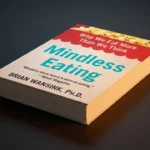
“The best diet is the one you don’t know you’re on.”
So here’s the subjective rundown. We eat mindlessly most of the time. Why? Because we are on autopilot.
But also because it is cultural in the West. People in the East (Japan, for example) eat to “not feel hungry.” Westerners (Canada, the U.S., for example) eat until we “feel full.” As a result, getting fat or eating too much is much easier for us than we care to think.
Brian Wansink spent decades running experiments at Cornell’s Food and Brand Lab, and what he found is both hilarious and terrifying. We make over 200 food decisions a day — and we’re conscious of maybe 15 of them. The rest? Our environment is calling the shots.
Tricks and Illusions
A big plate will trick you into eating more. More variety, such as different-coloured M&M’s, will make you eat more (think buffet — you just “need” to try everything). Even a bowl that fills itself without you knowing will make you eat more.
The bottomless soup bowl experiment is my favorite study in the book. Wansink rigged bowls to slowly refill from the bottom through a hidden tube. People eating from those bowls consumed 73% more soup — and STILL didn’t think they’d eaten more. When asked if they were full, they said, “How can I be? The bowl is still half full.” Our eyes literally overrule our stomachs.
But to really show how easily we’re fooled, do this: take two bottles of the exact same wine, same age, same everything, but switch out the labels. One from California and one from Detroit. Suddenly, the California wine “tastes” better in all tests with real people. The drinkers also believe their food tastes better, and they even stay longer to enjoy their meal. Rinse and repeat with name brands from shoes, ketchup, and everything else on the market.
This is the Halo Effect applied to food. One label — one perceived marker of quality — rewires your entire sensory experience. You’re not tasting the wine. You’re tasting the STORY you’ve been told about the wine.
Now for fast food — such as a bowl of chips — place it next to you and you will pig out. Place it just a meter away and you will eat less. Place it two meters away, and suddenly it’s too much effort to eat. We don’t want to consume energy to get energy. This goes as deep as risk versus reward, when a field mouse needs to run across a field to get a berry while the watchful hawk preys on the mouse.
I tested this myself. Moved the snack jar from my desk to a shelf across the room. Did I eat less? Absolutely. Not because I wanted to — but because I was too lazy to get up every ten minutes. That’s the entire thesis right there: small environmental changes beat willpower EVERY time.
Gender, Engineering, and Inheritance
Men believe it’s manly to eat a lot, especially on a first date, while women believe they should eat only a little to be perceived as feminine. Not to mention, eating meat is considered more manly as well (despite the huge negative health issues associated with excessive beef consumption).
Then we have scientifically manufactured colours, tastes, and smells, which culminate in McDonald’s and any other fast food on the market. Each food is engineered to have the scientifically “optimal” amount of the trifecta: salts, fats, and sugars. The trifecta feeds back into our primitive selves, when food was scarce and dangerous to consume. Salts help us store water, fats help us store energy, and sugars told us that a food was safe for consumption — as opposed to a sour, poisonous berry.
This is why fast food is so addictive — it’s ENGINEERED to hijack millions of years of survival programming. Food scientists have found the bliss point — the precise combination of salt, fat, and sugar that lights up your brain like a Christmas tree. You never stood a chance against that Big Mac.
Food inheritance was interesting as well. Why do you hate that food? Why do you love it? Can you trace it back? Dig deep. Dig into your childhood when you first fell in love with that taste, or the process of getting to that food. Does it remind you of your parents, your friends, relatives, that special occasion? We associate our emotions with certain foods, plain and simple.
I think about this every time I eat souvlaki. It’s not my favorite food objectively, but it takes me straight back to summers in Greece. The taste, the smell, the memory — all fused together. Wansink calls this “comfort food” programming, and it starts before we even have the vocabulary to describe what we’re eating.
The Subway Myth
Finally, Subway has been lying to you. Sure it might seem healthy, but is it really? How many calories are you actually consuming? Not too many fewer than a McDonald’s Big Mac. Add all that sauce, meat, veggies, bread, a drink, chips, and a cookie, and you are eating maybe 1,000 calories.
Common sense? Not when you eat with your stomach and not with your head. Also, those low-fat variety foods are only fractionally lower in fat. But you also end up eating more of the low-fat variety — you just tricked yourself.
Wansink calls this the “health halo” — slap a low-fat label on something and people give themselves permission to eat more of it. You eat 30% more of a product that has 10% fewer calories. Congratulations, you just gained weight while feeling virtuous about it.
Final Thoughts
What I love about Mindless Eating is that Wansink doesn’t preach deprivation. He’s not telling you to count every calorie or cut out entire food groups. His argument is simpler — just redesign your environment. Use smaller plates. Put healthy food at eye level. Serve from the counter instead of the table. These tiny tweaks add up to hundreds of fewer calories per day, and you won’t even notice.
That’s the genius of the book. It works WITH your autopilot instead of against it. Every diet requires willpower, and willpower is a depletable resource. Wansink’s approach requires a one-time setup and then your laziness does the rest.
Nonetheless, be mindful of what you eat, but before you are, read this book.
Solid 4/5 — especially if you’re into behavioral psychology, nutrition, or just want to understand why you ate that entire bag of chips last night without blinking.
Thanks for reading.
— Leonidas
