Yekaterinburg, Russia: 4 Days In The Capital Of The Urals
Yekaterinburg is the fourth-largest city in Russia (1.5 million people) and the unofficial capital of the Urals. It sits roughly on the border between European Russia and Siberia, 1,800 km east of Moscow and 1,500 km west of Novosibirsk. You reach it by spending a night on the Trans-Siberian or two hours on a flight from Sheremetyevo.
The city was founded in 1723 by Peter the Great as a state iron and copper works on the Iset River. It was named after his wife Catherine I (Yekaterina in Russian), the second Russian Empress, who was originally a Livonian peasant girl. For two centuries it was an industrial town producing weapons, coins, and the cannonball metal for the Russian army. The Demidov merchant dynasty made a fortune here.
Two events define modern Yekaterinburg. First, in July 1918, the Bolsheviks brought the deposed Tsar Nicholas II and his family from house arrest in Tobolsk to a merchant mansion called the Ipatiev House, and on the night of 16-17 July shot all of them, plus the family doctor and three servants, in the basement. The Soviets demolished the house in 1977. The Russian Orthodox Church built the Church on the Blood on the exact site in 2000-2003. It is now the most-visited religious site east of Moscow.
Second, Boris Yeltsin (the first president of Russia, 1991 to 1999) grew up in this region, ran the Sverdlovsk Oblast Communist Party in the 1970s, and rose from local apparatchik to the politician who stood on a tank in front of the Moscow White House on 19 August 1991 and ended the Soviet Union four months later. The Yeltsin Presidential Center, a 22-thousand-square-metre museum dedicated to his life, opened here in 2015 and is the most comprehensive history of the late USSR and the 1990s anywhere in Russia.
The city was called Sverdlovsk from 1924 to 1991, named after Yakov Sverdlov, the Bolshevik who signed the order for the Tsar’s execution. In 1991, by referendum, it took its imperial name back. The oblast (the Russian equivalent of a US state) is still called Sverdlovsk.
I spent four days here in 2017. Below: 143 photos and an embedded video review, covering the Stalinist civic centre, the Yeltsin Center museum, the Church on the Blood, Vainer pedestrian street, the surviving Imperial-era wooden mansions, and the city from the rooftop of the Vysotsky skyscraper.
A Video Review Of Yekaterinburg
Arrival In Yekaterinburg
First impressions of Yekaterinburg are about the layering: a 19th-century merchant house with a 25-storey condo tower wedged behind it, a Soviet tram crossing in front of a Russian-flag-bearing government block, a GAI traffic cop checking documents at a corner where every car is either a 30-year-old Lada or a new Hyundai. The city has changed three times in the last hundred years and you can see all three at once.
Old single-storey merchant mansion swallowed up by a modern VTB Bank tower behind it. The blocking together of late-Imperial wood-and-plaster against post-Soviet glass is the visual signature of central Yekaterinburg.
Yekaterinburg tram #762 with a Conte Kids ad along the side. The Yekaterinburg tram network opened in 1929 and still carries about 300,000 people a day.
A GAI traffic officer in a yellow high-vis vest standing between two Russian cars (note the regional code 96 on the licence plate, that is Sverdlovsk Oblast).
Lenin Square And The City Hall
The administrative heart of Yekaterinburg is Lenin Square (technically called Площадь 1905 года, the Square of 1905, after the failed first Russian Revolution). The square is dominated by the Yekaterinburg City Hall, a 1947-1954 Stalinist Empire-style behemoth in pale yellow stone, topped with a 61-metre spire crowned by a five-pointed gold Soviet star and four allegorical statues. The hammer-and-sickle is still on the pediment, and the Russian tricolour flies above it.
The bronze Lenin (1957) stands across the square pointing directly at the Soviet star on the City Hall, a sight line the sculptor deliberately planned. The street running east from here is still called Lenin Avenue, and the city was still called Sverdlovsk when the statue went up.
Sverdlovsk Oblast Government Headquarters, a brutalist Soviet civic tower flying the Russian tricolour. Built in the 1980s, it now houses the regional governor's office.
Vintage red tram on the cobblestones of Plotinka with the iconic yellow Yekaterinburg City Administration (1947-1954, also called the City Hall) behind. Note the pedestrians in autumn jackets, this is early September.
Top of the City Hall: the 61-metre golden spire crowned by a five-pointed Soviet star, with four allegorical statues representing science, agriculture, industry, and the arts.
Yekaterinburg City Hall lit up at night, the warm sandstone-colour facade glowing under floodlights. The building is Stalinist Empire style at its purest, designed to look like the Moscow Seven Sisters projected onto a regional capital.
Close-up of the clock tower at night, two clock faces visible, allegorical statues around the balustrade, the gold-leaf spire above.
City Hall full facade in daytime. The Soviet-era hammer-and-sickle emblem is still in place above the main entrance, and nobody has felt the need to remove it.
Close-up of the hammer-and-sickle pediment above the entrance: "PROLETARIANS OF ALL COUNTRIES, UNITE!" carved in Russian beneath the coat of arms.
Soviet pediment in close detail, with the Russian tricolour and Sverdlovsk Oblast flag flying alongside, and the small golden Soviet star catching light at the top of the spire.
Bronze statue of Lenin on Lenin Square (Площадь 1905 года), in his classic pose, with the City Hall and its golden Soviet star behind. The statue dates to 1957.
The same Lenin from behind, his outstretched hand pointing directly at the Soviet star on the City Hall spire. A composition the sculptor planned deliberately in 1957.
Tourist standing on a low wall mirroring Lenin's pose. The square hosts everything from communist anniversary rallies to anti-Putin protests in the same week.
Orange tram passing in front of the Lenin statue, with the 188-metre Iset Tower (one of the Yekaterinburg City complex's twin glass cylinders) catching light behind. A perfect Yekaterinburg three-eras frame.
Bronze plaque on Lenin Avenue: "On 5 November 1919, at the ceremonial session of the city council, the main avenue of the city was named after V. I. Lenin."
Another bronze plaque a few doors down, this one of Yakov Sverdlov, the early Bolshevik leader the city was renamed after in 1924. It stayed Sverdlovsk until 1991, when the city voted to reclaim its imperial name.
Vainer Pedestrian Street And Its Bronze Statues
Vainer Street (улица Вайнера) is Yekaterinburg’s main pedestrian shopping spine, the unofficial “Arbat of the Urals.” It’s about a kilometre long, cobblestoned, and lined with shops, cafes, a Burger King, two malls, and a cheerful series of bronze sculptures installed in 2008 to evoke the street’s history as a 19th-century commercial corridor.
The street is named for Lev Vainer, a 25-year-old Bolshevik revolutionary executed by tsarist authorities in 1908. The bronzes mostly do not depict him.
Vainer Street (улица Вайнера), Yekaterinburg's main pedestrian shopping street and unofficial Arbat. Named after Lev Vainer, a Bolshevik revolutionary executed by tsarist forces in 1908.
A street performer in an orange fox mascot costume working an interactive info kiosk on Vainer. Bahian street commerce, Russian style.
Bronze statue of "The Peddler" (Коробейник), a 19th-century travelling merchant with a folding portable counter. One of about a dozen bronze figures installed along Vainer in 2008 to evoke its history as a commercial corridor.
The famous green dandy of Vainer Street, a 4-metre Lego-block-coloured giant in a top hat and red shoes. Officially a marketing installation, unofficially the most photographed spot on the street.
Bronze statue of Yefim Artamonov, the Ural serf who in 1801 built one of the first pedal bicycles in the world, riding it 1,500 kilometres from the Urals to Moscow for the coronation of Tsar Alexander I.
Bronze of a fedora-wearing dance figure pointing back at the camera. Vainer is dotted with this kind of cheerful 2000s public sculpture.
Bronze of a top-hatted Edwardian gentleman in his crowned proto-automobile, a sort of generic Karl Benz reference. The Russian middle class on its way out of the 1900s.
Bronze of "Vainer himself" in the bourgeois pose: top hat, cane, frock coat. A historical fiction since the actual Lev Vainer was a 25-year-old revolutionary.
Bronze sculpture of an 18th-century artilleryman raising his pistol, mounted inside the Grinwich shopping mall on Vainer with a colourful diorama backdrop.
Living-statue street performer in an enormous flower dress inside one of the Vainer shopping centres. The performer earns tips from being photographed.
Plotinka, Passazh, And The Sevastyanov House
Plotinka (Плотинка, “the little dam”) is the geographic centre of Yekaterinburg, where the original 1723 dam on the Iset River created the pond that powered Peter the Great’s iron works. The dam is still there, now part of a pedestrian park.
Around Plotinka are some of the most photographed buildings in the city: the Passazh shopping mall (an Eclectic 1916 original, reconstructed 2014), the Sevastyanov House (1860s, the absolute icon of Yekaterinburg with its turquoise-and-white-and-red Gothic facade), and a cluster of surviving pre-revolutionary merchant houses now mostly serving as banks and law offices.
Passazh (Пассаж), the central downtown shopping mall, fronted by a row of Corinthian columns and topped with a glass dome. The current building is a 2014 reconstruction of the 1916 Eclectic-style original.
Red Tatra T3 tram crossing Plotinka with people piling on. The Plotinka (the small dam on the Iset River) is the historic and geographic centre of Yekaterinburg.
Pedestrians on Plotinka in autumn jackets, a street vendor stand visible, the orange-and-white traffic barriers of an active municipal repaving project in the foreground.
Tatra T3 tram #137 on a Plotinka track with construction barriers behind. Yekaterinburg still runs hundreds of these Czech-made Soviet-era trams from the 1970s and 1980s.
Plotinka stone-paving workers in front of a pink Eclectic-style merchant building, ground floor occupied by an Omega watch boutique. A snapshot of the city visibly being remade.
Three Central Asian construction workers (a common sight on Russian sites since the 1990s, mostly from Tajikistan and Uzbekistan) laying paving stones.
Passazh at night, the giant blue letters lit up, the brown Eclectic facade glowing, an old red tram parked out front, the whole scene looking weirdly cinematic.
Daytime Plotinka with a red tram, the Passazh mall to the left, the yellow Stalinist Hotel Iset visible on the right, packed minibuses (marshrutkas) and pedestrians.
Plotinka again at golden hour with the Passazh lit up and the cobbles full of pedestrians. The view from this corner has been a Yekaterinburg postcard for 100 years.
Sevastyanov's House (Дом Севастьянова, 1860s), the absolute icon of Yekaterinburg: a turquoise-and-white-and-red Gothic mansion on the bank of the Iset, the most ornate historic building in the city. Built by a merchant named Nikolai Sevastyanov, now used by the Russian president when in town.
Cast-iron Eclectic rotunda standing in the square in front of Sevastyanov's House, ironwork that survived both the Bolsheviks and the postwar reconstruction.
Bronze statue of Pavel Bazhov, the Soviet writer who collected the Ural folk tales of "The Mistress of the Copper Mountain." Born here in 1879, died here in 1950. Almost every Russian over 40 grew up reading him.
Bronze monk statue near the Church on the Blood, hands crossed at his chest in prayer, with a blue-painted tree trunk behind. One of the figures commemorating Tsar Nicholas II's family.
Allegorical statue group on the rooftop of a 1912 Eclectic-style merchant building, with a date plate "1912" visible. Pre-revolutionary architecture that survived the Soviet century.
A green and white pre-revolutionary merchant house with onion-style decorative finials, restored back to original colour, surrounded by Soviet apartment blocks. The whole centre is a patchwork.
The Yeltsin Presidential Center
The Yeltsin Presidential Center is the single best museum in the city and probably the most thorough historical institution about the late USSR and the 1990s anywhere in Russia. 22 thousand square metres of perestroika, the August 1991 coup, shock therapy, the 1993 constitutional crisis, the Chechen wars, the 1998 financial crash, and Yeltsin’s New Year’s Eve 1999 resignation speech, all laid out in a striking modernist building completed in 2015.
It is not subtle about its politics. The Yeltsin Center frames the 1990s as a hard but necessary transition from totalitarianism to democracy, and most Russians under 40 still go through it as their introduction to that decade. Russian conservatives hate it.
Boris Yeltsin (1931-2007) was born in Butka, a village 200 km east of Yekaterinburg. He came up through the Sverdlovsk Oblast Communist Party (running it as First Secretary 1976-1985), was promoted by Gorbachev to Moscow, broke with him, was elected the first president of the Russian SFSR in June 1991, and the rest is what the museum exhibits.
Iset Tower, one of the twin glass cylinders of the Yekaterinburg City development. The small wooden cottage at its base is the historic Demidov mansion, preserved next to the 188-metre skyscraper as a deliberate juxtaposition. The Yeltsin Center is in the building behind.
Entrance of the Yeltsin Presidential Center, a 22-thousand-square-metre modernist museum that opened in 2015. The central white-and-grey statue is of Boris Yeltsin himself, with his name ("ЕЛЬЦИН") cut below.
Welcome screen at the start of the museum, Russian above, English below: "The mission of the Center is to preserve, study, and interpret the historical legacy of the first president of Russia."
GAZ-14 Chaika, the Soviet state limousine reserved for the very top of the Politburo. The model Yeltsin would have ridden in as Sverdlovsk Oblast First Secretary in the 1970s.
ZIL-41047 with the Russian tricolour and presidential standard flying. The flagship Russian state car, used by Yeltsin through the 1990s and his successors after him.
The Yeltsin Center atrium: a five-storey white-and-glass building with a 25-metre indoor void, ping-pong tables set up for visitors, the whole space deliberately designed to feel open and Western.
Inside the museum: walls of perestroika-era posters, photographs, and timeline displays running through the late Soviet decades and the 1990s.
Display photo: "Tanks on Lenin Avenue in the capital of Tajikistan. Martial law declared. Dushanbe, 14 February 1990." The kind of late-Soviet collapse imagery the museum is built around.
Display photo: "Preparing tanks for utilisation. Leningrad Oblast, 7 February 1993." Endless rows of T-72s in the snow being decommissioned after the START treaties.
Wall of Baltic-state and Ukrainian independence posters from 1989-91: "Freedom for the Baltics, freedom for Belarus," "Russia's salvation is in exiting the USSR."
Period economic-reform poster: "FREEZE PRICES, and the deficit will grab us by the throat!" The political fight Yeltsin's team had to win to do shock therapy in 1992.
Shelf of consumer electronics that flooded post-Soviet Russia after the 1992 import liberalisation: VCRs, Walkmans, boomboxes, the early-Yeltsin equivalent of the iPhone moment.
Photo of a 1990s pro-Yeltsin rally with placards: "Russia will certainly be reborn!" "Yeltsin." One of dozens that filled Moscow's Manezhnaya Square in the early reform years.
Period photo from 1980s Sverdlovsk: women in summer dresses, men in pleated trousers, Ladas and Volgas, a city that no longer exists.
Another period photo of 1980s Lenin Avenue: trolleybus, pedestrians, the same buildings visible on the contemporary street outside the museum.
Museum wall collage of perestroika-era pop culture, magazine covers, dissident literature, the cultural unfreezing that started in 1986.
Recreated late-Soviet apartment: oak wall unit, parquet floor, glass-fronted bookshelf full of the Soviet classics, a TV playing 1989 broadcasts on loop.
Closer detail of the same recreated room. The black-and-white TV shows a news bulletin and the wallpaper is the classic late-Brezhnev pattern.
Visitor in the recreated apartment, leaning against a wooden cabinet, vinyl player in front. The whole space is built so you can sit down and live in 1985 for a few minutes.
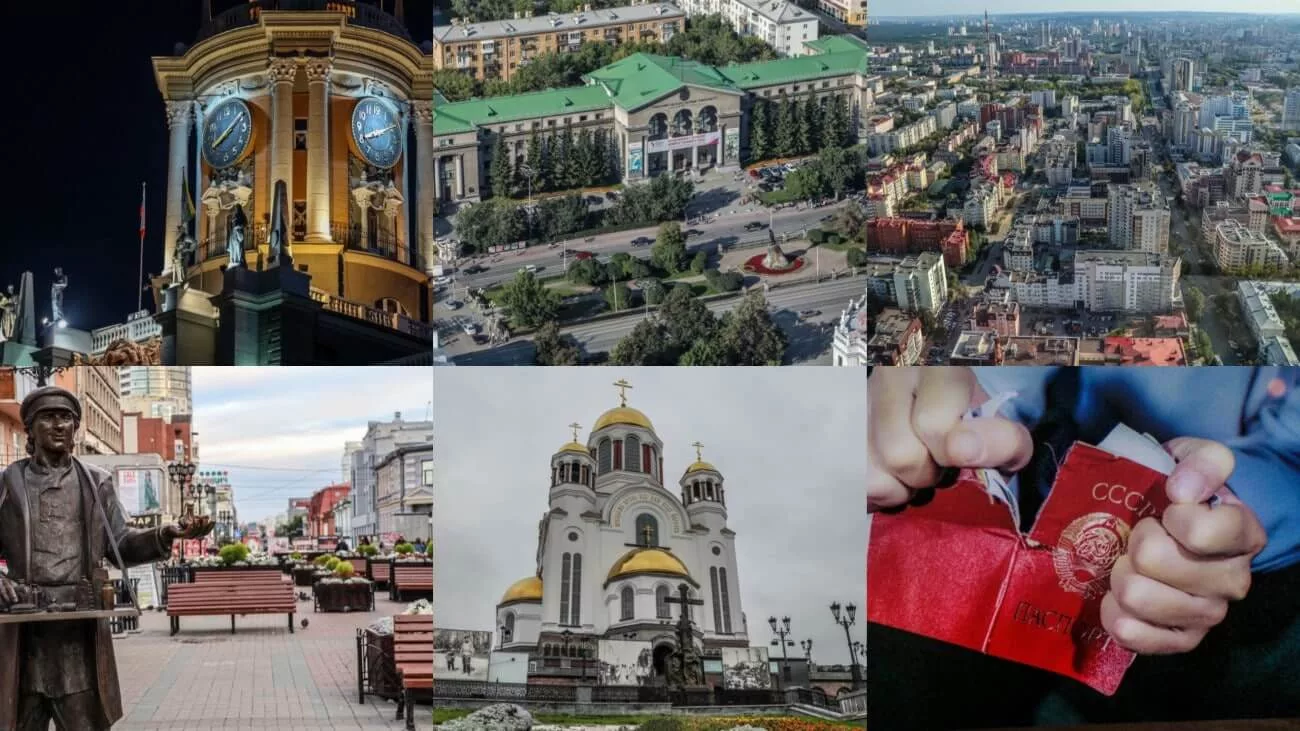
Iconic museum image: hands tearing a red Soviet ("СССР ПАСПОРТ") passport in half. The dissolution of the USSR was formalised on 26 December 1991.
Museum gallery showing the Yeltsin transition government's office equipment: CRT monitors, fax machines, paper-tray inboxes, the 1990s presidential administration as it actually worked.
Wax figures of Boris Yeltsin (centre, in suit) flanked by Valentin Pavlov (last Soviet prime minister, on the left in military uniform) and Gennady Zyuganov (leader of the Communist opposition, on the right). The political triangle of 1991-1996.
Recreated Yeltsin presidential office at the Kremlin, complete with the green-and-gold imperial furniture and the camera he gave his New Year's resignation speech to on 31 December 1999.
Diorama scene: Yeltsin in blue (visible in profile) standing at a podium with the Soviet hammer-and-sickle emblem, addressing a half-lit row of Politburo figures. Re-enactment of the 19 August 1991 coup, when Yeltsin defied the GKChP and saved Gorbachev.
Life-size bronze of Yeltsin seated on a bench in the Yeltsin Center foyer, looking thoughtfully at the floor. Russia's first elected president, 1991 to 1999, born in nearby Butka village.
Yeltsin's gift to Bill Clinton: a watercolour painting, "Joyous Meeting of Victorious Armies, April 26 1945," with handwritten dedication on the 50th anniversary of VE Day. Personally painted by Yeltsin himself.
Church On The Blood: The Romanov Execution Site
On the night of 16-17 July 1918, in the basement of a requisitioned merchant mansion called the Ipatiev House, the Bolsheviks shot the deposed Tsar Nicholas II, his wife Alexandra, their five children (the four grand duchesses and the 13-year-old Tsarevich Alexei), the family doctor, and three servants. They burned and partially dissolved the bodies in a forest pit 16 km outside the city.
The remains were rediscovered in 1979 (kept secret) and again in 2007 (Tsarevich Alexei and Grand Duchess Maria). The first batch was reburied at the Peter and Paul Fortress in St. Petersburg in 1998. The Russian Orthodox Church canonised the family as passion-bearers in 2000.
In 1977, on Brezhnev’s order, the Ipatiev House was demolished to prevent it becoming a place of pilgrimage. (The demolition order was signed by the local first secretary, a man named Boris Yeltsin.) In 2000-2003 the Russian Orthodox Church built the Church on the Blood (Храм-на-Крови), a five-domed white-and-gold cathedral, on the exact foundation. It is the most-visited religious site east of Moscow.
Distant view of the Church on the Blood (Храм-на-Крови, Church of All Saints), the five-domed white-and-gold cathedral built in 2000-2003 on the spot where the Romanov family was executed in July 1918.
Closer view of the Church on the Blood standing among Soviet apartment blocks and a Yota mobile-network billboard. The church was deliberately built on the foundation of the demolished Ipatiev House.
Standing in front of the Church on the Blood explaining the story for the camera. The cathedral is now the most visited religious site in the Urals.
Same shot wider, the second smaller chapel of Tsarevich Alexei visible on the right of the main cathedral.
Stone cross and bronze sculpture group at the church entrance, showing the Romanov family being led down to the cellar where they were shot. The inscription reads "Holy Royal Passion-Bearers, pray to God for us."
Black-and-white display photograph of the 1998 burial of the Romanov family's remains at the Peter and Paul Fortress in St. Petersburg. They were canonised as passion-bearers in 2000.
Wider angle of the church with the bronze monument in the foreground. The Bolsheviks shot the Tsar, the Tsarina, all five children, the family doctor, and three servants in the Ipatiev House basement on 17 July 1918. Stalin had the house demolished in 1977 to prevent it becoming a pilgrimage site.
Inside the church's Lower Chapel (Нижний Храм), built on the actual basement where the killings happened. Worshippers stand in front of the iconostasis under candle-lit golden light.
Icon of Saint George the Victorious slaying the dragon, painted on a red horse with the inscription "Победоносче" (the Victorious). One of the most-venerated saints in Russian Orthodoxy.
Aerial of the Church on the Blood from the Vysotsky tower observation deck, with the smaller Tsarevich Alexei chapel on the left and modern buildings surrounding.
The Literary Quarter And The Wooden Houses
The Literary Quarter (Литературный Квартал) is a preserved block of late-Imperial wooden merchant houses on the edge of the historic centre, kept intact as small museums for the Ural writers: Pavel Bazhov (the Soviet collector of Ural folk tales), Dmitry Mamin-Sibiryak (the 19th-century novelist of Ural mining life), Fyodor Reshetnikov (the 1860s realist who wrote about Ural workers), and Pushkin’s 1833 visit researching his history of the Pugachev rebellion.
The cluster of wooden houses with carved naličniki (window frames), painted in pastel green and white and ochre, is one of the most photogenic corners of the city and a survivor of three waves of Soviet demolition.
Map of the Literary Quarter (Литературный Квартал), a preserved cluster of 19th-century wooden merchant houses now used as museums for the Ural writers (Pushkin's brief visits, Mamin-Sibiryak, Bazhov, Reshetnikov).
Russian terem-style wooden mansion with a red-tiled steep-pitched roof and tall carved finials, a Russian folk-art revival design from around 1880.
White carved wood-and-plaster Eclectic mansion with green-trim window surrounds, modern apartment tower visible behind. One of the literary museum buildings.
Wooden log mansion in pristine condition, every window crowned with carved ornamental "naličniki" (window frames). One of the standout pieces of Old Yekaterinburg wooden architecture.
Detail of the carving above. Russian wooden naličniki were originally a protective magical motif, and the carving styles vary from village to village across the Urals.
Another preserved wooden mansion, this one in lighter pine with green trim, hidden behind an iron fence in the centre.
Yet another two-storey carved wooden house with elaborate eave decorations. Almost every wood building of this kind that the Soviets did not burn or demolish ended up either restored or rotted away.
Close-up of one of the wooden mansions' entry porches, carved supports with painted vine motifs and a heavy plank door.
Karl Liebknecht Street wooden mansion in classic late-Imperial Eclectic style: lacework white plaster trim, pastel paint, iron fence.
Reshetnikov House-Museum (Дом-музей Ф. М. Решетникова), a dark-stained wooden mansion that belonged to the 19th-century Ural writer Fyodor Reshetnikov. Now a small literary museum.
Same house from another angle, with a museum guide pointing at the entrance for visitors. The Russian and English signs are visible by the door.
Wooden carved residential house from the late 1800s pressed between Soviet five-storey panel blocks. A common Yekaterinburg sight: every literary-quarter house has a Khrushchyovka on at least one side.
Bronze monument of Saints Peter and Fevronia of Murom, the Orthodox patron saints of marriage and family, on a stylised boat. A popular Russian wedding-photo spot.
Close-up of the inscription on Saint Fevronia's scroll: "Holy wonderworkers Peter and Fevronia, pray to God for us, that He preserve the sanctity of our marriage to the end of our days on earth, and raise blessed children in faith and devotion."
Old black-and-white photograph displayed inside one of the literary museums: pre-revolutionary Yekaterinburg, the original See cathedral on the central square, men in bowler hats. The cathedral was demolished by the Soviets in 1930.
The white-and-gold Patriarchal Compound (Patriarchal Подворье) next door to the Church on the Blood, with two onion-domed bell towers. Built in the 1990s as administrative offices for the Yekaterinburg diocese.
Civic Monuments And Big Zlatoust
A few other civic landmarks worth knowing. The Sverdlovsk Oblast Government building (the executive branch of the regional government) sits across town under the Sverdlovsk coat of arms (two golden griffins flanking a silver bear with a trident). The Central Military District HQ has an equestrian statue of Marshal Zhukov in front, since Zhukov commanded the Ural Military District from 1948 to 1953 after Stalin demoted him from Moscow.
The Big Zlatoust (Большой Златоуст, Cathedral of Saint John Chrysostom) was the tallest building in pre-revolutionary Yekaterinburg, blown up by the Bolsheviks in 1930, and rebuilt 2006-2013 in its original 70-metre footprint. The reconstruction was largely funded by private donors and the local diocese.
Sverdlovsk Oblast Government building (Правительство Свердловской области), the regional executive HQ in a 1990s mirrored-glass tower with a Sverdlovsk Oblast coat of arms over the entrance.
Close-up of the Sverdlovsk Oblast coat of arms: two rampant golden griffins flanking a red shield with a silver bear holding a trident, all under the Russian imperial crown. The bear is a reference to the Ural region's traditional wildlife.
The Sverdlovsk Oblast Headquarters of the Central Military District, a pinkish-orange Stalinist office block built in the late 1930s. The equestrian statue in front is Marshal Georgy Zhukov, the Soviet WW2 commander.
Close-up of the Zhukov statue: medals across his chest (he held the highest Soviet rank, Marshal of the Soviet Union, plus four Hero of the Soviet Union stars), riding his cavalry horse. Zhukov commanded the Ural Military District from 1948 to 1953.
Big Zlatoust (Большой Златоуст), the Cathedral of Saint John Chrysostom, a 70-metre white-and-gold belltower-church on Maxim Gorky Street. The Bolsheviks blew it up in 1930 and the current building is a 2006-2013 reconstruction.
Vertical of Big Zlatoust's main belltower, five golden onion domes stacked vertically. At 70 metres it was the tallest building in pre-revolutionary Yekaterinburg.
Yekaterinburg Off The Tourist Map
The rest of the city is most of the city: bright-yellow trams on Lenin Avenue, pensioners playing chess on a low wall by the river, a 19th-century cottage flanked by 25-storey condo towers, a Yandex Taxi waiting at the crosswalk, a Stalinist university building, an Iset River embankment with a floating restaurant. The everyday-Yekaterinburg side of a four-day visit.
Museum painting of late-Soviet Yekaterinburg: an Orthodox church in the foreground, factory cooling towers in the distance. The visual contradiction of the city in one frame.
Another museum painting of pre-revolutionary Yekaterinburg, expressionist colours, the church spires of the old town.
Painting of a Ural village scene with women in folk dress crossing a wooden bridge. Bazhov's tales were set in places like this.
Pedestrian street at dusk with modern apartment towers ahead, the warm orange sunset light catching the glass. Yekaterinburg goes through about 20 minutes of golden hour at this time of year.
Twin modern condo towers (the Demidov complex) rising directly over a single surviving 19th-century wooden cottage in the foreground. The classic Yekaterinburg juxtaposition.
Same general area at blue hour with the lit-up glass towers and the red brick of an older building. The neighbourhood is being almost completely rebuilt every decade.
Brass commemorative plaque, with a single rose on the shelf below: "In this building until July 1953 the outstanding organiser and chief of the foreign intelligence of the USSR 1939-1946, Lieutenant General Pavel Mikhailovich Fitin, continued his service." Fitin ran Soviet foreign intelligence through WW2.
Cartoon cat graffiti on a residential building corner, modern apartment towers behind. Russian street art has its own tradition going back to perestroika.
Soviet panel apartment block with a kiosk selling tea ("чай") in the courtyard. The kiosk economy was the post-Soviet small business in a single image.
View of the Iset River with new high-rise construction (cranes, scaffolding) on the far bank, a pedestrian path along the water on the near side. The whole riverfront is being rebuilt.
Crumbling pre-revolutionary corner building with the Vysotsky skyscraper rising behind, the Yekaterinburg time-capsule contrast again.
Sidewalk view of decaying old buildings with a small Georgian restaurant ("Хата Пури" / Khatchapuri House) and a modern high-rise under construction in the background.
Plotinka fountain in full spray, the Iset River below, the Vysotsky skyscraper and Iset Tower visible behind. The fountain runs from May to September.
Long red-brick row of late-Imperial commercial buildings, ground floor occupied by an "Адвокаты" (Lawyers) practice and other small shops. Karl Liebknecht Street has the best surviving 1880s shopfronts in the city.
Karl Liebknecht intersection with a Yandex Taxi (the Russian Uber, founded 2011) in the foreground, modern high-rise being built behind, old brick on both sides. The full Yekaterinburg sandwich.
Ural State University main building (formerly Ural State University named after A. M. Gorky, now part of Ural Federal University). Founded in 1920, this campus dates to the 1930s. Bronze statue of Gorky to the right of the entrance.
Leafy pedestrian boulevard on a sunny afternoon, the central spire of City Hall visible at the end of the path. Yekaterinburg has more park space per capita than Moscow.
Bright yellow Tatra tram #26 at a Lenin Avenue stop with passengers waiting. The Verkh-Iset metalworks chimneys visible distant left, the historic centre right.
Lenin Avenue daytime view with the golden onion domes of Big Zlatoust visible at the end of the street. The intersection of Soviet civic planning and post-Soviet church reconstruction.
Leafy path inside the Literary Quarter with a Pushkin statue at the far end (Pushkin visited the Urals in 1833 to research his history of the Pugachev rebellion). Locals strolling on a perfect autumn afternoon.
Bronze monument to Alexander Popov, the Russian physicist who built one of the first working radio receivers in 1895. He was a Ural native, born in Bogoslovsky Zavod (now Krasnoturyinsk) near Yekaterinburg.
Iset River with the Vysotsky skyscraper and Sevastyanov House visible across the water, a small floating restaurant tied up below, a couple sitting on the embankment in the foreground.
Two old men playing chess on a low embankment wall, one in beret coaching the other in the cap. Russian pensioner park life unchanged in 50 years.
Wider shot of the chess circle: half a dozen older men around an outdoor chess board, classic Russian post-Soviet street scene.
Yekaterinburg From The Vysotsky Skyscraper
The Vysotsky Tower is a 54-storey 188-metre office building on the eastern edge of the centre, completed in 2011 and named for the Soviet singer-songwriter Vladimir Vysotsky. The 52nd-floor observation deck is the highest publicly accessible point in the city and the views are the highlight of the photos below.
Visible from up here: the city centre, the Iset River curving through, the Church on the Blood with its gold domes, the Plotinka and Lenin Avenue, dense Soviet Khrushchyovka housing on every flank, the Trans-Siberian rail yard with freight trains rolling east, and (in 2017) the half-built abandoned Sverdlovsk TV tower at 361 metres. The TV tower was finally demolished in March 2018, six months after these photos.
Vysotsky Tower, the 188-metre 54-storey skyscraper named after the Soviet singer Vladimir Vysotsky. Tallest building in Yekaterinburg from 2011 to 2018 and home to the observation deck the next 20 photos are taken from.
First look from the deck: central Yekaterinburg in tilt-shift, dense Soviet residential blocks giving way to scattered modern condo towers, a thin coal-plant chimney plume in the upper right.
From the deck looking out at the unfinished Sverdlovsk TV tower (361 metres tall), which stood half-built since 1991 and became one of Yekaterinburg's most famous unfinished landmarks. It was demolished in March 2018, six months after this photo was taken.
Closer look at the TV tower with the city stretching out behind. Local activists fought for years to save and finish it; the government chose to bring it down to make room for a new ice arena.
Side view of the TV tower from yet another angle, with the white-and-red Soviet aviation warning paint still visible up the shaft.
Aerial of the green central area, with the Literary Quarter visible centre and the terracotta-red roofs of restored merchant houses below.
Wide tilt-shift of central Yekaterinburg with the Plotinka and railway yard visible, freight trains on the tracks. Yekaterinburg is on the Trans-Siberian and is the largest rail hub between Moscow and Novosibirsk.
Aerial of central residential Yekaterinburg in tilt-shift, dense low-rise on terraces of the Iset River valley.
Tilt-shift aerial showing a tightly-packed central block with red brick warehouses on the lower right, mid-rise residential left.
Wide aerial of Yekaterinburg with the Church on the Blood visible as a cluster of white-and-gold domes near the centre.
Aerial close-up of a freight train passing through a residential district. Yekaterinburg's railway lines run right through the centre, and the Trans-Siberian still moves an enormous volume of cargo east-west.
Same train viewed from a slightly different angle, the rooftops of Khrushchyovka apartment blocks in the foreground.
Aerial overview with the Church on the Blood visible centre-left, the Holy Trinity Cathedral (gold-domed, white) right of it. Yekaterinburg has more churches than anywhere east of Moscow.
Ural State University main building from above, the green-roofed Stalinist Neoclassical block, with the Tatishev and de Genin monument (the city's two founders) at the front roundabout.
Tilt-shift of two orange trams crossing the same intersection, the Iset Bus Hotel rounded modernist building on the right.
Tilt-shift of a yellow city bus passing the Tatishev-Genin monument from above. The bronze pair were the two engineers who founded the original Yekaterinburg iron works in 1723 by order of Peter the Great.
Tilt-shift of pedestrians crossing the avenue in front of a white Neoclassical theatre building.
Wide aerial with the Church on the Blood domes glowing in afternoon sun, the Iset River curving on the left, the city stretching out to the forest horizon.
Far aerial of a residential housing estate: 16-storey panel apartment blocks with green roofs and beige plaster, the post-1991 update of the Soviet residential pattern. Most Yekaterinburg suburbs look like this.
Conclusion
Yekaterinburg is the best mid-size Russian city outside Moscow and St. Petersburg. Four days was enough to see most of it. The Yeltsin Center alone is worth the trip, and the combination of imperial wooden houses, Stalinist civic architecture, the Romanov execution site, and a thriving post-Soviet downtown gives you most of the Russian 20th century in walking distance.
Since 2010, Leonidas has been an incredible Web Developer, and amazing Digital Marketer. He is the author of various exciting case studies in digital marketing, most notably in Pay Per Call Marketing.
Make sure to read the case studies to make your life so much better!
2 Comments
Rogue Trader·
This is my home city got crowded in the last 10 years since I left.
Back in a day, climbing this “unfinished” (actually abandoned) TV tower was a kind of a right of passage.


This is my home city got crowded in the last 10 years since I left.
Back in a day, climbing this “unfinished” (actually abandoned) TV tower was a kind of a right of passage.
Nice! I would have gladly climbed that tower for fun 🙂