
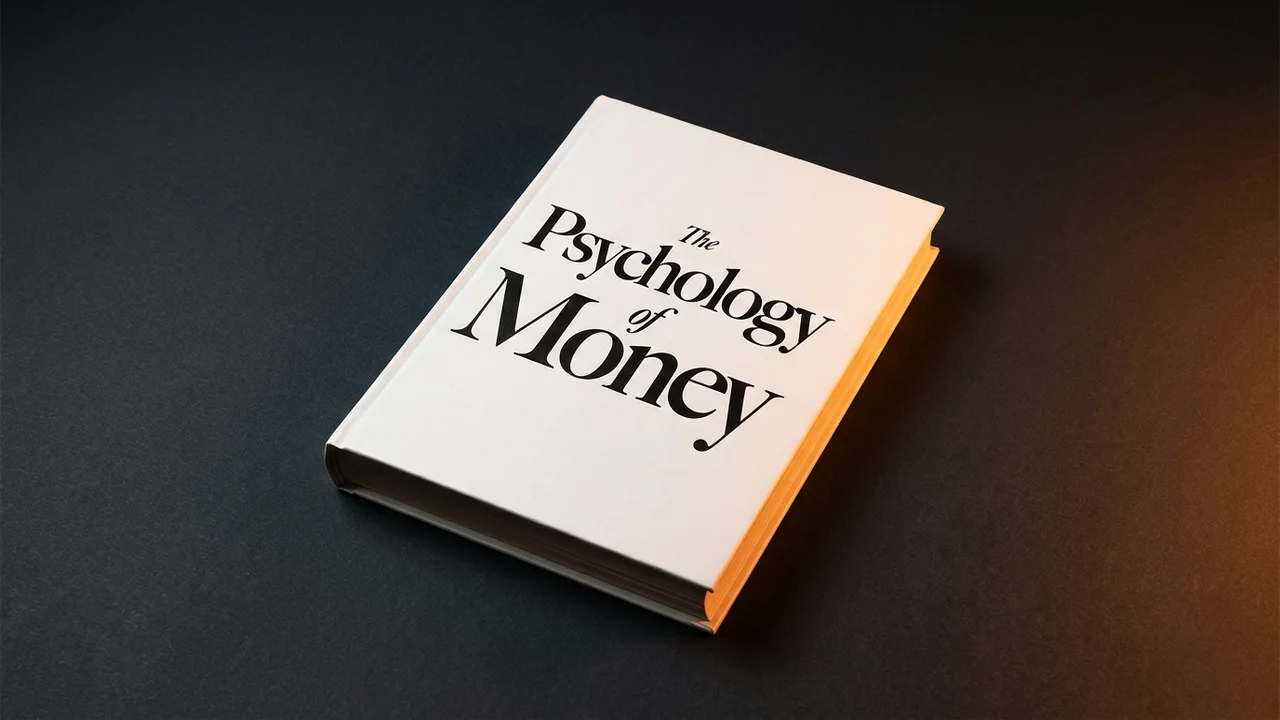

“Financial success is not a hard science. It’s a soft skill, where how you behave is more important than what you know.”
Luckily, this book is not about fluffy advice on how to make $1,000,000.
Key Takeaways
1. Everyone has a story to tell about how the world works. Everything in your life influences how you believe money and the financial markets work — your family, friends, culture, history, experiences, education, wins and losses, etc.
2. Luck is a huge factor in becoming wealthy in life. You can work your ass off and do everything imaginable to succeed, but in the end, luck plays a huge role in your success or failure. But “the harder you work, the luckier you get” also.
3. Some of us can never get enough. Eventually you begin to take greater and greater risks, even though you do not need the extra cash. And sometimes that risk-taking leads to complete ruin.
4. Try not to focus on quick returns; instead, focus on the magic of compounding interest over long periods of time. If you slowly invest into something, it will slowly grow, but each step of growth is just a bit faster than the step before. Whether it is for sports, fitness, health, a new skill, or even money. Warren Buffett made 95% of his wealth at the age of 60, even though he had been investing since his 20s.
5. It is one challenge to make money and become rich, but it is another challenge to keep it. Spending beyond what you make, or spending when you finally have some money coming in, can be very enticing and addictive. But if you do not save, you will end up broke when luck goes against you.
6. Since the 1870s, the financial markets have continued to grow. Although you can look at it as a giant Ponzi scheme, where money creates more money. Either way, historically speaking, even if you invested during a stock market crash (as long as you diversified), you would still come out on top. The human population continues to grow, it continues to produce, financial technologies continue to print money, and the index funds will inevitably continue to grow for the foreseeable future.
7. The most important reason to have money is to gain freedom to do what you want, when you want.
8. No one cares about your silly expensive phone or fancy car. They just want to imagine that they have it, yet you are not as important in that picture.
9. Showing off with your money is the fastest way to lose that money. While the validation is nice to have, it is ultimately fleeting, and you are back to where you were before showing off.
10. If there is one legitimate way to consistently make money, it is to save money when you do not need to spend it. This way, you have more control, and little bit by little bit, you will end up having more than before.
11. While it is easy to think about being logical and calculated about your finances, ultimately in the real world you need to also pay attention to emotion, life, and social conditions when considering your money and investments.
12. While we can learn about historical mistakes, we cannot predict what the future will hold. Thus, we can only prepare ourselves for when something will happen (even though we can never know what it will be), and we should always be diversified for it and develop emotional fortitude (I would recommend meditation or psychedelics).
13. When planning, expect that plan to not go according to plan. Be spontaneous and diversified with your investments and finances, because something will inevitably go in a different direction (whether good or bad).
14. Long-term planning is much harder than you think, because your goals change over time. At age 20 you might have just wanted to find a good job, while at 30 you wanted to be free to travel the world, while at 40 you might have a mid-life crisis. What you wanted at 20 will be completely different than what you wanted at 40. Your goals and desires will change after financial loss or gain, heartbreak or romance, exploring the world or being chained to your job.
15. Whether you buy something expensive or you invest in a volatile market, everything has an emotional price. These include “fear, doubt, uncertainty, and regret” when you either YOLO (you only live once / all-in) or FOMO (fear of missing out) or just face the wrath of watching the volatile markets every day. Try to “set it and forget it,” or watch passively for the most part.
16. When getting advice from “financial gurus,” never get advice from a single guru. Instead, look at patterns across multiple individuals in the niche you want to invest your time and mental energy into. What one person did to achieve success is not how you are going to achieve success, unfortunately (different time, different place, different circumstances). Their investment style might be totally against what you are trying to accomplish (they may be a short-term day trader, while you prefer to invest over a 10–20 year horizon).
17. You are more likely to pay attention to pessimistic news than to optimistic news. After all, you are trying to protect yourself and your assets. But historically speaking, pessimistic news is much more short-term, compared to optimistic news, which unfortunately does not quite grab our attention as much.
18. When you have a story or narrative in your head of how the universe, world, life, and finances work, then you will tend to find anything and everything that confirms that belief. The “illusion of control” will persuade you more than realizing that “reality is uncertainty” — you will never have all the information in the world. Thus, you will try to explain reality in the way that confirms your worldview.
Conclusion
Fantastic book, and not a complicated read. The author is coherent, concise, and creates a great story and narrative to explain his point. You could say these are fundamental psychological truths built upon over 100 years of financial data, psychology, sociology, and history. My only counterargument would be against the historical trend of index funds going indefinitely up. While historically this was the pattern, this is, after all, only a retrospective look. We can only prepare for the future and ensure we are diversified when the plan does not go according to plan and everything breaks, even if it is temporary.
Thanks for reading.
— Leonidas
